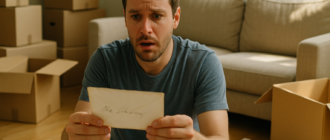
The old woman on the fifth floor kept slipping notes under my door, calling me “Daniel” and begging me not to sell the piano I never had. The first time I thought it was a mistake — a shaky piece of paper, blue ink bleeding where the hand had trembled: “Daniel, please, don’t sell the piano. It’s all I have left of you. — Anna”.

My name is Mark. I had moved into that run-down building only a week earlier, dragging a suitcase and a box of dishes up the dusty stairwell that smelled of boiled cabbage and old paint. There was no piano in my apartment. There was only a mattress on the floor, a crooked table, and a silence I was still learning to live with after my own mother died.
The second note came the next evening.
“Daniel, they say you’ll need the money. We’ll manage without it. I’ll eat less. Please. — Mom.”
The word “Mom” was underlined twice. I stared at it for a long time, my throat tightening in a way I hated. I told myself it was just some confused neighbor, that I should slip the note back and write: “Wrong door.” But I didn’t. I folded it carefully and left it on my table.
On the third day, I heard a slow, dragging step in the hallway, followed by a soft rustle at my door. When I opened it, the corridor was empty, only the dim bulb humming. Another note lay on the floor.
“Daniel, I sat by the window all day to hear you play. Do you remember how you played when Dad left? You said the piano understood sadness. Please don’t take that away too. — Anna.”
I pressed my back against the door, sliding down until I sat on the cold floor. I hadn’t cried since the hospital called about my mother. I didn’t cry then either, but something inside me ached with a dull, familiar pain. I knew what it was to lose the last thing that sounded like home.
That night I went upstairs.
The fifth floor hallway was narrower, the wallpaper more peeled, like no one had bothered to fix anything in years. Her door was the last one, with a faded doormat that said “Welcome” in letters almost rubbed off. I raised my hand to knock, then froze. What would I say? “Hello, I’m not your son, but I’m the stranger who has been reading your letters”? I turned to leave.
The door opened with a creak.
A tiny woman with silver hair pulled into a bun stood there, leaning on a cane. Her eyes were clouded but searching, and for a second they lit up.
“Daniel,” she breathed. “You came.”
I should have corrected her. Every sensible part of me knew that. But her face — fragile, hopeful, terrified — made the words die in my throat.
“It’s… me,” I said quietly.
She stepped aside to let me in. The apartment was small but painfully tidy, everything in its place. On the far wall, by the window, stood an upright piano, its black surface dulled by time, one key chipped at the corner.
She noticed my stare and smiled with a pride that didn’t match the worn instrument.
“You remember,” she said. “You always played when you didn’t know how to talk. Sit, please.”
I sat on the edge of a threadbare armchair. Up close, I saw the wrinkles around her mouth, the way her hands shook slightly as she poured tea into chipped cups.
“I know times are hard,” she began, eyes fixed on the piano. “After you lost your job… they told me downstairs. People talk. But the piano… it’s your childhood, Daniel. Your father wanted to sell it once, do you remember? You wrapped your arms around it and said, ‘If it goes, I go with it.’”
Her voice broke on the last word.
I didn’t remember. I had never been here before. But in my mind, I saw my own mother standing in a cramped kitchen, arguing with the landlord about a broken boiler, insisting we keep the old bookshelf I’d carved my name into. The details were different, the desperation was the same.
“I’m not going to sell it,” I heard myself say, surprising us both. “I promise.”
Her shoulders relaxed, just a little.
“You always promise big things,” she murmured, almost amused. “Play something for me, Daniel. Anything.”
I hadn’t touched a piano in years. Not since music school, not since I decided adulthood had no space for useless talents. My fingers hovered above the yellowed keys, clumsy and uncertain.
Then memory took over.
A simple lullaby came first, the kind my mother used to hum when the lights went out. The notes were uneven, some keys slightly out of tune, but Anna’s eyes filled with tears. She closed them, her lips moving silently along with the melody.
When I finished, she wiped her cheeks with the back of her hand and laughed softly.
“You still play like you’re telling a secret,” she said. “Thank you, son.”
The word “son” landed in the room like something heavy and fragile at once.
I went back to my floor that night with a knot in my chest. I told myself I’d talk to the building manager, explain that she needed her real family, that she shouldn’t be alone like this. But days passed, and instead of going to the office, I went upstairs.
Every evening at seven, she waited by the window. Sometimes she called me Daniel, sometimes “my boy,” sometimes just “you.” She told me how her real son had moved abroad years ago, how the calls became rare, then stopped. She pretended it was because he was busy. Her eyes said she didn’t believe it.
I never corrected her. I played the piano, carried her groceries, changed the lightbulb in the hallway. In her kitchen I heard the same old kettle whistle my mother’s had. In her complaints about aching knees I heard the conversations I would never have again.
The twist came on a rainy Tuesday.
I was at work, stacking boxes in the warehouse, when my phone buzzed with a number I didn’t know. A nurse’s voice spoke quickly, asking if I was related to Anna from Fifth Street. My heart dropped.
“She had a fall,” the nurse said. “Her neighbor gave us your number. It was on a note by the phone — labeled ‘my son, Daniel’.”
I ran through the downpour without an umbrella, reached the small hospital soaked to the skin. When I entered her room, she looked impossibly small in the white bed, a bruise blooming across her forehead.
Her eyes fluttered open and searched my face.

“Daniel,” she whispered.
This time the word hurt.
“I’m here,” I said, pulling the chair closer. “I’m here, Anna.”
She frowned faintly at the name, confusion passing through her gaze.
“You’re not… him,” she murmured. “I know. I’ve known for a while.”
I froze.
“I… I didn’t mean to lie,” I stammered. “You called me—”
She lifted a trembling hand a few centimeters off the sheet, as if to stop me.
“You didn’t lie. You were kind,” she said slowly. “When you played, you weren’t pretending. That’s enough truth for me.”
Tears I had been holding back since the first note under my door finally came. I looked away, embarrassed, but she watched me with a softness that felt like forgiveness.
“I left the piano to you,” she added suddenly.
My head snapped back.
“What?”
“In my drawer. There’s a paper. The neighbor helped me write it. My Daniel… he has his own life. He doesn’t need an old piano. But you… you play like it still saves you.”
Her breathing grew shallow. Panic rose in my throat.
“Don’t talk like that,” I begged. “You’ll come home. I’ll push you in a wheelchair if I have to. You’ll sit by the window, remember?”
She smiled, a small, tired curve of her lips.
“If I don’t,” she whispered, “promise me something else, my boy.”
“Anything.”
“Don’t let them throw it away. The piano. Let it be… someone’s home again.”
I wanted to promise her a miracle, but the only words that came out were simple.
“I promise.”
Anna died that night.
The building manager tried to sound practical when he told me the next day, talking about papers, relatives they couldn’t reach, things that needed clearing out. His voice became distant noise when he mentioned the piano.
“We’ll probably have to get rid of that old thing,” he said. “No one wants to carry it down. Maybe the junk guys—”
“I’ll take it,” I cut in. “It’s mine.”
He looked surprised, then shrugged. “If you can move it, it’s yours.”
It took three friends and a lot of swearing to get the piano into my tiny living room. Its bulk swallowed half the space, the chipped key glaring at me like an accusation and a blessing all at once.
In the middle drawer of Anna’s dresser, under folded handkerchiefs, I found the paper she had spoken about. The handwriting was clumsy, the sentences simple: “I, Anna, leave my piano to the kind young man from the third floor who plays for me. He is not my son, but he feels like one.”
That line broke me more than any funeral could have.
Now, every evening at seven, I sit at the piano. The building is still old, the stairwell still smells of boiled cabbage, my own life still an uncertain stack of bills and half-finished plans. But when my fingers touch the keys, the apartment fills with something bigger than its cracked walls.
Sometimes, as the notes drift down the stairwell, I hear footsteps pause outside my door. Once, a small voice whispered, “Mom, listen, someone’s playing.”
I like to imagine that somewhere, far away, a man named Daniel hears his phone ring and hesitates, thinking of the mother he didn’t call enough, of the piano he left behind.
I don’t know if he ever picks up.
But I know this: an old woman on the fifth floor who knew I wasn’t her son still chose to love me like one. And because of that, in a cramped apartment with a mattress on the floor and a secondhand table, there is a piano that remembers her name.
I promised her I wouldn’t sell it.
And some promises, once made to a lonely heart, feel heavier than blood.