The old man kept sitting on the same bench every day with a suitcase on his knees, until one evening a stranger opened it and realized why he had really been coming there for ten years.

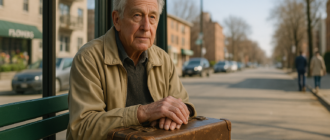
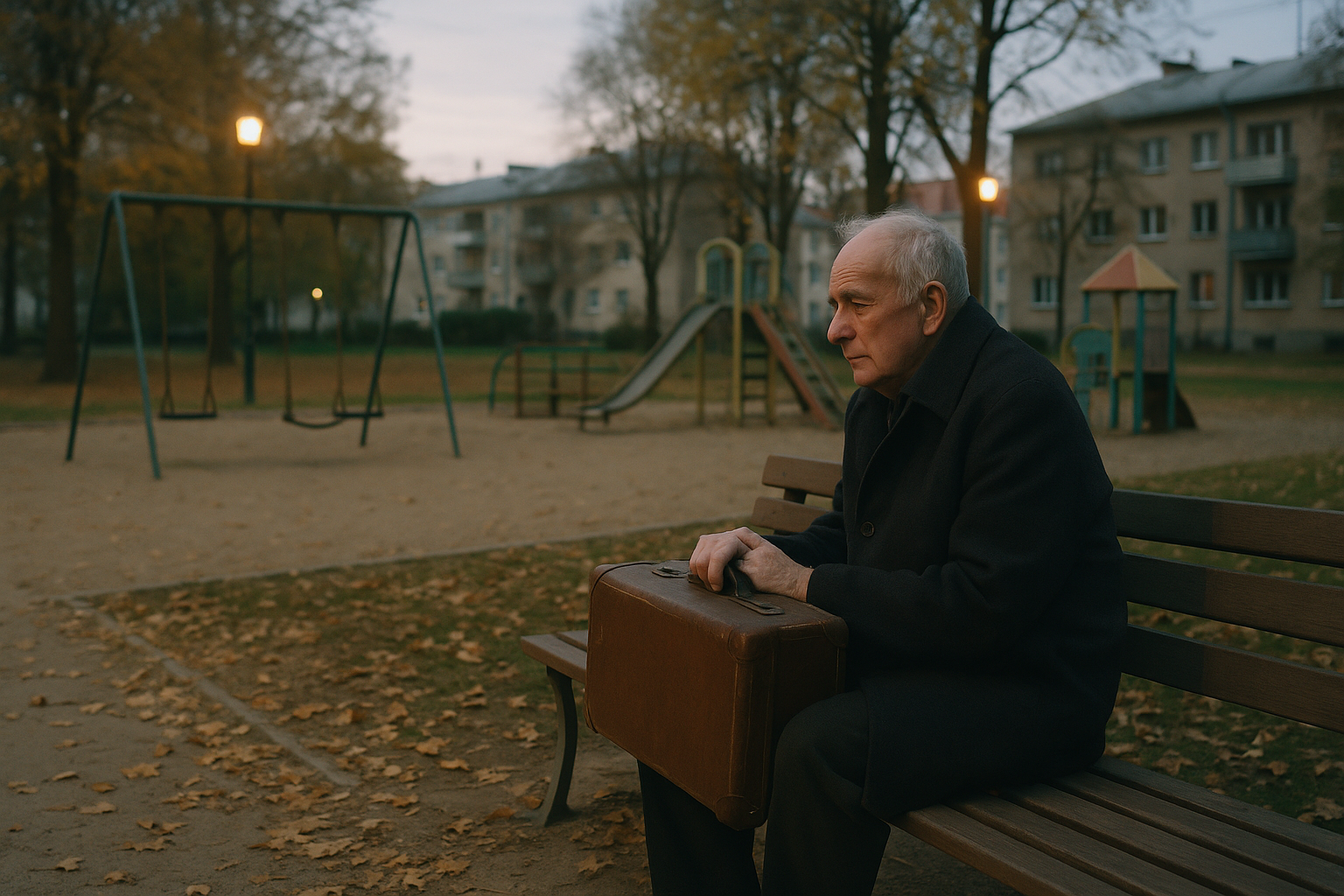
People in the small town park had grown used to him. Thin, a little stooped, in the same dark coat regardless of season, Daniel would arrive at the bench near the playground at exactly four o’clock. He would set a battered brown suitcase on his knees, rest his hands on it, and just watch.
Children ran past him, parents chatted on phones, teens scrolled through screens. Some nodded to him. Most didn’t notice. He sat quietly until the church bell rang six, then he would slowly get up and leave, clutching the handle of the suitcase like something fragile.
Rumors swirled around him. Some said he was waiting for a wife who had left him. Others whispered he had been rich once and had gone mad. To the kids, he was simply “the suitcase grandpa”.
One rainy afternoon, when the park was almost empty, Adam, a young social worker who cut through the park on his way home, noticed the old man sitting under a tree instead of his usual bench. The bench was wet, but Daniel was there anyway, his shoulders damp, the suitcase balanced on his knees as always.
Adam hesitated, then walked over.
“Good evening, sir. Do you want to sit under the gazebo? It’s drier there,” he said gently.
Daniel looked up. His eyes were pale blue, surprisingly clear.
“No, thank you,” he replied politely. “This is my place.”
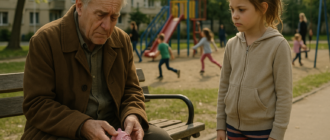
Adam glanced at the playground. Only one little girl in a yellow jacket was still playing, her mother hurrying her to leave.
“You come here every day,” Adam said. “Is someone meeting you?”
“Someone was supposed to,” Daniel answered after a pause. “But she’s late.”
Adam sat down on the wet bench beside him. “For ten years?” he asked softly.
Daniel smiled, a tiny, tired smile.
“For ten years.”
They sat in silence, listening to the rain tap on the leaves. Adam’s gaze kept drifting to the old suitcase. The leather was cracked, the corners frayed, but it was carefully polished.
“May I ask what’s in there?” Adam finally said. “You always hold it so carefully.”
Daniel’s fingers tightened on the handle. For a moment Adam thought he had gone too far. Then the old man exhaled.
“Memories,” he said simply.
The wind grew colder. The last child left the playground. The park lamps flickered on, bathing the empty swings in yellow light.
“I had a daughter,” Daniel began quietly. “Her name was Emily. Her mother died when she was three. I raised her myself. I wasn’t always… like this.” He gestured vaguely at his worn coat, his thin hands. “I worked a lot. Too much. Always ‘later’, always ‘tomorrow’.”
He swallowed.
“On her eighth birthday, I promised her a trip to the sea. She packed this suitcase herself—her favorite book, her red dress, a toy rabbit. She sat on this very bench, right here, waiting for me. I was finishing some urgent work. I told her, ‘Wait for me there, I’ll come at four.'”
His voice trembled on the last word.
“There was an accident on the road. A car lost control near the crossing by the park. She was still sitting on the bench, hugging the suitcase. They said she didn’t even scream. She just… didn’t have time.”
Adam felt his throat tighten. The rain had almost stopped, but Daniel’s coat was soaked.
“After the funeral,” Daniel continued, “they gave me this suitcase. I couldn’t open it. I locked it and swore I would bring it here every day at four. I thought… if there is any justice in this world, if there is any way for her to see me, she will see that I came. That I am not late this time.”
He looked at the empty playground.
“Ten years,” he whispered. “Ten years of ‘I’m here, Emily. I’m on time.'”
Adam stared at the suitcase, feeling a heavy ache in his chest.
“Daniel,” he said softly, “have you ever thought that maybe she has already forgiven you? That she doesn’t need you to sit here in the cold and rain to know that you loved her?”
The old man smiled sadly.
“Forgiveness is not the problem,” he answered. “The problem is my own heart. It still waits for four o’clock.”
A gust of wind made them both shiver.
“Please,” Adam said suddenly, surprising even himself. “Let me help you. Let me carry this with you, at least. Maybe it’s time to open it. To see what you’re really carrying.”

Daniel’s eyes clouded with fear. For a moment he looked like a child who was about to lose his last toy.
“I can’t,” he whispered. “If I open it, it’s over.”
“Or maybe,” Adam replied quietly, “it’s the beginning.”
They sat like that for a long moment, the old man clutching the suitcase, the young one waiting. Finally, with a shaky breath, Daniel slowly turned the key in the tiny brass lock.
The click sounded unnaturally loud in the empty park.
His hands trembled as he lifted the lid. Adam leaned closer, expecting to see a child’s treasures frozen in time. But the suitcase was almost empty.
Inside lay a single small photo in a cracked frame and a stack of yellowed envelopes, tied with a blue ribbon.
“Where are her things?” Adam blurted out, confused.
Daniel stared at the contents as if seeing them for the first time.
“I… I gave them away,” he murmured. “To a shelter. The dress, the rabbit, the book. Years ago, when I thought I was ready to move on. I guess I wasn’t.”
He picked up the photo. A little girl with dark hair and a missing front tooth smiled at the camera, holding a brown suitcase almost as big as she was.
“The letters,” Adam said softly, pointing at the envelopes. “Can I…?”
Daniel nodded weakly.
Adam untied the ribbon and opened the first envelope. The paper shook in his hands as he read the childish handwriting aloud:
“Dear Daddy, if you are reading this, it means you opened the suitcase. I’m happy. It means you are brave now.”
Adam froze. Daniel’s face went completely still.
“I don’t understand,” the old man whispered.
Adam continued, his voice hoarse.
“I asked Mrs. Laura to help me write this and hide it. I know you are always busy and sad. If something happens to me, I want you to know it is not your fault. Not ever. I love you when you are late, I love you when you forget, I love you when you work. I just love you. Please don’t sit on the bench forever. Go to the sea for me. Take the suitcase. Put new things inside. New memories. It’s okay. I won’t be angry. I promise. Your Emily.”
Silence fell over the bench. Adam could hear only Daniel’s breathing—shallow, broken.
“She… she knew,” Daniel whispered. “She knew I would punish myself.”
Tears streamed down his wrinkled cheeks, mixing with the last raindrops.
“There are more letters,” Adam said gently, touching the stack.
“No,” Daniel answered, surprising him. “Not today.”
He carefully placed the photo and the letter back into the suitcase and closed it—this time without locking it.
“Are you sure?” Adam asked.
Daniel nodded slowly.
“For ten years, I came here to prove I could be on time for her,” he said. “Maybe now… I should try to be on time for myself. And for whoever else might still need me.”
He stood up, straighter than before, the suitcase in his hand suddenly looking less like a burden and more like luggage for a journey.
“Will you come tomorrow?” Adam asked.
Daniel looked at the bench, at the empty playground, then at the street leading out of the park.
“Tomorrow,” he said quietly, “I’m going to the sea.”
Adam watched the old man walk away, the brown suitcase swinging slightly at his side. For the first time in ten years, the bench at four o’clock would be empty.
And somewhere, if there was any justice in this world at all, a little girl with dark hair and a missing front tooth was finally smiling without worry, seeing that her father had stood up and gone on.