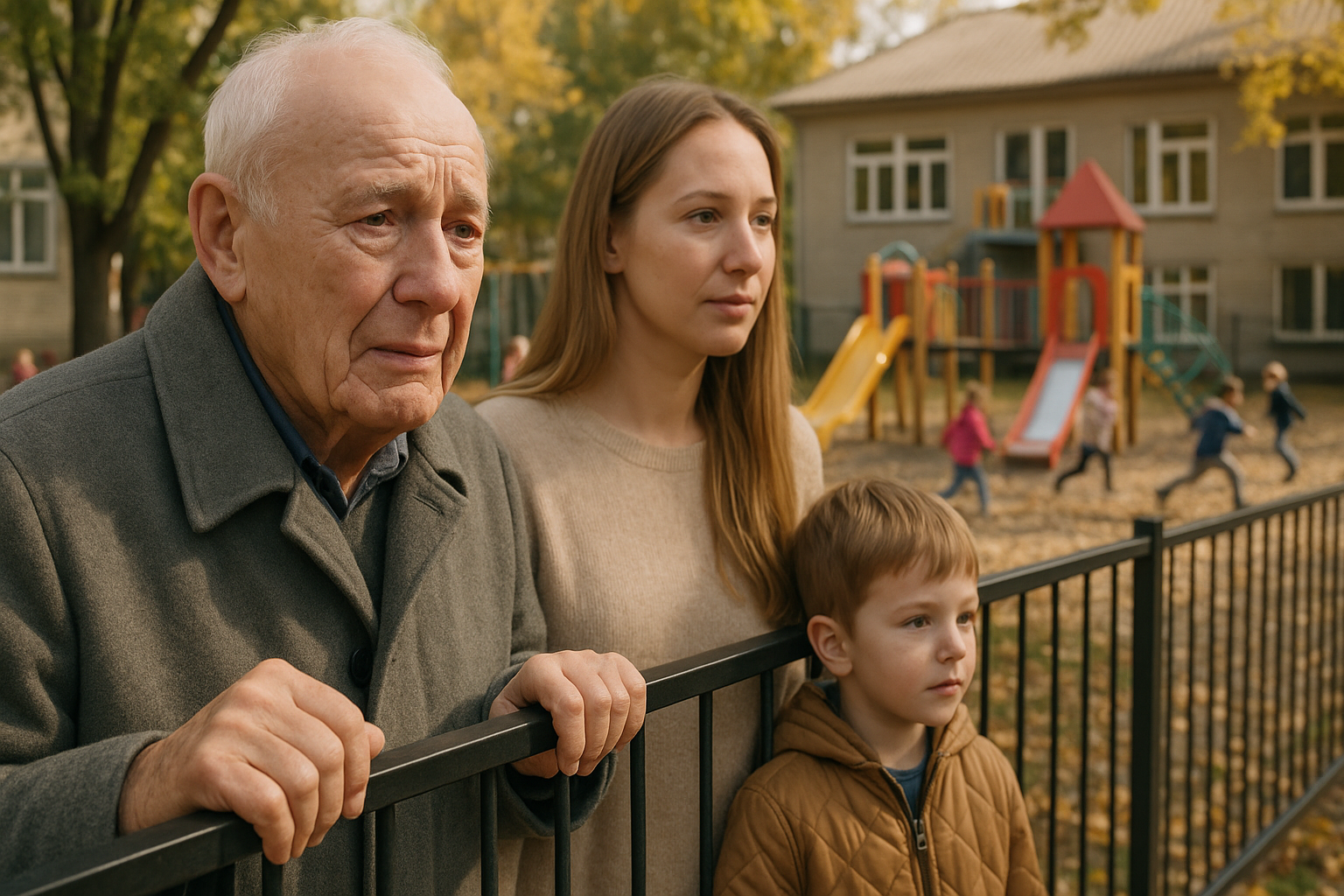
The old man kept coming to the kindergarten fence every morning, watching the children play, until one day my son walked up to him and asked, “Are you waiting for someone?”

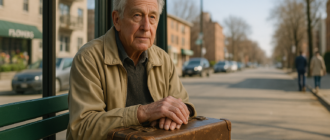
The teachers had already noticed him. Tall, stooped, in the same gray coat, hands trembling slightly as he held onto the metal bars of the fence. He never shouted, never waved, never tried to come closer. He just stood there, eyes following the children, as if searching for one particular face.
Parents whispered. Some were annoyed, some afraid. “Why is he here every day?” “Should we call the police?” The director said he was harmless, that she’d spoken to him once and he “just liked watching kids play.” That answer didn’t calm anyone.
My son, Leo, five years old and painfully direct, had been talking about him for a week.
“Mom, the grandpa at the fence was sad again.”
“Maybe he’s just tired, sweetie.”
“No,” Leo insisted. “His eyes are sad. Like when you cried in the hospital.”
He meant the year I lost my second pregnancy. I flinched. Children remember everything.
One chilly October morning, I saw the old man myself. I had taken a day off and decided to bring Leo later than usual. Most parents had already left. The yard was almost empty. The old man stood in his usual place, fingers white on the bars.
He wasn’t scary. He looked… lost. His eyes were moving from one child to another with a strange, desperate tenderness.
“Mom, that’s him,” Leo tugged my sleeve. Before I could stop him, he ran to the fence.
I hurried after him, ready to apologize, to pull Leo away.
But the old man simply straightened, as if someone had called his name.
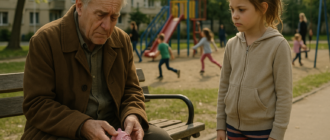
“Hello,” Leo said seriously. “Are you waiting for someone?”
The old man’s lips trembled. His eyes filled with tears so quickly it was almost painful to watch.
“I was,” he answered quietly. “A long time ago.”
I opened my mouth to say something polite and neutral, to close this conversation before it became awkward. But Leo spoke first.
“Who?”
“A little girl,” the man replied. “Her name was Emma.”
He swallowed, looking somewhere above our heads.
“She used to go to a kindergarten like this. I brought her every morning. She would run in without looking back, and I would stand outside the fence and wait until the bell rang. I liked to watch her play. She laughed very loudly. Everyone turned to look.”
He pressed his forehead against the cold metal, as if trying to see that other yard, that other time.
“That was my granddaughter,” he continued. “One day my daughter moved to another city. They said they’d come visit. They never did. New job, new school, new everything. And then…” He hesitated, choosing the word as if it hurt. “Then she changed her number. I don’t know where they live now.”
His voice broke on the last sentence.
“I thought maybe,” he said, forcing a smile at Leo, “if I come here, I can remember her better. Your laugh sounds like hers.”
Leo frowned the way only small children can—serious, concentrated.
“That’s not fair,” he finally declared.
“Leo,” I murmured, embarrassed.
“It’s not,” he repeated, looking at me now. “You cried when you lost our baby. He lost his Emma. But she’s not even really lost, Mom. She’s just… gone somewhere. And nobody came back for him.”
The old man closed his eyes. Two tears slid down his wrinkled cheeks.
“I’m sorry,” I blurted out, helplessly. “I didn’t know.”
He shook his head.
“Why would you? I’m just an old fool at a fence.”
That day, I went to work and couldn’t concentrate. His words stuck to me. I thought of the empty room at home, the tiny clothes in a box on the top shelf, my own grief I had carefully folded away. I had a child to hold. He had only a memory and a fence.
The next morning, I bought two cups of tea at the café near the kindergarten. When I saw him at the same spot, I walked up without thinking too much.
“I brought you tea,” I said.
He seemed startled, as if no one had addressed him directly in a very long time.
“Thank you,” he whispered, taking the cup with both hands.
We started talking in short fragments over the next few days. His name was Daniel. His wife had died three years earlier. His daughter had remarried. “He never liked me,” Daniel said simply. “It was easier for her to erase the past.” The worst part was not knowing whether Emma remembered him at all.
“She was five when I saw her last,” he told me. “About your boy’s age. Sometimes I dream that she’s standing on the other side of the road, grown up now, but still with the same pink backpack. And I can’t cross. My legs won’t move.”
I started to dread the day I might not see him anymore.
The twist came a week later, on a rainy Friday.
I was late for pickup. The traffic was terrible, my phone battery almost dead. When I finally rushed to the kindergarten, soaked and anxious, the yard was nearly empty. Only the teacher, Leo, and Daniel at the fence.
Leo was talking to him animatedly, waving his hands.
When he saw me, he ran over, cheeks flushed.
“Mom! I did something important,” he announced.
A cold fear gripped my chest.
“What did you do?” I asked slowly.

“I used your phone,” he said proudly. “When you were in the kitchen yesterday. I called the number you said we don’t use anymore.”
My blood ran cold. My old number. The one I kept out of stubbornness, the one from the city we used to live in.
“I left a message,” Leo continued. “I said, ‘If you are Emma and you had a grandpa named Daniel who watched you at the kindergarten fence, he is here. He waits every day. Please come.’ I remembered his last name from his medicine box.”
I almost dropped my umbrella.
“You did what?”
Leo’s lower lip trembled. “Did I do something bad?”
Daniel was looking at us, confused, worried. I walked over to him, my legs weak.
“My son called… someone,” I said, feeling absurd. “He thinks he left a message for your granddaughter.”
“A message?” Daniel echoed. His hand clutched the fence so tightly his knuckles turned white.
“Yes. To my old number. I… I don’t know who has it now. Probably no one. It was stupid, I’m sorry, he shouldn’t have—”
My phone vibrated in my pocket. Unknown number.
I stared at the screen. My heart hammered so loudly I could hear it in my ears.
“Answer it,” Daniel whispered.
I did.
A hesitant female voice came through the speaker.
“Hello? Is this the… the person who left the message about a grandpa named Daniel?”
Daniel’s eyes widened. His free hand rose to his mouth.
“Yes,” I said, my throat suddenly dry. “My son did. Are you… Emma?”
There was a pause. Then a shaky exhale.
“I am,” she said. “I thought… I thought he was dead. My mother told me he didn’t want to see us. I always remembered the fence. The way he waited after school. I never forgot.”
I put the phone on speaker and held it out so Daniel could hear.
“Emma,” he choked. One word, and his whole body shook.
On the other end, a muffled sob.
“Grandpa?”
The teacher had quietly taken Leo’s hand and stepped back, giving us space. The rain had almost stopped. The world felt strangely still.
“I’ve been coming here,” Daniel said, pressing closer to the phone, “because I didn’t know where else to go. I just wanted to remember you. I thought… I thought you forgot me.”
“I never forgot,” she cried. “I asked about you all the time. They always changed the subject. I thought you were angry. I’m so sorry.”
I watched an old man at a kindergarten fence crumble and come back to life all in one minute.
They talked for a long time, stumbling over years of silence. She lived only two hours away. She had two little boys. She promised to come on Sunday.
When the call ended, Daniel leaned his forehead against the cool metal, his shoulders shaking with quiet, disbelieving sobs.
I knelt to Leo’s level.
“Do you understand what you did?” I asked softly.
He looked at Daniel, then at me.
“I just thought,” he said, “if it hurts that much, maybe we should try one more time.”
On Sunday, I drove past the kindergarten, even though it was closed. I don’t know why. Maybe to see if it had all been real.
Through the fence, I saw them.
A young woman with the same eyes as Daniel’s, only without the fog of loneliness. Two small boys running around, shrieking with laughter. And in the middle, Daniel, without his gray coat, standing straighter than I’d ever seen him, his hands trembling for a different reason now.
He wasn’t holding the fence anymore.
That evening, I opened the box on the top shelf of my closet. Tiny clothes, a faded ultrasound photo, the hospital bracelet. I sat on the floor and let myself cry—not the quiet, hidden tears of the past years, but the kind that bend you in half.
Leo came in silently and sat beside me.
“Is this for the baby?” he asked.
“Yes.”
“Will we see them again too?”
“Not like Daniel saw Emma,” I said, wiping my face. “But maybe… one day. Somewhere else.”
He thought about it, then nodded.
“Then we’ll wait,” he said simply. “Like he did. But together.”
And for the first time in a long while, my grief felt a little less like a locked gate, and a little more like a fence you could stand next to, hand in hand with someone small, and still see the world on the other side.