The old man kept sitting on the same park bench every afternoon, staring at the playground and clutching a tiny pink shoe, until one day a little girl walked up to him and asked why he was crying over someone who never came.

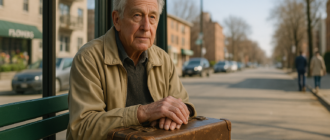
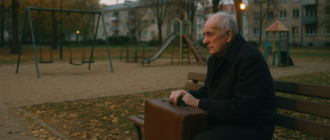
His name was Daniel. The park was small, noisy, and always full of young parents chasing toddlers. Daniel didn’t fit there: his hands were too wrinkled, his coat too old, his eyes too tired. But he came every day at three o’clock, sat on the exact same bench, and watched the swings.
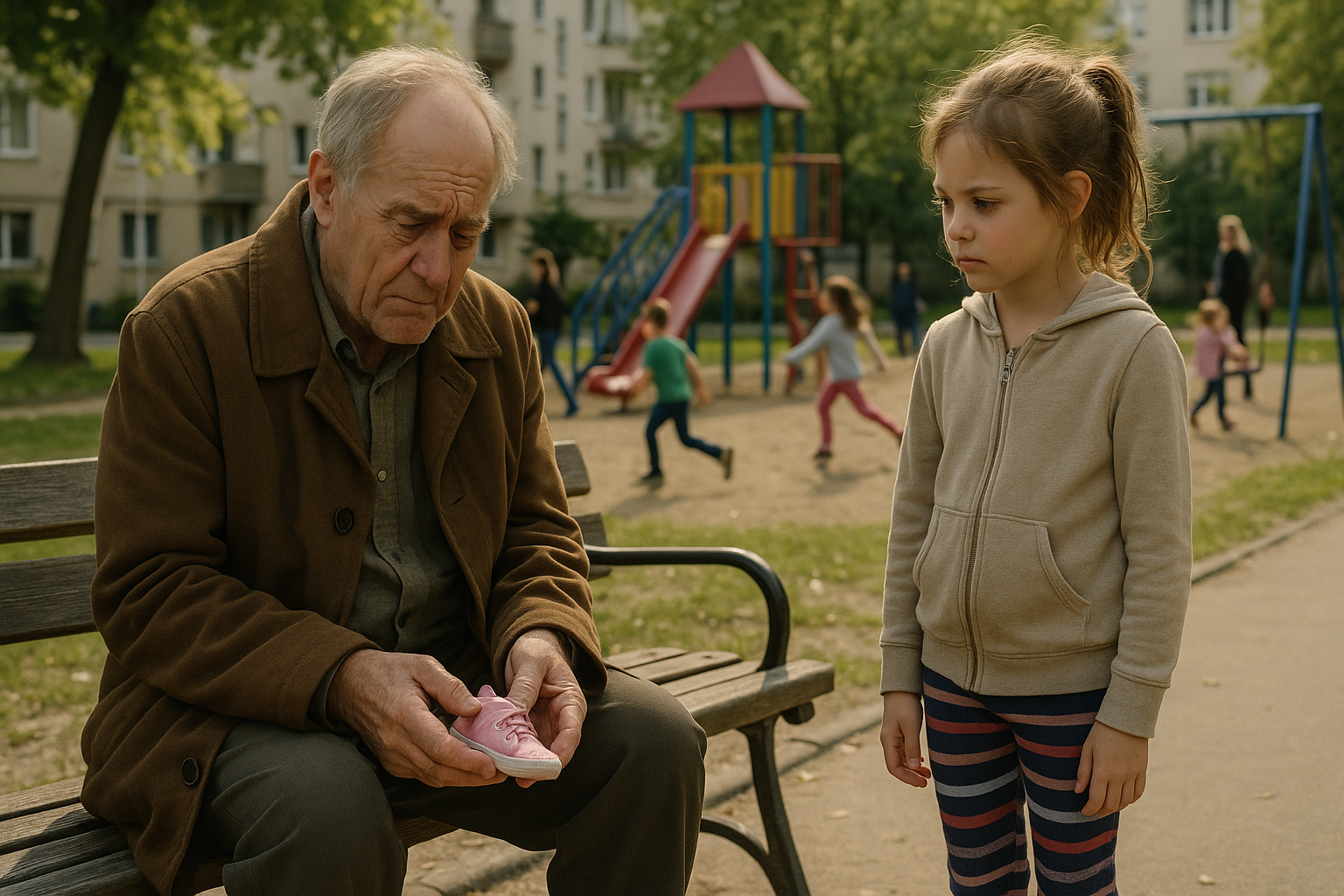
In his palm lay the tiny shoe. The leather was cracked, the sole worn thin on one side. A small faded flower was stitched on the front. He held it carefully, as if a wrong move might erase what little he had left.
Children ran past him, laughing. Sometimes they bumped into his knees. Parents would pull them away, murmuring apologies, then steal a quick, uneasy glance at the shoe in his hand and the tears in his eyes. No one asked him anything.
Until that day.
A girl of about eight stood in front of him, thin knees in striped leggings, brown hair in a messy ponytail. Her name, as he later learned, was Emma. She tilted her head, studying him with the blunt honesty only children have.
“Why are you crying?” she asked.
Daniel cleared his throat. “I’m not crying.” His voice cracked on the last word.
Emma squinted. “Your eyes are wet. That’s what my mom calls crying.”
He tried to smile and failed. “Sometimes old eyes leak, that’s all.”
She ignored the joke and pointed at the shoe. “Is that for a baby?”
His fingers tightened around it. For a moment he thought about lying, about saying it was nothing, just something he’d found. But the question hung between them, stubborn and innocent.
“It was my granddaughter’s,” he said quietly.
“Where is she?”
He swallowed. “She was supposed to be right there.” He nodded at the swing set. “Every Saturday. I promised her.”
Emma sat down beside him without asking. “My dad promises things and forgets,” she said matter-of-factly. “But I’m not supposed to talk about that.”
He glanced at her. There was no self-pity in her voice, just a tired acceptance that hurt to hear.
“What’s her name?” Emma asked.
“Lily,” he whispered. “She liked pink. She kicked off this shoe in my car, and I kept it, thinking I’d give it back next time.”
Emma smiled. “I like pink too. Did she get another shoe?”
Daniel looked at the playground so she wouldn’t see his face. “No. She… never got the chance.”
For a while they sat in silence. Children screamed with joy on the slide, a dog barked, a stroller wheel squeaked. Life went on around them, careless and loud.
Emma swung her legs. “Why don’t you go see her?”
His answer came out harsher than he meant. “I can’t.”
“Why?”
“Because her mother won’t let me.” He exhaled, shoulders sagging. “My daughter, Anna, doesn’t want me anywhere near them. Didn’t want me.”
“Did you do something bad?” Emma asked.
He almost said yes. The word sat on his tongue like a stone.
“I made mistakes,” he said instead. “Big ones. I worked too much. I missed birthdays. I drank when I should have listened. I shouted when I should have said ‘I’m proud of you.’ And one night, I drove when I shouldn’t have.”
Emma’s eyes widened. “Did you hurt someone?”
He shook his head slowly. “By some miracle, no. But the police called my daughter. She came to the station with Lily on her hip. Lily kept patting my face, asking why Grandpa was sleeping in the wrong place.” His mouth trembled. “Anna said she was done. That Lily would grow up without a drunk for a grandfather.”
He stared down at the shoe. “I promised I’d stop. I did stop. Haven’t touched a drop in seven years. But by the time I got my life together, Anna had moved and changed her number. I didn’t even know which city they were in.”
Emma frowned. “But how do you know Lily was supposed to be on that swing?”
He almost laughed at the question, but there was nothing funny in it. “Because this is the park from the last photo Anna sent. Before she disappeared from my life.” He pulled a worn picture from his wallet: a little girl in pink overalls, hair in two crooked pigtails, on the very same swing set.
Emma took the photo carefully. “She looks happy.”
“She was,” he said. “At least, I hope so.”
Emma hesitated. “So you just… wait here? For seven years?”
“Not seven,” he answered. “Three. It took me four years to find this park. I called every old friend, checked every city I could. When I finally found it, I started coming here. Every Saturday at three. Just in case.”
“And she never came,” Emma said softly.
He shook his head.
The wind picked up, tossing Emma’s hair into her face. She pushed it back impatiently.
“My mom says waiting for people who leave is dumb,” Emma said. “But I still wait. Sometimes by the window. For my dad.”
Daniel turned to her. “Does he know you’re waiting?”
“I don’t think so,” she muttered. “He said he’d come back when he had ‘less problems.’ Grown-ups always have problems.”
He looked at her small, serious face and felt something twist inside his chest. How many Emmas and Lilys were out there, sitting by windows, staring at empty seats on swings, wondering why they weren’t enough?
“Maybe your dad is scared,” Daniel said. “Sometimes it’s easier to run away than to admit you broke something you loved.”
Emma thought about that. “Are you scared?”
“Terrified.” He tried to smile. “I’m scared Anna will never forgive me. That Lily grew up thinking I didn’t care.”
Emma leaned forward, elbows on her knees. “My mom says people who really don’t care don’t feel sad. You look very sad.”
He let out a shaky breath. “That I am.”
They fell quiet again. A boy cried near the sandbox; his father rushed to him, kneeling, brushing sand off his scraped knee. The sight made Daniel’s throat burn.
“Emma! Where are you?” a woman’s voice called.

Emma stood up. “That’s my mom. I gotta go.” She paused. “Will you be here next Saturday?”
“If I’m still breathing,” he said.
She nodded, as if that settled it, and ran off toward a tall woman with a worried face. The woman grabbed Emma’s shoulders, scolding her softly. Emma pointed back at Daniel. The woman followed her gesture, their eyes met, and for a second her expression softened. Then she turned away, leading Emma home.
Daniel watched them leave, then looked down at the shoe. His fingers traced the little flower. He felt older than he ever had, and yet, for the first time in years, not completely invisible.
The next Saturday, Daniel came at three. The bench was cold. The sky was clearer.
At three fifteen, Emma appeared, dragging her mother behind her.
“There he is!” she said, tugging harder.
Her mother approached slowly, uncertain. Up close, Daniel could see the lines of tiredness under her eyes, the way her fingers gripped the strap of her bag.
“Hello,” she said. “I’m Laura. Emma’s mom.”
He nodded. “Daniel.”
Emma climbed onto the bench. “I told my mom about Lily. And the shoe.”
Laura shot her a quick look. “Emma…”
“It’s all right,” Daniel said quietly.
Laura sighed. “Emma said you come here every week. Waiting for your granddaughter.”
“That’s right.”
Laura looked at the playground, then back at him. “Do you know… anything about where your daughter might be now?”
“Nothing,” he admitted. “I lost everything. Her address, her number, her trust.”
Laura hesitated, then opened her phone. “What was your daughter’s name again?”
“Anna. Anna Miller.” His voice trembled over the surname.
Laura’s fingers froze over the screen. Something flickered across her face—shock, recognition, then confusion.
“What?” he asked, heart thudding.
She swallowed. “I’m sorry, this might be a strange question, but… did Anna ever live on Oak Street? Above a bakery?”
The world narrowed to the sound of his pulse in his ears. “Yes. I used to carry Lily up those stairs when she fell asleep in the car.”
Laura exhaled shakily. “I… I knew her. We worked at the same café for a while. She moved away after… after she lost her little girl.”
Daniel’s hand went cold around the shoe. “Lost?”
Laura nodded, eyes shining. “There was an accident. Not your fault,” she added quickly, seeing the horror on his face. “A fever that turned into something worse. Anna told me once that the last thing she regretted was not calling her father before it happened. She said she was too proud. And then it was too late.”
The bench seemed to tilt under him. Lily was gone. Truly gone. All those Saturdays, all that waiting, and the person he had hoped to see had left the world years ago, while he sat in another city, clutching a bottle.
Emma’s small hand touched his sleeve. “I’m sorry,” she whispered.
Daniel stared at the tiny shoe in his palm. For the first time, he understood the full weight of it. Not a symbol of hope anymore, but of every moment he could never get back.
Laura sat down carefully on the other side of him. “Anna tried to find you once,” she said softly. “She told me about the drinking, about the night at the police station. But she also told me about the dad who built her a treehouse, who stayed up all night when she was sick, who taught her how to ride a bike. She missed that man.”
He pressed his lips together until they hurt. “I became someone she couldn’t recognize.”
“People break,” Laura said. “Sometimes they fix themselves too late.”
He nodded, because what else was there to do?
Emma shuffled closer on the bench. “You don’t have to wait alone,” she said.
He blinked at her. “What?”
She pointed to the swings. “You waited for Lily. She’s… she’s in heaven now, right?”
He nodded, tears spilling freely.
“So maybe you can wait with me instead,” Emma said. “For my dad. And if he never comes, we’ll still have each other.”
Laura’s eyes filled, but she said nothing.
Daniel looked at the shoe one last time, then at the swing set, then at Emma’s hopeful, trembling smile.
His hands shook as he stood. Slowly, almost reverently, he walked to the swings. Children parted around him, sensing something solemn. He knelt and, with all the care of a man burying a treasure, placed the tiny pink shoe in the soft earth beneath the swing from the photo.
He pressed it down, not to hide it, but to let it rest.
“I’m sorry, Lily,” he whispered. “I’m so, so sorry.”
When he returned to the bench, Emma took his hand without asking. Her fingers were small and warm.
“Next Saturday?” she said.
“Next Saturday,” he agreed.
He still came to the park at three o’clock. He still watched the swings. But now, a little girl with a messy ponytail ran to him, waving, telling him about school and lost teeth and a mother who worked too much. And sometimes, when the light was just right and the wind was gentle, he imagined a second pair of small feet on the swing beside Emma’s.
He knew he could never fix what he had broken. He knew that some doors stay closed forever. But on that worn park bench, between an empty swing and a child who refused to let him be alone, Daniel found a different kind of waiting.
Not for forgiveness.
Just for a chance to be better, for someone else, before time ran out.