The day Leo stopped waiting at the window was the day Emma realized her father was never coming back, but the old dog still dragged his blanket to the door every night.

Emma used to measure evenings by the sound of keys in the lock. When she was six, it meant her father was home and everything was safe again. Now she was thirteen, the apartment was too quiet, and the only sound at seven o’clock was Leo’s claws tapping against the floor as he shuffled to the door, tail already wagging in hope.
Three months earlier, her father had left with a single suitcase and a promise that felt too big for his tired voice. “I just need to sort things out, Em. A few weeks. I’ll come back for you. For Leo too.” He had scratched the old Labrador behind the ear, kissed Emma’s hair, and closed the door with a soft click that sounded, to Emma, like the end of something she didn’t know how to name.
Her mother, Sarah, didn’t cry in front of Emma. She moved around the house with the stiffness of someone afraid to touch anything in case it broke. She washed the same cup twice, kept the TV on with the volume low, and answered Emma’s questions with the same two words: “He’s trying.”
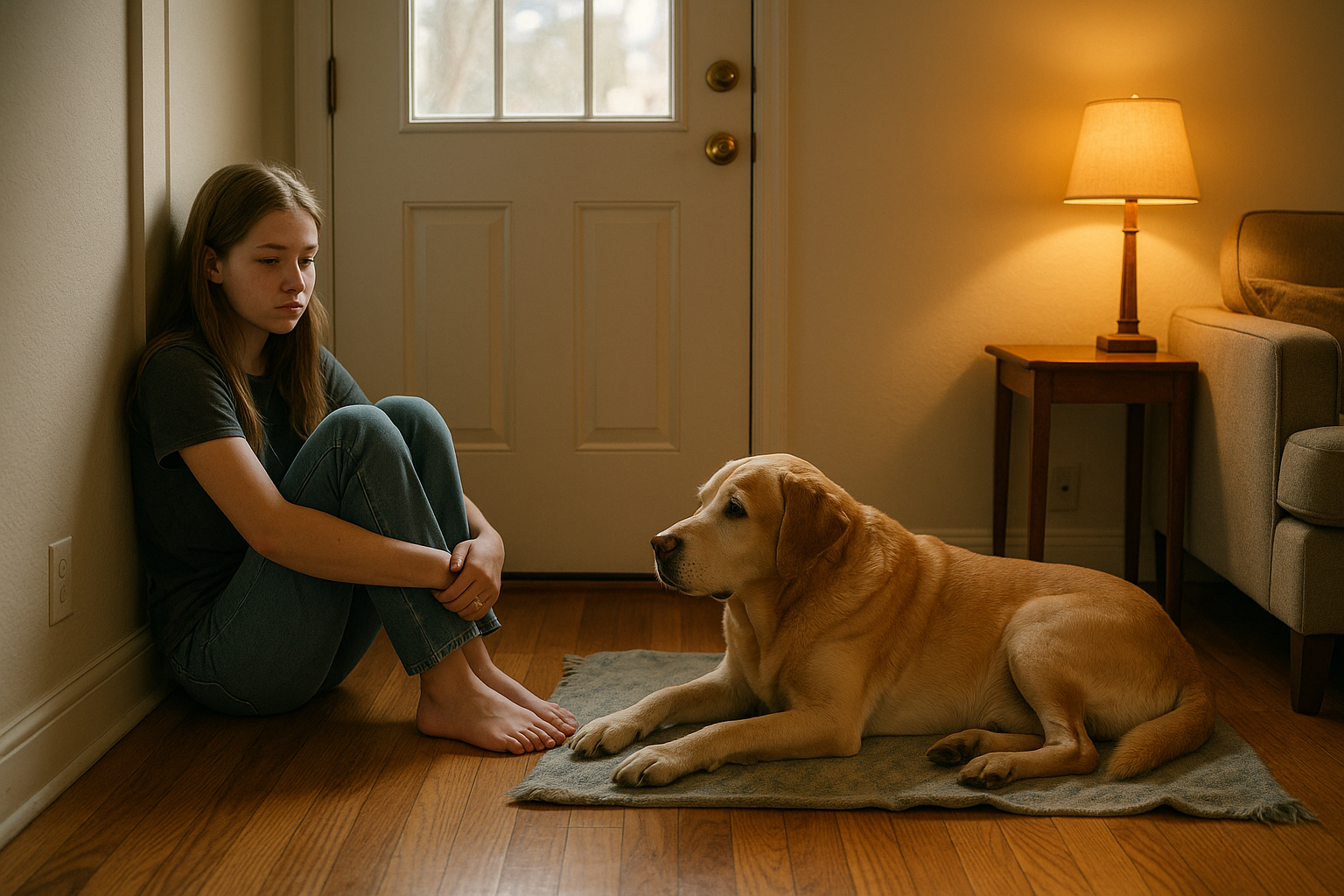
But it was Leo who refused to believe in absence. Every evening, ten minutes before seven, he limped to the hallway, lay down by the door, and stared at it with a devotion that made Emma’s chest hurt. On the first week, Emma sat beside him and watched too. The second week, she just passed by, pretending not to notice the way his ears perked up at every sound in the stairwell.
One rainy Tuesday, the silence finally cracked.
“Mom, can you call him again?” Emma asked, twisting the cord of her hoodie. “Maybe he lost his phone. Maybe—”
“Emma.” Sarah’s voice was too calm, the kind that meant it was holding something heavy. “We agreed we’d give him time.”
Leo’s tail thumped hopefully at that word: him.
“But he said—”
The phone buzzed on the table. An unknown number. Sarah froze. For a moment, the three of them—the woman, the girl, the dog—stared at the screen as if the future were glowing there.
Sarah answered on speaker. A flat, unfamiliar voice spoke.
“Is this Sarah Miller?”
“Yes.”
“This is County General Hospital. We’re calling about Daniel Miller.”
Emma felt the room tilt. Leo raised his head, ears pointed at the phone.
The words that followed came in pieces: accident, serious, intensive care, no ID at first, your number in his file. Emma’s mind grabbed only one sentence: “You should come as soon as you can.”
At the hospital, everything smelled like metal and soap. Emma’s shoes squeaked on the polished floor. Leo wasn’t allowed in, so he stayed in the car, his nose pressed to the window, leaving foggy circles on the glass every time he exhaled.
Emma saw her father through a rectangle of glass. Tubes, machines, a bruise blooming across half his face. He looked smaller, like someone had folded him in on himself.
“Can he hear us?” Emma whispered.
“Maybe,” the nurse said softly. “Talk to him.”
Emma pressed her palm against the glass.
“Dad, it’s me. It’s Emma. Leo’s with us. He… he still waits for you at the door. Every night.” Her voice cracked on the last word. “You promised you’d come back.”
Her father’s eyes didn’t open. A machine beeped steadily, uninterested in promises.
For three days, they came and went from the hospital. Leo waited in the car each time, whimpering when Emma and Sarah disappeared through the sliding doors. On the third evening, a doctor with tired eyes sat them down in a small room with a box of tissues no one wanted to touch.
“We’ve done everything we can,” he said. “I’m so sorry.”
The drive home was silent. Streetlights slid over Emma’s face like slow tears. Leo lay with his head on her knee, sensing something had changed but not knowing what. At a red light, Sarah finally spoke.
“He was on his way to see you,” she said hoarsely. “The nurse found a bus ticket in his jacket. Our stop.”
Emma pressed her forehead to the cold window. The knowledge didn’t make anything better; it just twisted the knife differently.

After the funeral—small, with more wind than people—Emma carried Leo’s leash home like a piece of someone else’s life. That night, at exactly seven, Leo dragged his blanket to the front door and lay down. He looked back at Emma, as if asking, “Aren’t you coming?”
“He’s not coming, Leo,” she whispered, crouching beside him. “He’s gone.”
Leo sighed, a deep, human sound, and rested his gray muzzle on his paws, eyes fixed on the handle.
The weeks blurred. There were school days Emma couldn’t remember and nights she remembered too well, lying awake to the quiet wheeze of Leo’s breathing. Sometimes she heard her mother crying in the bathroom, the water from the tap running too loud to be about washing hands.
One evening, Sarah came home later than usual, her hair damp from the drizzle.
“Your dad left something,” she said, holding a worn envelope. “I found it in the drawer with the bills. I think he meant to send it.”
Emma took the letter with trembling fingers. Inside was a single, folded page in her father’s messy handwriting.
“Dear Em,
If you’re reading this, it means I was too much of a coward to say this in person. I’m going to rehab. I should have gone years ago. I’m sorry I made you grow up in my shadow. I’m sorry I broke your trust. I want you to know I’m trying, really trying, to be someone you’re not ashamed of.
Tell Leo I’ll be late for our seven o’clock walk, but I’m on my way back to you. I don’t know how long it will take, but I will come home. That’s a promise I intend to keep this time.
Love,
Dad.”
Emma’s tears fell on the ink, blurring the word “love” until it looked like it was melting.
“He was trying,” Sarah said quietly, sitting beside her. “He checked himself in two days before the accident. The hospital called from there too.”
The twist cut Emma open: all the anger she’d been feeding like a secret pet had nowhere to go now. He hadn’t simply left them. He had been fighting his way back when life ended the round without asking if everyone was ready.
That night, Leo didn’t go to the door at seven. He lay in his bed, staring at nothing. His food bowl stayed half full. When Emma knelt beside him, he only flicked his eyes toward her, as if the world had lost its shape.
“You stopped waiting,” Emma whispered, stroking the soft fur behind his ears. “Did you… did you understand?”
Leo’s eyes glistened in the lamplight. He nudged her hand weakly, then looked away.
Days turned colder. Leo’s walks grew shorter, his steps slower. The vet said the words Emma had been pretending not to hear: age, heart, not much time.
On Leo’s last evening, Emma spread his blanket not by the door but under the living room window that overlooked the street. The sky was painted with the gentle pink of a forgiving sunset.
“Let’s wait here tonight,” she said, sitting down beside him. “Together.”
Leo rested his head in her lap. She could feel every shallow breath as it lifted and fell.
“You know,” she whispered, fingers sunk in his thinning fur, “he was coming home. He was really coming. Maybe… maybe you were waiting for both of us.”
Leo’s tail moved once, a small, tired wave.
Emma talked until the words ran out—about school, about the way her mother had started humming again while cooking, about the letter, about how scared she was of forgetting the exact sound of her father’s laugh.
When Leo’s breaths finally spaced out and stopped, it was so gentle that for a moment Emma didn’t notice. The room was filled with the soft orange of the setting sun, warm and kind, as if someone had dimmed the world carefully, not wanting to disturb them.
Sarah found her there a little later, a girl and a dog frozen in a moment that was too big for either of them.
“We’ll get another dog one day,” Sarah said weeks after the small, quiet burial in the park where Leo used to chase leaves. “Not to replace him. Just… to have someone to walk with again.”
Emma looked at the empty spot by the door where Leo’s blanket used to be.
“Maybe,” she said. “But no one will ever wait like he did.”
Years later, when Emma walked past a window at seven o’clock and saw a dog pressed against the glass, watching the street with loyal, foolish hope, something inside her still ached. She would remember an old Labrador who dragged his blanket to the door every night, believing in a promise long after the man who made it was gone.
And she would think that sometimes the cruelest part of love isn’t when people leave, but when someone keeps waiting long after everyone else has learned how to stop.