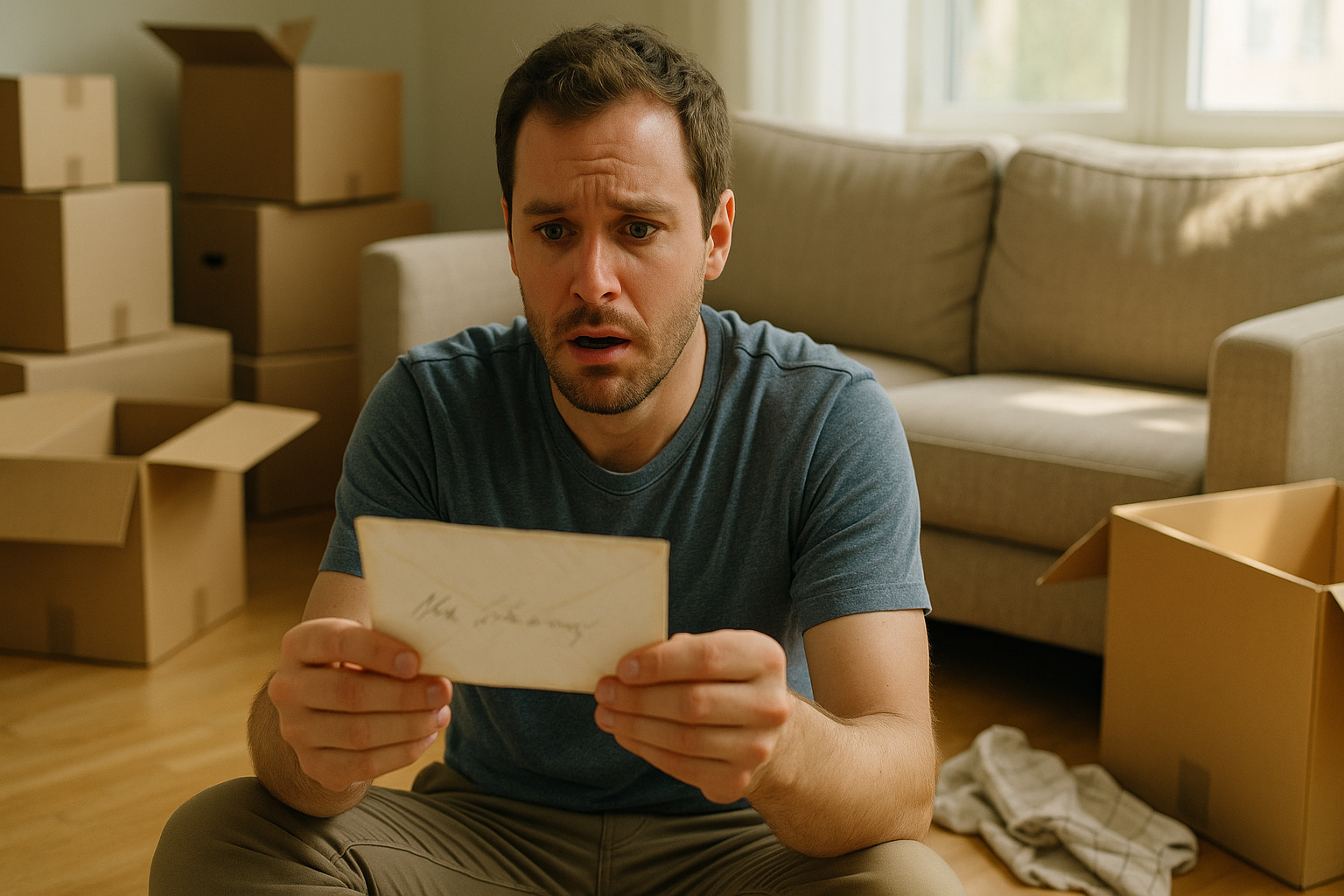
The envelope arrived on a Tuesday morning, addressed in a shaky hand to “To Whoever Knows Where Daniel Carter Is Now,” and the mailman stood on my porch refusing to slip it through the slot until I signed, as if he knew that whatever was inside would not let my life stay the same.

I stared at my own name in the second line, cramped under that strange greeting: “c/o Daniel Carter, Former Address.” The house was still half-unpacked; I had moved in only three weeks earlier. I almost told the mailman to return it to sender. Instead, I scribbled my signature, took the envelope, and felt the thin weight of paper that somehow pressed on my chest like a stone.
Inside was a single letter, folded with painful precision. The handwriting was the same shaky script as on the envelope.
“Dear Daniel,” it began. “If this reaches you, it means you have not forgotten all of us. Or at least, I still hope you haven’t.”
I almost put it down. I was not Daniel. I was just a thirty-four-year-old graphic designer who had moved across the city to forget my own failed marriage. I had my own ghosts. I did not need someone else’s.
But the letter went on.
“I am Elena. I live at the Willow Home for Seniors. You used to visit Mrs. Harper in Room 213 every Sunday. She talked about you every day until her last one. She called you her ‘almost grandson.’ I am writing because I think she would want you to know what happened. And because I need to ask you something that I am ashamed to ask.”
My throat tightened. I sank onto a box labeled “Books – Kitchen?” and kept reading.
“She waited for you the Sunday before she died,” the letter said. “She had something in her nightstand for you. A green envelope with your name. She held it when she slept. When the fever got bad, she called out for you. When you didn’t come, she told me, ‘Maybe he forgot. He is young. Young people forget old people. It is how the world works.’ But her hands shook when she said it.”
I looked around my silent living room, at the leaning towers of moving boxes, at the empty couch where my ex-wife used to fall asleep with her laptop on her knees. I had not forgotten old people. I had just never had time for them.
The letter continued.
“After she passed, the nurses were going to throw away the envelope. I asked to keep it. I thought you might come. You never did. I do not judge you; I know life is heavy. But I am eighty-two, I cannot leave this place, and I have no one. I am sending this to your last known address, hoping someone will know you, or at least read this. I cannot keep her envelope forever. I am ill now. There is a bill for her funeral that no one has paid. And there is a small note for you. Please, if you are out there, come. Or if you are not Daniel, and you have some kindness left in you, bring this letter to him. Or just come instead of him. Room 213 is empty now, but I am in 215. I am so tired of waiting alone.”
The letter ended with an address and a trembling signature: “With hope, Elena.” There was a brown water stain at the bottom, like a tear that had dried months ago.
I checked the postmark: four months earlier.
For a long time I just sat there, the letter crumpled in my hand. The reasonable part of me whispered that this was none of my business. I was not Daniel. I did not know Mrs. Harper. I owed nothing to a stranger in Room 215.
But something in the way she had written “instead of him” would not leave me alone.
By noon, I was driving across town with the letter on the passenger seat and my GPS stuttering the directions to Willow Home for Seniors.
The building was clean but tired, its brick walls stained by years of rain. Inside, everything smelled faintly of disinfectant and overboiled vegetables. A woman at the front desk looked up, surprised.
“Can I help you?” she asked.
“I… I got a letter,” I said, suddenly feeling foolish. “From an Elena. Room 215?”
Her face changed. “Oh,” she said softly. “You must be Daniel.”
The name hit me like a slap. I opened my mouth to correct her, then closed it again. In her eyes, there was a flicker of relief I had seen once in my own mother’s face when I visited after months of silence.
“I’m… here because of Daniel,” I managed. It was not exactly a lie.
She nodded, picked up the phone, spoke quietly, then gestured toward the hallway. “She’s awake today. It will mean so much to her.”
Room 215’s door was half open. Inside, an old woman lay in a narrow bed, propped up on thin pillows. Her hair was as white as the sheets. The skin on her hands was almost translucent, blue veins tracing fragile paths. On the bedside table stood a glass of water, a plastic clock, and a picture frame turned face-down.
“Daniel?” she whispered when she saw me.
I froze. Her eyes were pale but sharp, shining with that particular hope that hurts to look at.
“I’m…” The truth rose to my lips.
Then I saw the way her fingers were already lifting from the blanket, as if reaching across years toward someone who had not come for a very long time. I had left my own father sitting on a hospital bed years ago, saying I would be back after work. He died while I was in a meeting about a logo.
“Hi, Elena,” I said quietly, stepping closer. “I got your letter.”
Her hands fell, then trembled. “You came,” she breathed. “I thought… I thought the mail was lost. Or you were lost. Everyone gets lost.”
I pulled a chair to the bed. “I’m sorry it took so long.”
A slow smile unfolded on her face, lined and beautiful. “Mrs. Harper said you were a good boy,” she murmured. “She said, ‘He will come. He is just late.’ She died still believing that. I was the one who doubted. I was wrong.”
Something in my chest cracked. I swallowed.

“Elena,” I said, my voice unsteady, “I need to tell you something about Daniel.”
Her eyes clouded for a moment, as if bracing for a blow. Then she shook her head, a tiny gesture. “Later,” she said. “First, the envelope. The nurses, they kept it for you. In the drawer.”
She pointed to the nightstand. My hand shook as I opened it.
Inside, under a stack of tissues, lay a green envelope with “For Daniel” written in a different hand: neat, looping letters. Mrs. Harper’s, I guessed.
“Please,” Elena whispered. “Read it here. I want to hear her words again.”
My heart pounded. I slid a finger under the flap and unfolded the letter.
“Dear Daniel,” it began. “If you are reading this, it means I was right about you. You came back, even if I wasn’t there to see it.”
My vision blurred. The words on the page wavered.
“You know I had no family left,” the letter continued. “You were my Sunday boy. The one who fixed my radio and listened to my stories like they mattered. When the time comes, someone will bring you this. I put aside a small insurance for my funeral; if anything remains, I want you to use it for something that makes you happy, not just for bills. But if there is nothing left, I have one more request.
Please don’t forget us. Not just me—us. People like me and Elena and the ones whose names you never learned. We are a house full of almost-grandmothers and almost-grandfathers, waiting for footsteps in the hallway that never come. If you cannot carry my memory, then carry a chair into someone else’s room and sit. Listen to them. Let them borrow your youth for an hour. It will not cost you much, but it will mean everything. This is the only inheritance I can give you: a request to be kinder than the world expects you to be.
With love, your almost-grandmother,
Margaret Harper.”
By the time I finished, my cheeks were wet. I did not bother to hide it.
Elena was watching me, her eyes glistening. “She wrote that when they told her the cancer was back,” she said. “She said, ‘He will come, Elena. Maybe not for my funeral, but someday, for someone. Maybe for you.’”
The twist of it hit me then: I was not the Daniel she had loved, but I was the someone she had hoped for. The world had given her an empty doorway; fate had pushed a stranger through it.
“Elena,” I said softly, finally letting the truth out, “I’m not Daniel. My name is Mark. I moved into his old house. The letter was forwarded. I never met Mrs. Harper. I’m so sorry.”
Her fingers tightened in the blanket. For a moment, the room felt unbearably still.
“I see,” she whispered.
I waited for disappointment, for anger, for the crushing of that fragile hope.
Instead, she looked at me with a tired, gentle sadness. “You came,” she said. “You are not him. But you came. Do you know how many people walk past this place every day and never come in?”
She reached toward the green envelope with trembling hands. I placed it in her palms.
“She was right anyway,” Elena said, stroking the paper like it was a living thing. “Someone came. An almost-grandson, for an almost-grandmother. Names are just names.”
Her words broke something open inside me that had been locked for years.
I stayed for an hour that day. We talked about Mrs. Harper, about the songs they played in the dining room, about the old cat that wandered the halls and chose beds like thrones. She asked me about my work, my parents, the marriage I had tried and failed to keep. She did not judge. She just listened, the way, I realized, no one had listened to me in a long time.
When I left, the hallway felt less like a corridor and more like a fragile bridge stretched between generations.
I went back the next Sunday. And the one after that. Not as Daniel. As Mark, who now knew that waiting was its own kind of quiet cruelty.
I brought board games and cheap flowers, printed photos from my phone, stories about the world outside their windows. I learned the names on the doors. I learned that the man in 219 had a son three hours away who never visited. I learned that the woman in 210 still dressed up every afternoon “just in case” someone came.
Months later, when Elena’s bed lay empty and her name disappeared from the door, I found another letter in the drawer. It was addressed to “To Whoever Reads This After Me.” Inside, in that same shaky hand, were just three lines:
“Thank you for coming, whoever you are. Tell the others out there that we are still here. We are still waiting. Sometimes, all we need is one stranger brave enough to walk through the door.”
I folded the letter and slipped it into my wallet, behind my driver’s license and credit cards. A quiet reminder that somewhere, someone older, lonelier, was still waiting for a Tuesday envelope, a Sunday visit, a name in a doorway.
I had gone there to deliver a letter meant for a man I had never met. I left knowing that the person who most needed it had been me all along.