My son stopped calling me dad after one weekend at his mother’s.

It was a Sunday night. I was waiting for Ethan to come back like always. Backpack, messy hair, stories about his week. My ex, Laura, was late, like always too.
They pulled up to the curb, but something was off. He got out of the car without running to me. Just opened the trunk, took his bag, and stood there, looking at the ground.
Laura didn’t turn off the engine. Window half-open, phone in her hand. She didn’t look at me either. Just said, “He has something to tell you,” and stared straight ahead.
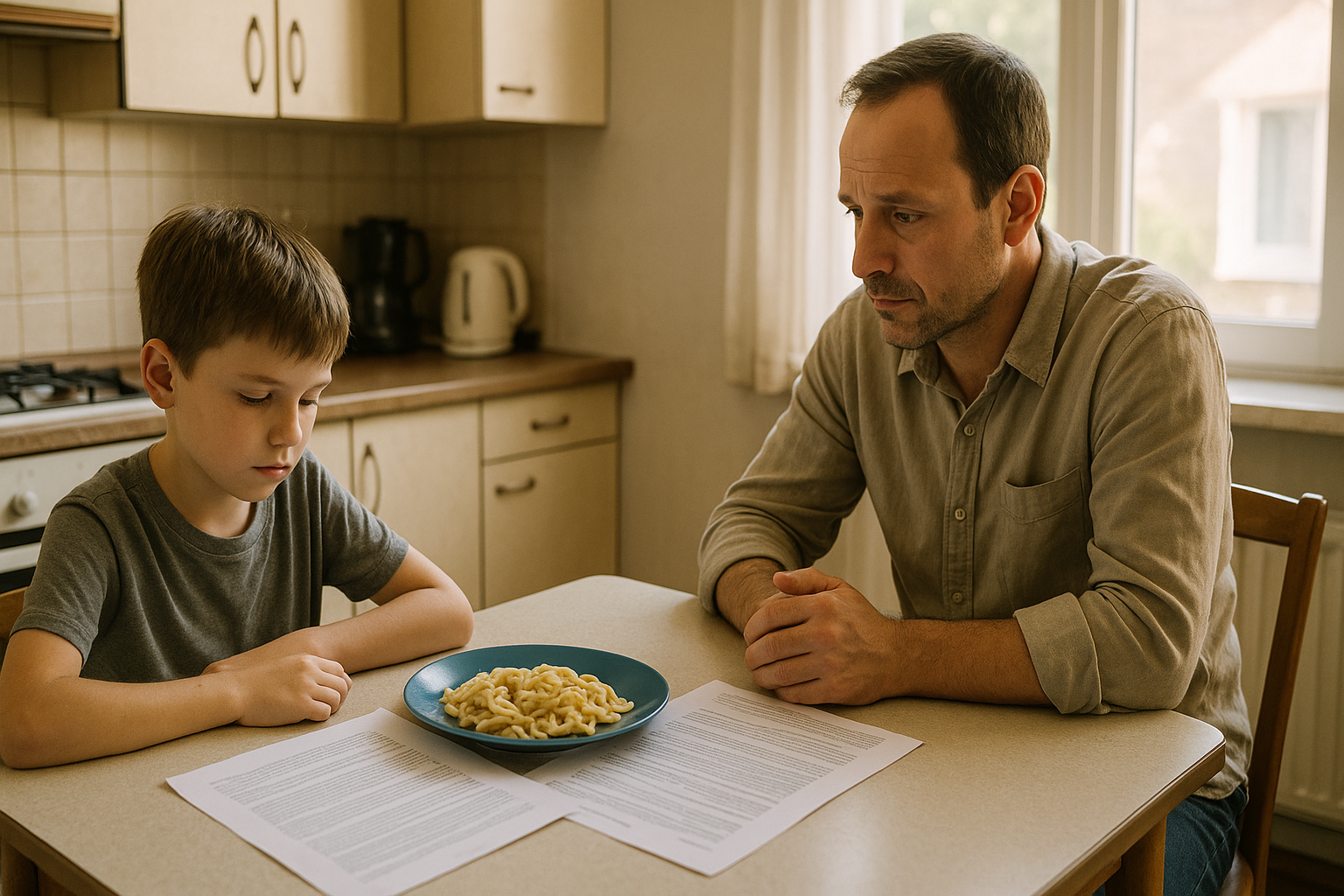
Inside the apartment, Ethan walked past his room and sat at the kitchen table. No cartoons, no asking for a snack. He put his hands together like he was at the principal’s office.
“Do you want some pasta?” I asked. That was our thing. Sunday night pasta, extra cheese.
He shrugged. “It’s not good for me. Too much salt.” He was eight. He never cared about salt in his life. He used to drink pickle brine.
I laughed, but it sounded wrong. “Okay, champ. What’s going on?”
He shifted in the chair. “Don’t call me champ.”
It was so quiet I could hear the fridge humming. “Okay. What should I call you?”
He swallowed. “Just Ethan.”
I sat down opposite him. No pasta. No jokes. “Did something happen?”
He looked at his hands. “Mom said I should tell you. I know everything now.”
My stomach dropped. “Everything about what?”
He took a folded paper from his pocket. It was crumpled, like he had been squeezing it all day. He pushed it across the table. It was a printout of our old emails. Me and Laura. The ones from when she was pregnant.
The subject line on the first one: “We need to talk about the test.”
I recognized the thread immediately. The night she told me the doctor wasn’t sure I could have kids. The night we fought about donors and timing and money. The night I wrote the stupidest sentence of my life: “I don’t even know if this baby will feel like mine.”
Ethan’s finger tapped that line. Slow, precise. “So… you didn’t want me?”
My throat closed. “Ethan, no. That’s not what—”
He cut me off. “Mom said you knew you probably couldn’t be my real dad. You said it yourself. You wrote it.”
The words hit harder than when Laura threw a glass at the wall that night. Back then it was just us, two adults in a fight. Now my son’s voice carried those same broken pieces.
“Listen,” I said quietly. “When you were in mom’s belly, the doctors said it might be hard for me to be a biological dad. I was scared. I wrote stupid things. But when you were born, when I held you, you were my son. You’ve always been my son.”
He shook his head. “Mom said real dads don’t need papers to love their kids.”
I felt it then. The word papers. I knew where this was going.
“Did she show you anything else?” I asked.
He nodded and pulled out another sheet. A DNA test result. My name. His name. The percentage: 0% probability.
I had done that test three years ago in a moment of panic after Laura joked one too many times about “good genes from my side”. I never told anyone. I kept the result deep in my email, like a bad thought you never say out loud.
“Where did you get this?” I whispered.
“Mom printed it. She said I should know why you left us.”

I leaned back. The chair creaked. The fridge kept humming. Somewhere outside, a car alarm went off and stopped. Inside, everything felt very still.
“I didn’t leave you,” I said. “Me and mom couldn’t live together anymore. But I never left you. I fought to see you. Every weekend, remember?”
He looked up finally. His eyes were red but dry. “She said you only did that because the court made you. Because you didn’t want to pay more money.”
I wanted to scream. To call Laura. To print all the bank statements where I paid extra, bought him shoes, paid for his school trip when she said she couldn’t. But he was just sitting there, small and stiff, with papers that looked more real than any of my memories.
“Ethan,” I said. “Who taught you to ride a bike?”
He stared at me like it was a trick question. “You.”
“Who sat with you in the hospital when you had that asthma attack?”
“You.”
“Who makes pasta every Sunday?”
His lip trembled for a second. Then he straightened. “Mom says memories don’t change biology.”
There it was. The sentence that had been repeated to him all weekend until it sounded like law.
I got up and opened the cupboard. Took out the blue plastic plate with superheroes on it. The one he’d had since he was three. I put it on the table and sat back down.
“You don’t have to call me dad,” I said. My voice sounded flat, like someone else’s. “You can call me whatever you want. But I’m the man who will be here every Sunday at six. With pasta or something without salt. With bike repairs. With homework help. With or without biology.”
He stared at the plate for a long time.
“Mom says maybe I shouldn’t come every weekend,” he said finally. “She says it confuses me.”
I felt something inside me give way, like a rope snapping. “Do you feel confused when you’re here?”
He hesitated. “No. But she cries a lot when I’m gone.”
We sat in silence. The test result lay between us, a thin sheet of paper heavier than any wall.
In the end, he stayed that night. He ate pasta without extra salt. He slept in his room, but with the door half-open.
The next Sunday, he didn’t come. Laura texted: “He’s not ready. Respect his feelings.”
The Sunday after that, she didn’t reply at all.
It’s been seven months. I see him twice a month now, supervised at a “family center” with bright walls and plastic chairs. He calls me “Mark” there. Never dad.
On the days I don’t see him, I still cook pasta at six. I put out the blue plate. I sit at the table and wait until it gets cold.
Then I eat it alone, fold the napkin, and put the plate back in the cupboard.
The DNA paper is in my desk drawer. Not torn, not burned. Just there.
Like a fact.
Like the silence between us.