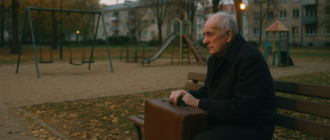
The old man kept sitting on the same bench with a suitcase on his knees, and everyone in the neighborhood knew he was waiting for a son who would never come.

At first, people thought it was sweet. An elderly father, gray-haired Daniel with kind blue eyes, sitting near the bus stop every afternoon, a small brown suitcase clutched to his chest. Children on scooters rushed past him; nurses from the nearby clinic greeted him; the florist from across the street sometimes brought him a cup of tea.
Daniel would nod, smile a little, and glance toward the road with the same hopeful expression, as if at any moment a familiar figure would step out of the crowd and shout, “Dad!”
Nobody ever did.
He had been there through the first snow of November, the storms of winter, the first warm days of spring. Always the same time: three o’clock. Always the same seat on the green metal bench. He brushed off the snow in winter, spread an old scarf on it in early spring, but never missed a day.
One afternoon, Mia, who lived in the building opposite, watched him again from her window while she washed dishes. She had just lost her own father two months earlier and the sight of the lonely old man hurt in a way she couldn’t quite explain. Her six-year-old son Noah ran through the living room with a toy car, the noise filling the small apartment, but Mia’s eyes stayed on the bench.
“Mom, why is the grandpa always sitting there?” Noah asked, suddenly appearing by the window.
“I don’t know,” she murmured. “Maybe he’s waiting for someone.”
“For who?”
She swallowed. “Maybe for his son.”
The next day, when Mia came back from the store, she found Daniel still on the bench, the suitcase on his knees. The sky was clear, bright daylight spilling over the street, but a cold wind cut through her jacket. She hesitated, then crossed the road.
“Good afternoon,” she said softly.
Daniel looked up, surprised. Up close, he seemed even smaller, as if the coat he wore was too big for him.
“Good afternoon, miss,” he answered in a polite, slightly old-fashioned way.
“I see you here every day,” Mia continued. “Are you… are you waiting for someone?”
He smiled, and something helpless flickered in his eyes. “For my son. His name is Adam. He works far away. Today he’s coming back to pick me up. We’ll live together again.”
Mia’s heart clenched. “Today?”
“Yes. He wrote to me,” Daniel said with certainty, tapping the suitcase. “I’m all packed. I don’t want to make him wait.”
She looked at the worn leather. “What do you have in there?”
“Oh,” he chuckled shyly, “just the important things. My Sunday shirt. The photo of his mother. And the train ticket he sent me.”
Mia nodded, but something felt wrong, like a picture hung just a little crooked on the wall. She said goodbye and went home, the image of the suitcase burned into her mind.
That evening, she could not shake the uneasiness. When Noah fell asleep, she opened her laptop and searched “Daniel bus stop suitcase son”. To her surprise, a local article appeared, dated almost two years back.
She clicked.
The headline made her freeze.
“Elderly Father Refuses to Accept Son’s Death, Waits Daily at Bus Stop.”
The article showed a familiar photo: Daniel on the same bench, the same suitcase in his lap. The text below explained the rest. His son Adam had died in a car crash on a highway three years earlier. After the funeral, something in Daniel’s mind had broken. A few months later, he started coming to the bus stop every day, convinced that his son had written he would come back for him. Neighbors tried to talk to him. Social workers visited. The doctor mentioned dementia, gentle words like “memory issues”, “disorientation”.
But Daniel kept coming.
Mia closed the laptop with trembling hands. From her window, she could still see the bench. Empty now. The next day he would be there again.
She barely slept that night.
The following afternoon, she bought a small thermos of tea and two paper cups at the café. Then she crossed the street.
“Hello again, Daniel,” she said, carefully using his name from the article.
He looked at her, slightly puzzled, then smiled. “Ah, yes, the kind young lady. Still no bus. But it will come.”
“I brought you tea,” she said.
His eyes brightened. “For me? You shouldn’t have.”
They sat side by side on the bench, steam rising from their cups in the cool air. Cars moved in a steady stream; people passed by, glancing curiously at the unlikely pair.
“Tell me about Adam,” Mia said.
And he did. His words poured out like a long-held breath. How Adam used to sleep with his football under his arm. How he hated math but loved music. How his mother would stand at the door, wiping her hands on her apron, waiting for them to come home from the park. How Adam had left for the city, promising to return soon.
“Children grow up,” Daniel sighed. “They get busy. But he didn’t forget me. He sent me a letter. He said, ‘Dad, be ready. I’ll come for you. We’ll live together.’ So I’m waiting. A father should always be ready when his son needs him.”
Mia’s throat burned. She wanted to tell him the truth, that the letter was years old, that the accident had already happened when he first unfolded those words. But looking into his hopeful, tired eyes, she couldn’t. The truth felt like a cruel knife.
Days turned into weeks. Mia started planning her afternoons around three o’clock. Sometimes she brought cookies, sometimes just conversation. Noah began waving to Daniel from the window, and on warmer days, Mia let him run across the street.
“Hello, Grandpa Daniel!” Noah chirped.

Daniel laughed, the sound surprisingly young. “Hello, young man! Have you been good to your mother?”
One sunny afternoon, as they sat together, a white van with the logo of a care agency pulled up. A woman in a neat jacket stepped out, carrying a folder.
“Mr. Harris?” she called gently.
Daniel’s fingers tightened on the suitcase. “I’m waiting for my son,” he said defensively.
The woman smiled sadly. “I know. I’m Laura. We talked last month at your apartment, remember? The neighbors are worried. It’s not safe for you to sit here alone every day. We want to help you come to the day center. There are other people your age there. Warm meals. Games. You won’t have to wait out here in the cold.”
“I’m not going anywhere,” he replied, his voice suddenly sharp. “My son is coming. He wrote to me. I have his ticket.”
He fumbled with the suitcase locks, hands shaking. The worn leather creaked. Mia watched, her heart pounding, as he finally opened it.
Inside, neatly folded, lay a single faded shirt, a cracked family photograph—and a yellowed bus ticket with a date that made Mia’s stomach drop.
The departure date was the same day as the car accident in the article.
Laura and Mia exchanged a glance. The truth sat between them like something heavy and poisonous.
“Daniel,” Mia whispered, “may I see the ticket?”
He hesitated, then handed it to her. She held it as if it were a fragile piece of glass.
“The bus this ticket was for…” She swallowed. “It left a long time ago.”
Daniel’s face crumpled, confusion fighting with stubborn hope. “No… no, that can’t be. He said he would come. Maybe the bus is late. Buses are late.”
Laura knelt in front of him. “Your son loved you,” she said carefully. “He wanted to come. But something happened on the way. That’s why he didn’t arrive. It wasn’t because he forgot you.”
Daniel’s eyes filled slowly with tears, like a glass being overfilled drop by drop.
“So… he tried?” he whispered.
“Yes,” Mia said, her own voice breaking. “He tried. He didn’t leave you. The world did.”
For a long moment, Daniel stared at the ticket in Mia’s shaking hand. His shoulders, always squared in stubborn expectation, sagged.
“I thought…” he muttered. “If I waited long enough, if I stayed ready… maybe I could fix it. Fathers are supposed to fix things.”
Mia put the ticket back into the suitcase and closed it gently. “You did what you could,” she said. “You waited. You loved him. That’s all a father can do.”
He looked at her with a strange clarity, as if a fog had lifted just enough for him to see the outline of his grief.
“And now?” he asked quietly.
“Now you don’t have to wait alone,” Mia answered. “You can come with Laura today. I’ll visit you with Noah. We’ll bring tea. You can tell him about footballs and bad math and good music. You can be a grandfather to a boy who still needs one.”
A tear slipped down his wrinkled cheek. “Will your son call me Grandpa?”
“If you want,” she said.
Daniel looked one last time down the road, where no bus was coming. Then, with visible effort, he stood up, the suitcase still in his hands but held a little differently now—not as a ticket to another life, but as a box of memories he was finally willing to carry forward instead of backward.
“Then I will go,” he said. “Not because my son forgot me. But because he would want me to be warm.”
Laura opened the van door. Daniel turned to Mia.
“Thank you for waiting with me,” he said.
Mia nodded, tears blurring her vision. “We’ll keep waiting,” she replied. “But now we’ll wait for visiting hours, not for a bus that never comes.”
As the van drove away in the bright afternoon light, Noah tugged at Mia’s sleeve.
“Mom, where is Grandpa Daniel going?”
“To a place where people will take care of him,” she said softly, watching the disappearing vehicle. “And we’ll visit. Every week.”
“Will his son come there too?”
Mia knelt, pulling Noah close. “His son can’t come, sweetheart. But we can.”
Noah thought for a moment, then nodded seriously. “Then we will.”
Across the street, the green bench stood empty for the first time in years. The wind moved gently over the worn slats. For the neighbors, it was just an empty seat at a bus stop.
For Mia, it was proof of how cruelly a heart could cling to hope—and how, sometimes, the only kindness left was to help it let go, not into nothing, but into new hands reaching back.