The late summer evening in Central Park still held the warmth of the day, as if time itself did not want to let go of the light. The sun’s rays filtered through the tree canopies in golden streaks, while musicians played along the walkways, their melodies slowly spreading through the air. Children ran across the grass, vendors called out to tourists, and somewhere nearby the sound of a violin drifted above the crowd.
Daniel Foster moved carefully along a winding path, slowly pushing a wheelchair. His hands held the handle steadily, as if even the slightest hurry could disturb the fragile balance of the moment.
In the chair sat his son.
Ethan.
The boy was only seven years old. Dark strands of hair fell across his forehead, and his gaze observed the world with a quiet distance that seemed too serious for such a young child.
Doctors had examined him again and again.
They found nothing abnormal.
No fracture.
No nerve damage.
No neurological problem.
PHYSICALLY, ETHAN’S LEGS WERE COMPLETELY HEALTHY.
Yet months earlier, when his mother disappeared from their lives without any warning, something inside the boy simply closed.
He stopped walking.
At first, Daniel thought it was only temporary. The shock of loss — something that love and patience would heal over time. But days turned into weeks, weeks into months. The little boy who once ran through the house slowly withdrew into a quiet, distant world for which no one could find the key.
Daniel spent nearly a year searching for answers.
Specialists from Europe.
Rehabilitation centers in California.
Experimental treatments in Boston.
No one could explain why a completely healthy child refused to stand.
Their vast house slowly filled with therapists, special equipment, and the silent weight of disappointment.
THEN ONE FINAL DOCTOR SUGGESTED SOMETHING DANIEL DID NOT EXPECT.
“Take him somewhere where there is life,” he said. “Not to a hospital. Among people.”
That is how they ended up at a charity event in Central Park.
Children ran past them laughing, chasing each other with the lightness of a summer afternoon. But Ethan did not react to anything. His gaze stared blankly ahead, as if the world around him belonged to another reality.
Daniel quietly exhaled and turned the wheelchair toward the park exit.
But then someone stepped in front of them.
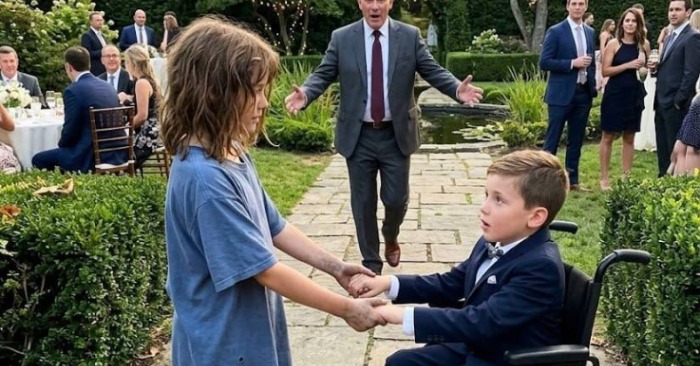
A barefoot girl stood on the gravel path.
Her clothes were worn, slightly too big for her. Her hair was tangled by the wind and long days. Yet there was something strangely calm about her. Her gaze was clear and steady, and her posture carried a confidence that caught Daniel off guard.
“HI” — SHE SAID.
Her voice was soft, yet certain.
Daniel thought she was speaking to him.
But she wasn’t.
The girl looked at Ethan.
Daniel immediately tensed. New York had taught him that strangers often approached wealthy people — not always with good intentions.
Before he could ask her to step aside, the girl crouched down next to Ethan.
“Please, let me dance with your son,” she said quietly.
DANIEL STARED AT HER IN DISBELIEF.
“What?”
The girl did not look at him.
“I can help him walk again.”
Daniel’s patience vanished instantly.
“Step back immediately,” he said sharply.
But before he could finish his sentence, Ethan moved.
Not just a quick glance.
THE BOY TURNED HIS HEAD COMPLETELY TOWARD HER.
His gaze fixed directly on the girl.
Daniel froze.
The girl leaned down to Ethan’s eye level.
“I know what this feels like,” she said gently. “My sister went through it too.”
Ethan’s voice spoke softly, uncertainly.
“What happened to her?”
Daniel almost forgot to breathe.
THIS WAS THE FIRST FULL SENTENCE HIS SON HAD SPOKEN IN WEEKS.
“She also stopped walking when our mother left,” the girl continued. “Her legs worked. But her heart became too heavy.”
Ethan swallowed.
“How did she get better?”
The girl smiled.
“We danced.”
Daniel looked at her, confused.
“What’s your name?” he asked.
“GRACE PARKER.”
Grace began to hum softly. The melody carried a slow, calm rhythm that almost imperceptibly filled the air.
She gently took Ethan’s hand.
She did not try to make him stand.
She simply turned the wheelchair slightly and began to sway to the rhythm, as if the chair itself were part of the dance.
For a few seconds, nothing happened.
Then Ethan began to laugh.
The sound was sudden and bright — like sunlight breaking through clouds.
TEARS FILLED DANIEL’S EYES.
Grace glanced at him briefly.
“We don’t force the body,” she said softly. “We just remind it that it’s still alive.”
Daniel hesitated, then spoke.
“Come to our place tomorrow. I’ll pay you for your time.”
Grace immediately shook her head.
“I’m not interested in money,” she said. “I just want to help.”
That night, hope returned.
Not loudly.
Not dramatically.
But quietly — like a small light at the end of a long, dark corridor.
The next day, Grace arrived at Daniel’s estate.
She brought her sister, Lily, with her.
Lily could already walk normally, but in her eyes there was still a shadow of old pain.
The housekeeper was surprised when she saw them.
“Let them in,” Daniel said immediately.
“AND PLEASE, GIVE THEM FOOD.”
Grace and Lily ate slowly at first, then faster and faster — as if plentiful food was a rare thing in their lives.
Later, they told their story.
Years earlier, when their mother abandoned them, Lily had completely withdrawn. She did not walk, barely left her bed. Doctors recommended therapy.
But Grace chose a different path.
Every day she played music.
And danced beside her sister.
Not to make her stand.
BUT TO REMIND HER: MOVEMENT CAN EXIST WITHOUT FEAR.
Eventually, Lily stood up.
Days turned into weeks as Grace worked with Ethan.
She never forced him.
At first, she taught rhythm.
Shoulders.
Arms.
Posture.
Music filled the therapy room, and slowly laughter returned as well.
But sometimes there were difficult days.
ONCE, ETHAN BURST INTO TEARS.
“Why won’t my legs listen to me?”
Grace knelt beside him.
“They’re not broken,” she said softly. “They’re just afraid.”
Daniel watched from the doorway.
And then he understood something.
Grace and Lily could not return to the streets.
“Would you like to stay here?” he asked one evening.
LILY LOOKED AT HIM IN SHOCK.
“You mean… live here?”
“For as long as you want.”
Not everyone agreed with his decision.
Daniel’s mother became angry.
“You’re bringing strangers from the street into our home?”
Daniel remained calm.
“They are giving Ethan his life back.”
EVEN THE NEUROLOGIST DOUBTED — UNTIL HE SAW ONE OF GRACE’S SESSIONS IN PERSON.
“This is not imagination,” he said later.
“The brain is reconnecting with the body.”
Month by month, Ethan grew stronger.
First, he stood up.
Then he took a step.
Then another.
Grace eventually suggested creating a small studio for children who had lost their movement due to emotional trauma.
Daniel immediately funded the idea.
THE SMALL ROOM SOON BECAME A PROGRAM TO WHICH DOCTORS SENT CHILDREN.
Grace and Lily taught them with patience.
They did not promise miracles.
Only movement.
On a spring morning, Ethan let go of the support.
And walked across the room on his own.
“I did it, Dad.”
Even Daniel’s once skeptical mother later approached Grace.
“I WAS WRONG ABOUT YOU.”
A year later, the studio held its first small performance.
Grace and Ethan danced together on stage — imperfectly, but with immense joy.
Parents wiped away their tears.
And Daniel, sitting in the audience, felt something he had not felt in a long time.
Peace.
That Christmas, the estate was completely different.
Ethan ran in the garden, Lily laughed beside him, and Grace raised a glass at dinner.
DANIEL SAID WITH A SMILE:
“To family.”
Then he added:
“And to the girl who reminded us that miracles are not born from money or power…”
Grace finished the sentence.
“But from love.”
And somewhere in the background, the music began to play again.