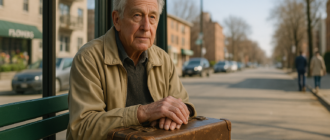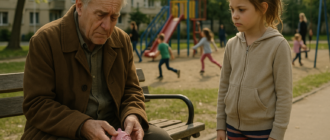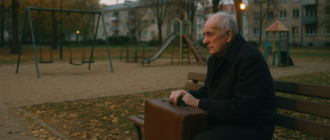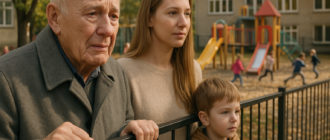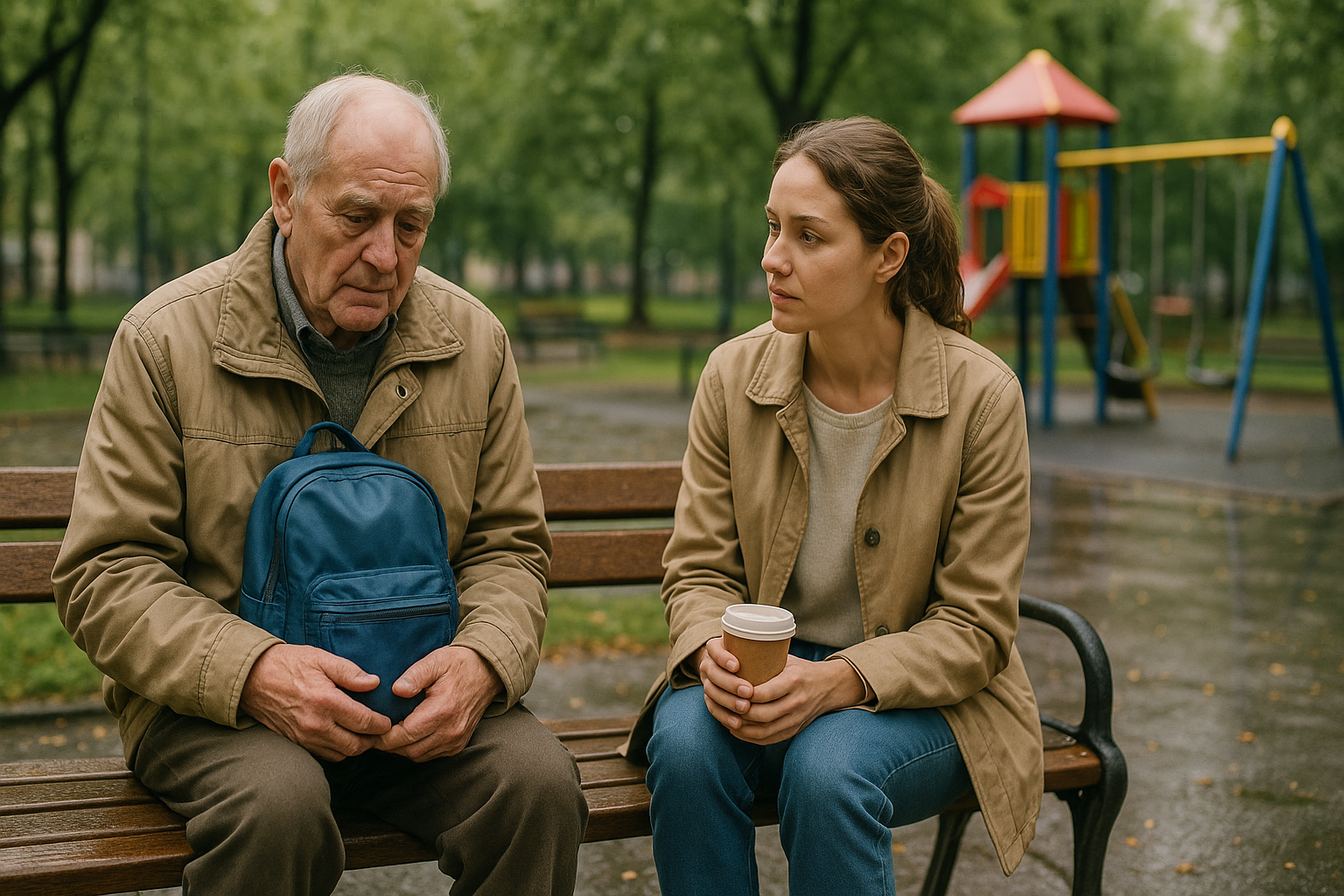
The old man who sat alone on the park bench every day, whispering apologies to a little blue backpack that no one else cared to notice. People in the neighborhood knew him as Mr. Thomas. Some called him “the quiet one,” others just walked faster when they passed his bench. Children ran by, dogs barked, buses came and went, and he sat there, thin fingers stroking the frayed handle of the backpack, lips moving soundlessly.

Inside the backpack was a tiny pink sweater, a broken plastic dinosaur, and a crumpled drawing of a house with three stick figures holding hands. On the roof, in shaky letters, was written: “OUR HOME – by Lily.” The paper had been folded so many times that the edges were as soft as cloth.
Every morning, as the church clock struck nine, Thomas would arrive at the park. His walk was slow, careful, as if the air itself might shatter. He sat on the same bench near the playground, placed the backpack beside him, and began his ritual. He would unzip it, touch each item gently, and then start to talk, very quietly.
“I’m here, Lily,” he would murmur. “I didn’t forget today either. I remember the swings you liked. I remember the way you laughed when the pigeons stole your crumbs.”
Most days, no one listened. A few mothers pulled their children a little closer when they walked by. A teenage boy once filmed him on his phone, snickering about the “crazy old man talking to a bag.” The video got some likes, a few laughing emojis, and then disappeared into the endless stream of things that did not matter.
One rainy afternoon, a young woman named Emma stopped under a nearby tree, waiting for the storm to ease. She had seen him before, always in the same place, always with the same backpack. This time the bench beside him was wet, but he sat there anyway, shoulders trembling under his thin brown coat.
The backpack was open on his lap. He held the tiny sweater in his hands, the fabric worn thin at the cuffs. His eyes were red, but no tears fell. Perhaps they had dried up years ago.
Emma hesitated, then stepped closer. “Sir… do you want an umbrella?” she asked softly.
He looked up, startled, as if she had shaken him out of a dream. For a moment, he just stared, as if he didn’t remember how to talk to someone who was actually listening.
“No, thank you,” he said at last. “The rain doesn’t bother me.” He glanced at the backpack. “It used to bother her. She’d complain her socks got wet.” A faint, broken smile touched his lips.
Emma sat at the far end of the bench, careful not to crowd him. The rain slowed to a gentle drizzle, the park almost empty. “Is that your granddaughter?” she asked, nodding at the sweater.
His fingers tightened around the fabric. “My daughter,” he said. “Her name was Lily.”
Emma heard the past tense and felt something twist in her chest. “Was?”
He nodded, eyes on the playground. “I come here every day,” he said. “This is where I last held her hand.”
He said it so quietly that Emma had to lean forward to catch the words. Somewhere behind them, a car horn sounded, a distant dog barked. Life went on, loud and indifferent.
“We were supposed to go home,” he continued. “Her mother had already left us. It was just the two of us. I worked nights, slept during the day. I was always tired, always saying, ‘In a minute, Lily, in a minute.’” His voice cracked. “I didn’t understand that minutes can run out.”
He told Emma about the day everything changed. The park had been crowded and bright, full of laughter. Lily had wanted ice cream. He had been on the phone with his boss, arguing about extra shifts. He remembered waving his hand dismissively and saying, “Stay where I can see you.”
He had turned his back for what felt like a heartbeat.
When he turned around, she was gone.
At first, he thought she was hiding behind the slide, playing a game. Then he thought she had run to the ice-cream cart without him. The minutes stretched, his heartbeat pounded in his ears. He shouted her name, ran from corner to corner, his voice hoarse and higher with each call: “Lily! Lily!”
They found her three hours later, near the river at the edge of the park. Slipped, they had said. Accident, they had said. She must have wandered too close to the water. There were a lot of kind words, a lot of sad looks. But no one had been holding her hand when she needed it.
“I should have been there,” Thomas whispered now, staring at the wet playground. “A father’s job is to hold on. I let go. I answered a phone call instead of my child.”

Emma felt tears sting her eyes. She didn’t interrupt. The park seemed to shrink around them, every creak of the swings a reminder of what had been lost.
“For a long time,” he said, “I didn’t come here at all. I stayed in my apartment, curtains closed. I stopped answering the door, stopped talking to people. But the guilt…” He placed the sweater gently back into the backpack. “The guilt didn’t stay away. So I came back, thinking maybe if I sat where we last were together, if I said I was sorry enough times, it would matter somehow. That she would hear me.”
He looked at Emma suddenly, eyes sharp with a desperate hope that made him look almost young. “Do you think she can hear me?”
Emma swallowed. She thought of her own father, who had walked out when she was eight and never apologized for anything. She thought of all the words that had never been said to her. “I think,” she said slowly, “if love can reach us when we’re alive… maybe it doesn’t stop just because we can’t see each other anymore.”
For the first time, his eyes filled with fresh tears. One slipped down his cheek and landed on the blue fabric of the backpack, darkening it like a tiny storm cloud.
“I see you here every day,” Emma continued. “People walk past, but you’re still here. You haven’t forgotten her once in all these years, have you?”
“Not a single day,” he whispered.
“Then that’s what she knows,” Emma said. “Not the phone call. Not the moment by the river. She knows you keep coming back.”
He let out a shuddering breath, half sob, half sigh. For a long time they sat in silence, two strangers sharing a grief that had different names but the same weight.
After a while, Emma stood. “I have to go,” she said, “but… can I sit with you again sometime?”
He looked surprised. “If you want,” he said. “I don’t have much to offer. Just stories of a little girl who loved pigeons too much.”
“I’d like that,” Emma replied. “And… maybe you could tell me more about the house in that drawing. The one that says ‘Our Home.’”
He glanced at the crumpled paper, then back at her. Something in his face softened, a thin crack in a wall that had been solid for years. “Our home,” he repeated. “I haven’t said those words in a very long time.”
The next day, when the clock struck nine, Thomas was on his bench as always. But this time, when he looked up, he saw Emma approaching with two paper cups.
“I brought coffee,” she said, a little shy. “And some bread for the pigeons. I thought… maybe you could show me which ones she liked the most.”
He took the cup with trembling hands. The backpack sat between them like a small, sacred object. For the first time, he unzipped it and held out the drawing, not to the empty air, but to another living person.
“This was our home,” he said, voice trembling. “Maybe one day I can talk about it without feeling like I’m breaking apart.”
Emma nodded. “And until that day,” she said gently, “you don’t have to sit here alone.”
People still walked past them without really looking. Children still laughed and ran, dogs still tugged at their leashes. The world did not suddenly become kinder or quieter. But on that bench, an old man’s apology, carried for years like a stone in his chest, finally met a pair of open ears.
Lily was still gone. Nothing could change that. The guilt would never vanish entirely. Yet as Thomas watched Emma feed the pigeons the way his daughter once had, something shifted—just a little. His hand, resting on the blue backpack, felt not only the weight of what he had lost, but the faint, fragile warmth of what he still had: the chance, at last, not to be invisible in his grief.
And for a man who had spent years talking only to a backpack, that small, trembling mercy felt almost like forgiveness.