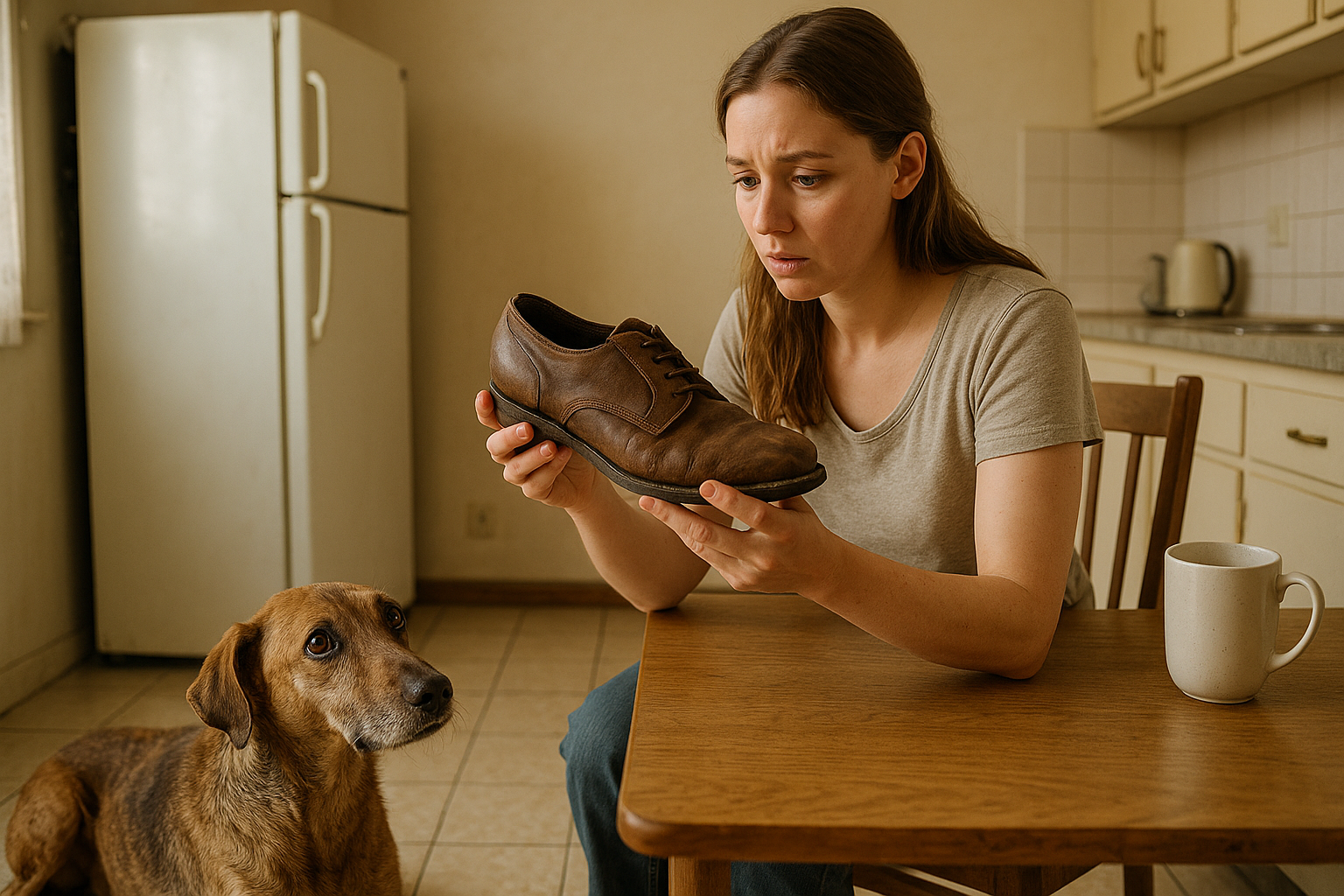
When Oliver dragged an old, torn shoe to my door at 3 a.m., I thought he was just a stray dog begging for food – I had no idea he was trying to return something my late father had thrown away 20 years ago.

The banging woke me first. A dull, repetitive thud against the metal door, like someone gently but insistently knocking with a soft fist. I lived alone on the edge of town, in a small ground-floor apartment that nobody visited without warning. For a second I thought it was just the wind.
Then I heard the whine.
I pulled on a sweater and opened the door, ready to shout at whatever drunk neighbor had mistaken my door for theirs. Instead, I saw a thin, mud-covered dog, ribs visible under patchy fur, a frayed rope still hanging like a noose from his neck. In his mouth he clamped a single, filthy shoe – men’s, leather, torn at the heel.
He dropped it at my bare feet and looked up at me with such desperate hope that I forgot to breathe.
“Hey, buddy,” I whispered, my voice suddenly too soft for the silent stairwell. He smelled of wet earth and something older, sadder – like mold in an abandoned house. Rain had started outside, and tiny drops glittered on his whiskers.
I should have shut the door. My landlord hated pets. My salary barely covered rent. I had promised myself I wouldn’t let anything else depend on me. I already failed once.
But when the dog trembled and carefully nudged the shoe closer with his nose, as if this ugly, ruined thing was an offering he’d crossed the world to deliver, my chest ached in a way I hadn’t felt since my father’s funeral.
“Okay,” I sighed. “Just for tonight.”
He limped inside, favoring his right leg. The smell got worse in the warm air of my kitchen, but he sat with a politeness I didn’t expect, eyes fixed on me while I poured water into a bowl and tore bread into small pieces. He didn’t rush. He waited until I stepped back, then ate as if each crumb was a miracle.
The shoe lay between us on the floor.
I tried to ignore it, but something in the shape of it, the slope of the sole, tugged at the edge of my memory. I picked it up, turning it in my hands, brushing away dirt.
My heart stopped.
The leather was cracked, but the pattern on the side – three faint, crooked lines my father had carved with his pocketknife when I was ten – was still there. I remembered that day vividly: him sitting on the steps of our old house, laughing as he said, “Now you’ll always know which ones are mine, Emma.”
My father had thrown those shoes away the week before he died.
I had watched from the window as he limped to the trash, breath heavy, his heart already failing. He’d dropped them in the metal bin with a tired finality and said, “No point fixing what’s already walked its miles.”
I never saw them again.
Until now.
I sank onto a chair, the room spinning. The dog watched me, head tilted, as if gauging whether he’d done his job.
“This… how?” I whispered, more to myself than to him.
The next morning, I took him to the vet. His leg was infected from an old wound, the rope had rubbed his neck raw, and he was dangerously underweight. The vet asked if he had a name.
“Oliver,” I said without thinking. It was my father’s middle name.
“You’re keeping him, then?” the vet asked.
I opened my mouth to say no. I pictured my overworked days at the office, the empty fridge, the unopened letters from the bank. I had already walked away from my mother years ago, after my father’s death, when grief made her a stranger who blamed me for not calling the ambulance sooner.
I couldn’t even keep a family together. What made me think I could keep a dog alive?
But when I looked down, Oliver’s eyes met mine. They were not begging. They were waiting – as if he had already chosen me, and was just politely allowing me time to accept it.
“Yes,” I heard myself say. “I’m keeping him.”
The vet smiled. “He’s lucky.”
For weeks, I told myself I was the one saving him.
I fed him, cleaned him, cut the rope from his neck. I bought a cheap blue collar and wrote my number on a metal tag. Oliver followed me from room to room, never barking, never demanding. At night, he slept on an old blanket beside my bed, one paw always stretched just close enough to touch the edge of the mattress.
He dragged that old shoe everywhere.
To the kitchen, to the bathroom door, even to the hallway when I left for work, as if it were a talisman. Sometimes I caught him resting his chin on it, staring at the door like he was waiting for someone else.
One rainy Saturday, curiosity finally won.
I cleaned the shoe properly. Under layers of mud and time, I found something else: faint letters scratched on the inside of the tongue. Not my father’s carvings. Smaller, shakier.
“EM–”

The rest was worn away, but the first two letters of my name were still there.
My knees buckled. I slid to the floor, Oliver immediately pressing against my side.
I remembered a storm years ago, right after my father threw the shoes away. The trash collectors had been late. That night, thunder shook the house, and I’d woken to a hollow clatter outside. I’d been too scared to look. The next morning the bin was empty.
My father died a week later.
He had asked me, two days before his heart stopped, “Emma, did you see my old shoes? The brown ones? I thought I heard them fall.”
I had shrugged, headphones in, too busy with my phone. “You threw them out, Dad.”
He’d gone quiet. “Right,” he’d said finally. “Right. I forgot.”
Now, all these years later, a starving dog had dragged one of them back to me in the middle of the night.
It felt like a message from a man who used to say that nothing truly lost ever stops looking for its way home.
That afternoon, I did something I had avoided for five years. I called my mother.
The phone rang so long I almost hung up. Then her voice, smaller and older than I remembered: “Hello?”
“It’s me,” I said. “Emma.”
Silence. Then a shaky breath. “Oh.”
“I… I got something of Dad’s back,” I blurted out. “His old shoe. The brown one. With the lines.”
Another silence, but this time I could hear her crying.
“I threw the pair away again after the funeral,” she whispered. “I couldn’t bear to look at them. Every time I saw them, I heard you shouting for him, and I… I thought if I threw everything away, the memory would stop.”
Oliver pressed his head against my knee, grounding me.
“I think one of them wanted to come home,” I said. My voice broke. “And he sent a dog to carry it.”
We both cried then – two people who had spent years pretending we were fine.
By the time we hung up, my mother had agreed to meet me the next day. “Bring the dog,” she said. “If he’s stubborn enough to drag your father’s shoe back, I think I’d like to see his face.”
On the bus to her house, Oliver sat at my feet, the shoe between his paws. People smiled at him, some reached out to pet him. He watched the passing streets with quiet focus, as if memorizing the path.
When my mother opened the door, she looked at Oliver first.
He looked back, tail slowly wagging, then – to my surprise – he picked up the shoe, walked past her trembling legs, and laid it gently on the worn rug in the hallway.
Right where my father had always left his shoes.
My mother’s hand flew to her mouth. She didn’t look at me; she looked at the empty space by the door, where an invisible man might have been standing, smiling at the dog that had finally returned what he’d lost.
We spent the day talking. Not yelling, not blaming – just talking. About my father’s jokes, his awful singing, the way he used to fix everything with tape and faith. Oliver lay between us, occasionally resting his head on one lap or the other, stitching a torn family together with the simple weight of his presence.
When I left that evening, my mother stood longer than usual at the door.
“Leave the shoe,” she said softly. “Let it stay here. It’s where it belongs.”
I hesitated, then nodded. Oliver didn’t protest. He sniffed it once, then trotted back to my side as if his mission was finally complete.
On the walk home, the sky was clear for the first time in weeks.
People say dogs need us. Food, shelter, care. But as Oliver leaned against my leg at the crosswalk, I realized something that made my eyes sting.
He hadn’t come to my door that night because he needed saving.
He had come because I did.