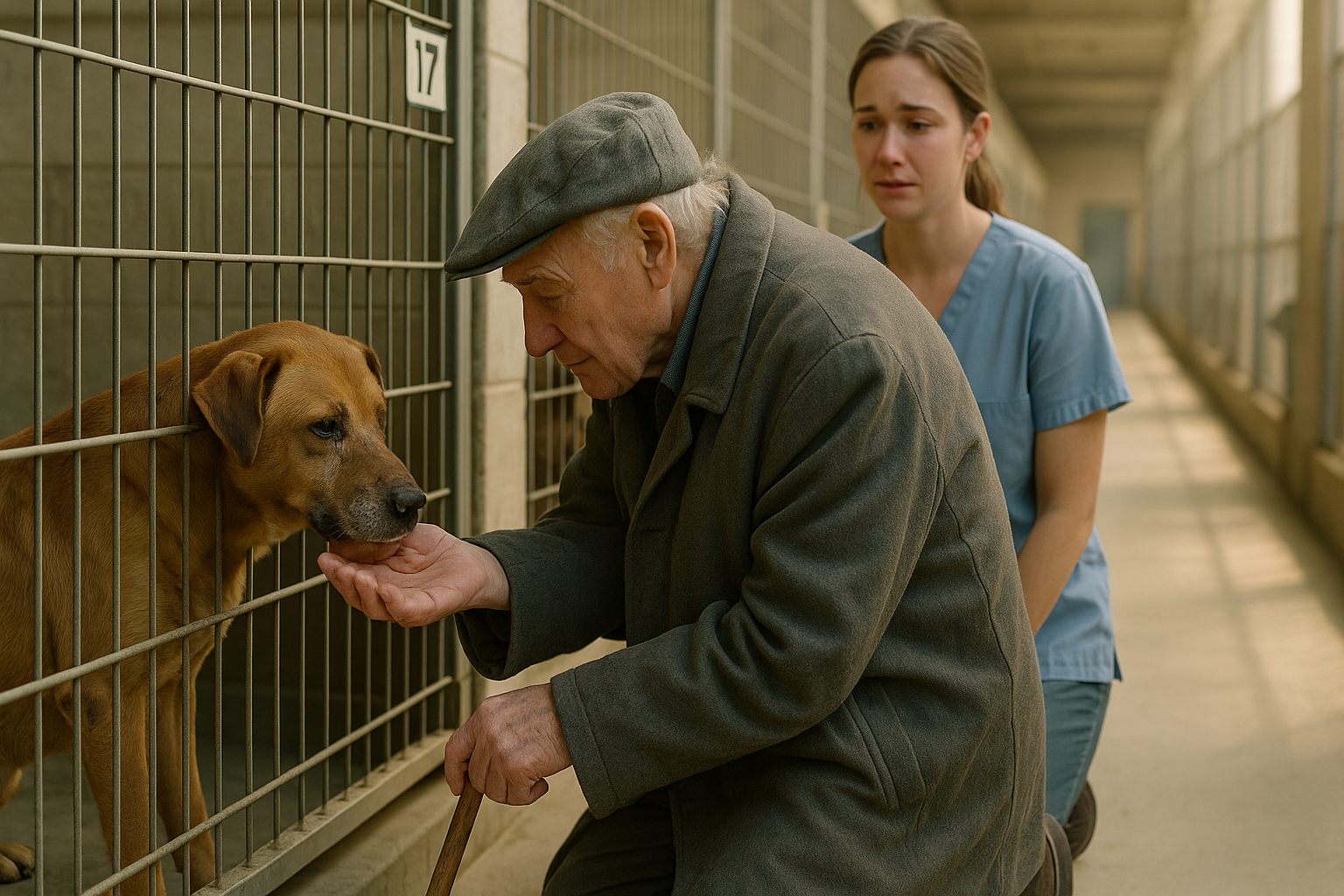
The old man who came to the shelter every Sunday and asked for the same dog no one else wanted was already waiting by the gate when Lisa arrived, his thin hands wrapped around a crooked walking stick, his gray coat too big for his narrow shoulders.

“Morning, Mr. Mark,” Lisa said, locking her bike. She had started working at the small animal shelter three months ago and quickly learned his routine.
“Is he still here?” he asked, skipping any greeting, his pale blue eyes searching the building behind her.
Lisa glanced at the intake list on her phone. “Yes. Cage 17, like always.”
He exhaled with a kind of fragile relief that made her chest tighten. Every Sunday, at exactly 9:30, he came. He never looked at the puppies that jumped and yelped, never asked about the friendly, fluffy dogs everyone wanted. He came for one dog: a scarred, one‑eyed, graying mutt named Bruno, who growled whenever anyone got too close.
Inside, the wet smell of disinfectant and fur wrapped around them. As they walked down the corridor, dogs barked, tails thumped, paws scratched metal bars. Bruno, in Cage 17, didn’t make a sound. He just lay on his blanket, his one eye dull and watchful.
“Hello, old soldier,” Mr. Mark whispered, kneeling with difficulty in front of the bars. Bruno’s lip twitched, but he didn’t growl. Not at this man.
Lisa watched as the old man slowly pushed his hand through the bars, palm up. Bruno sniffed, then rested his muzzle on those trembling fingers. The first time she’d seen it, she was sure she’d imagined it. Now it happened every week, like a quiet ritual.
“You know,” she said softly, “you could adopt him. We’d be happy to help with the paperwork.”
Mr. Mark smiled without looking at her. “I can’t,” he said. “I just came to see how he’s doing.” He carefully stroked Bruno’s scarred head. “We agreed, he and I. No more cages. Not again.”
His words didn’t make sense to Lisa, but something in his voice kept her from asking more.
Weeks passed. Sundays blurred into each other: the same corridor, the same cage, the same old man and the same unwanted dog. Bruno never wagged his tail for anyone else. Potential adopters walked past Cage 17 quickly, afraid of his scars, his missing eye, the note on the door: “Can be reactive. Needs experienced owner.”
One rainy Sunday, the shelter was almost empty. The sound of water drumming on the roof filled the silence. Lisa brewed tea in the tiny kitchen and brought a cup to the old man, who sat on a plastic chair opposite Bruno’s cage.
“Thank you, Emma,” he said. He always called her Emma, even though her name tag clearly said “Lisa.” She’d stopped correcting him; there was a softness in the mistake.
“Why this dog?” she finally asked, sitting down next to him. “He scares everyone else.”
Mr. Mark blew on his tea. “He doesn’t scare me,” he said. “He just looks like he knows what it means to lose everything.”
“You lost something?” she asked before she could stop herself.
He chuckled, but there was no joy in it. “Someone,” he corrected. “My wife, Sara, six years ago. And before that, my son, David.”
“I’m sorry,” Lisa murmured.
“He had a dog,” the old man continued, nodding toward Bruno. “A big, clumsy mutt. Brown, like this one. Name was Max. They grew up together. When David… when the accident happened, Max stopped eating. Just lay by the door all day, waiting.” His voice cracked on the last word.
“What happened to Max?” Lisa asked quietly.
“I brought him here,” Mr. Mark said, his eyes fixed on Bruno. “To this shelter.”
Lisa straightened. “Here? To us?”
“The building was different then, but yes. I thought he’d find a better home. I told myself that every day. I signed the papers and left him behind. He cried when I walked out. Scratched at the bars. I heard him from the parking lot.”
Bruno whined softly, as if he understood.
“I came back a week later,” Mr. Mark went on. “I couldn’t sleep. Couldn’t eat. I wanted to take him home. But they told me…” He swallowed hard. “They told me he’d gotten sick. Stress, old age. They’d put him down the day before.”
The air in the corridor felt heavier. Lisa’s hand tightened around her tea cup.
“That was the last sound I heard from him,” he whispered. “His paws on the bars. I never said goodbye properly. Never held him when he was scared. I just left him.”
He leaned closer to Bruno’s cage, his eyes wet. “When I saw Bruno’s picture on your website, I knew. I recognized that look. The look of someone who decided not to trust anymore.”
Lisa blinked away her own tears. “But if you feel that guilty… why don’t you adopt Bruno and give him a home? You could make it right.”

The strong twist came so quietly it almost didn’t sound like a twist at all.
“I don’t have a home to give him,” Mr. Mark said simply. “Not really.”
She stared at him. “What do you mean?”
He hesitated, then sighed. “I sleep at the shelter down the road. For people, not animals.” He attempted a smile. “Funny, isn’t it? The man who gave away his son’s dog doesn’t even have a place of his own now.”
The words hit her like cold water. Suddenly the oversized coat, the worn-out shoes, the way he always left exactly when visiting hours ended—it all fit.
“How long?” she asked hoarsely.
“Two years,” he said. “Pension’s not enough. Rent went up. It’s quiet there, but they don’t allow dogs. And Bruno…” He looked at the animal with a tenderness that hurt to see. “Bruno deserves a couch, a garden, maybe a kid who drops food on the floor. Not a bunk bed in a room full of old ghosts.”
For a long moment, all that could be heard was the steady patter of rain and Bruno’s slow breathing.
“You know what I tell him every Sunday?” Mr. Mark asked.
Lisa shook her head.
“I tell him I’m sorry for Max. And I tell him that if no one comes for him, I’ll still come. So he knows he hasn’t been completely thrown away.”
He reached through the bars again. Bruno pressed his head into his hand with a low, broken sound that wasn’t quite a whine.
That night, after closing, Lisa couldn’t sleep. Bruno’s one eye and Mr. Mark’s hunched back followed her into her dreams. The next morning, she walked into the director’s office with a knot in her stomach.
“This isn’t about rules,” she said. “It’s about decency. About not repeating the same story twice.”
The director frowned at the proposal, at the forms, at the idea of bending procedures for an old man with no address. But Lisa didn’t back down.
A week later, on a bright Sunday morning, Mr. Mark arrived at 9:30, as always. Lisa met him at the gate, nerves fluttering in her chest.
“Is he still here?” he asked.
“For now,” she said. “Come with me.”
They walked down the corridor. Bruno stood up before they even reached his cage, ears perked, tail uncertainly twitching.
On Cage 17, the sign was gone.
“What’s this?” Mr. Mark whispered.
Lisa held out a trembling folder. “Temporary foster agreement,” she said. “The shelter down the road agreed to let Bruno stay during the day in our office, and at night he’ll go with you to a small room we rented in the volunteer house nearby. It’s not much. But it’s a door you can both close from the inside.”
He stared at her as if he hadn’t heard correctly. “You… you did this?”
“Not just me,” she said quickly. “Some of the volunteers pitched in. The director signed off. Bruno will still be under our medical care. On paper, he’s a shelter dog. But in reality… he’s yours. If you want him.”
For a moment, the old man didn’t move. Then he reached for the cage latch with shaking fingers. Bruno didn’t growl. He stepped out slowly, his paws almost silent on the concrete.
Bruno sniffed Mr. Mark’s trousers, then leaned his whole weight against the frail legs, as if he’d been doing it his entire life. Mr. Mark’s hand sank into the rough fur.
“I never got to say goodbye to Max,” he whispered, voice breaking. “Maybe… maybe I can learn to say hello this time.”
Lisa watched them, her throat tight. The dog who no one wanted and the man who thought he had nothing left to give stood in the bright strip of sunlight falling through the high window, two shadows touching.
For the first time since she started working at the shelter, Cage 17 was empty. And for the first time in a long time, Mr. Mark did not leave alone.