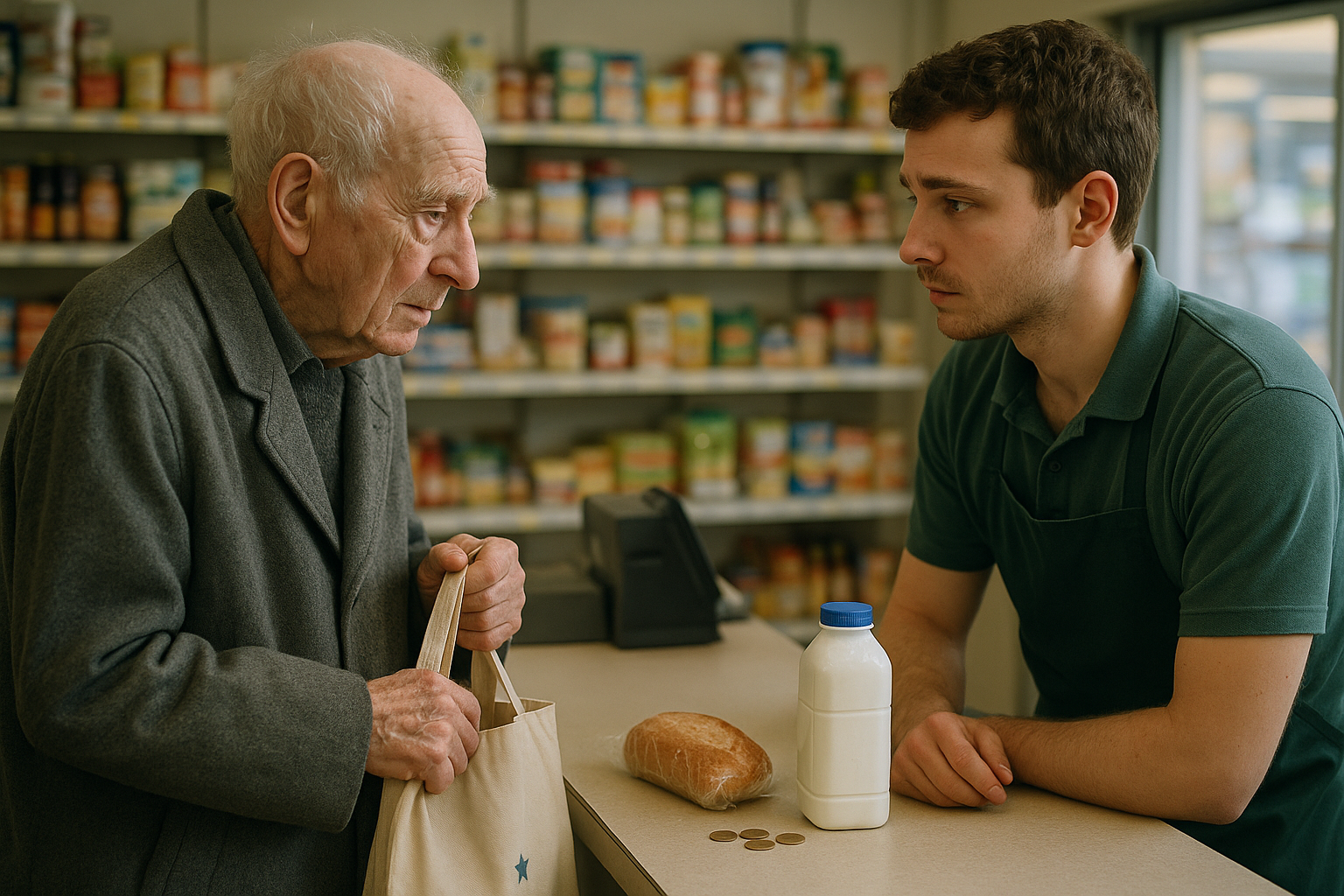
The old man kept returning the same grocery bag to the store every evening, until the cashier followed him and discovered who was waiting for his bread.

Liam noticed him on a rainy Tuesday, just before closing. A very thin, stooped old man in an oversized gray coat came in, clutching a crumpled reusable bag. His hands shook as he placed a small loaf of bread, a carton of milk, and two bruised apples on the counter.
“That’s all?” Liam asked automatically.
The old man nodded, eyes fixed on the total on the screen like it was a mountain he had to climb.
He paid in coins, counting them out one by one. When Liam handed him the change, the old man hesitated.
“Could you… mark it?” he asked in a soft, embarrassed voice. “This bag. So you remember me.”
Liam forced a smile. “Sure. Why?”
“So you know it’s me, when I bring it back.” The old man looked away. “In case… something’s wrong.”
Liam scribbled a tiny blue star on the handle with a marker. The old man nodded gratefully, took the bag, and shuffled out into the rain.
The next evening, at almost the exact same time, he returned.
Same gray coat, same trembling hands, same bag with the blue star. But this time, instead of placing items to buy, he put the loaf of bread from yesterday on the counter — still in its plastic, untouched.
“Is something wrong with it?” Liam asked.
The old man cleared his throat. “You said yesterday I could return if… if it wasn’t good.”
“Is it moldy?”
“No.”
“Stale?”
“No.”
“Then why…?”
The man’s fingers tightened around the handle. “I… I realized I can manage with just milk today. Maybe you can put this back. Someone else might need it.”
Liam stared at the loaf. The old man was trying to return perfectly fine bread.
“You already opened it?”
“It’s still sealed,” the old man said quickly, almost apologizing. “I kept it safe.”
There was a long, heavy pause.
“Sir, you don’t have to—”
“Please,” the old man whispered. “I don’t like wasting.”
Liam didn’t argue. He processed the return, gave him a few coins back, and watched as the man used them to buy only milk and one apple.
For the next five days, it continued.
Every evening, the same routine: the old man came in with the same marked bag. Sometimes he returned the bread. Sometimes the apples. Once he even returned an unopened can of soup, apologizing that it was “too heavy to finish alone.”
Each time, he walked out with just enough to survive for a day — never more.
The other cashiers rolled their eyes.
“He’s just lonely,” one said. “He wants to talk to someone.”
“Or confused,” another suggested, tapping her temple.
But there was something in the old man’s eyes that bothered Liam. A quiet, desperate calculation, like someone counting breaths.
On the seventh day, the old man came in later than usual. His coat was wetter, his hair plastered to his forehead. He coughed into his sleeve and winced.
“Bread and milk?” Liam asked gently.
The old man shook his head. “Just bread today.”
He paid with trembling fingers. No returns this time. No awkward explanations. But when he turned to leave, his knees buckled for a second and he grabbed the counter.
“Are you okay?” Liam stepped out from behind the register.
“I’m fine, son.” The old man forced a weak smile. “It’s just a bit far to walk back, that’s all.”
“How far?”
“Not so far when you’re young,” he said. “Too far when you’re not.”
Something inside Liam snapped. He thought of his own grandfather, who had died alone in a small apartment three cities away, with no one noticing for two days.
“Wait,” Liam said. “I’m on break in five minutes. Let me drive you home.”
The old man immediately shook his head. “No, no, I don’t want to be a burden.”
“You’re not,” Liam insisted. “Please. It’s raining.”
For a moment, the old man stood there, wrestling with his pride. Then he nodded once.
In the car, he sat perfectly straight, the grocery bag clutched to his chest like something precious.
“By the way,” Liam said, trying to sound casual, “I’m Liam.”
“Arthur,” the old man replied quietly.
They drove through narrow, darkening streets until Arthur pointed to a crumbling building at the edge of town. Half the windows were broken, the paint peeling in large, tired patches.

“You live here?” Liam asked.
Arthur nodded. “Top floor.”
There was no elevator. Arthur refused help on the stairs, but his breathing grew harsher with each step. At the third floor, Liam pretended to tie his shoe just to give him a moment to rest.
At last, they reached a faded brown door. Arthur unlocked it with shaking hands.
“Thank you, Liam,” he said. “You’ve been very kind. I can manage from here.”
Liam hesitated. Something about the silence behind that door felt wrong. Too deep.
“May I… just carry the bag inside for you?” he asked.
Arthur opened the door wider in resignation.
The first thing that hit Liam was the cold. The apartment felt like a refrigerator. No TV noise, no radio. Just the ticking of an old clock and the soft hum of the fridge.
The second thing he noticed was that the apartment was meticulously clean — but almost empty. A small table. Two mismatched chairs. A narrow bed with a carefully folded blanket.
On the table lay three objects: a cracked pair of reading glasses, a worn-out children’s book, and a framed photo of a young woman holding a baby, both laughing at something just outside the frame.
“That’s my daughter, Emma,” Arthur said softly, following Liam’s gaze. “And my grandson, Noah.”
“They don’t live with you?”
Arthur swallowed. “They used to live in another country. Emma worked very hard. She called often. Then… she stopped.”
“What happened?”
“She was in a car accident two years ago,” Arthur replied. “Noah went to live with his father’s family. They said it would be ‘too complicated’ for me to visit.” His voice cracked on the last word.
Liam felt his throat tighten.
“And you live here… alone?”
Arthur nodded, then walked slowly to the small balcony door and opened it.
“Not entirely,” he said.
Cold air swept in. From the balcony came a faint, excited sound — tiny claws on metal, soft squeaks.
Liam stepped closer and froze.
On the balcony, under an improvised shelter made from an old coat and cardboard, sat three skinny cats and one small, scruffy dog with cloudy eyes. Their tails thumped weakly when they saw Arthur. The dog gave a hoarse, joyful bark.
Arthur’s voice changed when he spoke to them — suddenly warm and alive.
“I’m back, Charlie. I told you I’d bring the bread.” He broke the loaf into careful pieces, giving some to each animal, stroking their heads with those same trembling hands.
“You’re… feeding them with your own groceries?” Liam asked, stunned.
Arthur looked almost ashamed. “They were abandoned here last winter,” he said. “Someone threw them out. They cried all night. I couldn’t sleep.” He shrugged helplessly. “I know I don’t have enough. That’s why I return what I can. So I can stretch the rest. I eat every other day. They don’t understand hunger like we do. They just hurt.”
The bread disappeared quickly. The dog licked Arthur’s fingers, then rested his head on the old man’s knee, eyes half-closed with trust.
“You skip meals… so they can eat?” Liam whispered.
Arthur gave a small, tired smile. “When you get to my age, you learn what matters. I couldn’t save my daughter. I couldn’t keep my grandson. But these little souls… they’re still here. They wait for me. Someone has to come back for them.”
Liam felt an ache in his chest so strong it almost scared him. He thought of Arthur counting coins under the supermarket’s bright lights, the shame in his eyes as he returned untouched bread.
“Arthur,” he said quietly, “you can’t go on like this.”
“I’ve gone on like this for a year,” Arthur replied. “It’s not so bad. Some people have less.”
Liam looked at the animals, then at the empty kitchen shelf with its single plate and cup.
The next day at the store, Liam did something he had never done before. During his break, he posted in the local neighborhood group online:
“Is anyone willing to help an elderly man on the edge of town who is feeding four abandoned animals and often returns his own food to make sure they eat?”
He didn’t post Arthur’s photo. Just the story. He expected one or two kind comments.
By evening, there were over a hundred messages.
People offered cat food, dog food, money, blankets. A vet offered to check the animals for free. A local electrician said he would look at Arthur’s broken heater. A woman wrote that she regretted not visiting her own grandfather before he died and begged for the address.
Liam printed the messages and took a taxi straight to Arthur’s.
Arthur opened the door in the same gray coat, surprised.
“Did you forget something at the store?” he asked.
“No,” Liam said, holding up the stack of papers. “But I think some people forgot something a long time ago. They forgot about people like you. And now they want to fix it.”
He handed Arthur the pages. The old man adjusted his cracked glasses and began to read.
With each line — “I can bring food,” “I can visit,” “I can help with the animals,” — his lips trembled more. Finally he looked up, eyes wet.
“All… all this is for me?” he whispered.
“For you,” Liam said, his own voice unsteady. “And for Charlie. And for everyone waiting for your bread.”
On the balcony, the little dog barked once, as if he understood.
That night, for the first time in a very long time, Arthur didn’t have to return anything.