My father died on a Tuesday, and on Wednesday I found his second family.

I was in his small apartment with my mother, going through his things. They had been separated for five years but never divorced. She still called him “my husband” to neighbors. He still sent her money on the first of every month.
The place looked like a temporary hotel room. Half-empty fridge, one toothbrush, a single plate in the sink. My mother kept saying, “He lived like a bachelor,” as if trying to convince herself it was true.
I opened the wardrobe to pack his clothes for donation. On the top shelf there was a blue shoebox with a rubber band around it. It wasn’t dusty. Someone had touched it recently.
Inside were photos.
Not old ones of me as a kid. New ones. A woman around my age, maybe a bit younger. Dark hair pulled back in a simple ponytail. A boy, about six. In every photo, my father was with them. Holding the boy’s backpack. Standing behind them at a birthday table. In one, the kid sat on his shoulders, hands in my father’s hair.
The boy looked exactly like me in my school pictures.
My mother was folding his shirts on the bed. I watched her hands move slowly, carefully. I didn’t say anything. I put the photos back in the box, but my hands were shaking and the rubber band snapped. A few pictures slid onto the floor.
She turned at the sound. Bent down. Picked one up.
She stared at it for a full minute without blinking. Then she sat on the bed, still holding the photo, and said, very quietly, “So that’s where the money went.”
There was no screaming. No accusations. Just that one sentence. She put the picture beside her, smoothed the blanket with the flat of her palm, and kept folding shirts.
At the bottom of the box there were documents. A lease agreement with the same address as on his driver’s license. Two names as tenants: his, and the woman from the photos. A birth certificate for the boy. Under “Father” was my father’s full name.
I checked the date. The boy was born three months before my parents’ twentieth wedding anniversary.
There was also a cheap smartphone with a cracked corner in his nightstand. No password. The last messages were from a chat labeled “Home”.
The woman: “Doctor said we need to repeat the tests next month. Don’t worry him yet.”
My father: “I’ll take him on Saturday. We’ll buy that red ball he wanted.”
The woman: “He keeps asking why you don’t sleep here. I told him you work nights.”
My mother read over my shoulder without asking. I felt her breath on my neck, short and uneven. At one point she put her hand on my arm, not to comfort me, but like she was holding on to furniture during an earthquake.
The call log showed my number, my mother’s number, and a third one called three times a day, every day, for years. Sometimes right after he spoke to me.
I dialed it.
A child answered. The same voice you hear in those birthday videos parents send each other. High, serious, trying to sound grown-up.
“Hello?”
I froze. My mother took the phone from my hand.
“Hello, who is this?” she asked.
“I’m Daniel,” the boy said. “Is this about my dad? He didn’t come home yesterday.”
There was a pause that lasted too long. My mother looked at me, then at the photos on the bed. Her face didn’t move. She said, in a steady voice that didn’t sound like hers, “Where is your mother, Daniel?”
A woman came to the phone. I could hear panic in the background, cupboards opening, a chair scraping the floor.

“Hello?” Her voice cracked. “Did something happen? His boss called. He didn’t show up. He never does that.”
My mother introduced herself with my father’s last name. The woman went silent. Completely. No breathing, no sound. Then a chair scraped again.
“How long?” my mother asked.
“Ten years,” the woman said. “We met at the clinic where I worked. He said he was divorced.”
The rest of the conversation was practical. Which hospital. What time to come for the papers. Whether someone should tell Daniel now or after school. Two widows organizing a funeral for one man.
After the call, my mother stood in the middle of the room. Not crying. Just standing. Then she picked up the boy’s birth certificate, folded it in half, and put it into her handbag.
“He has a right to his inheritance,” she said. “You’ll help me with the lawyer.”
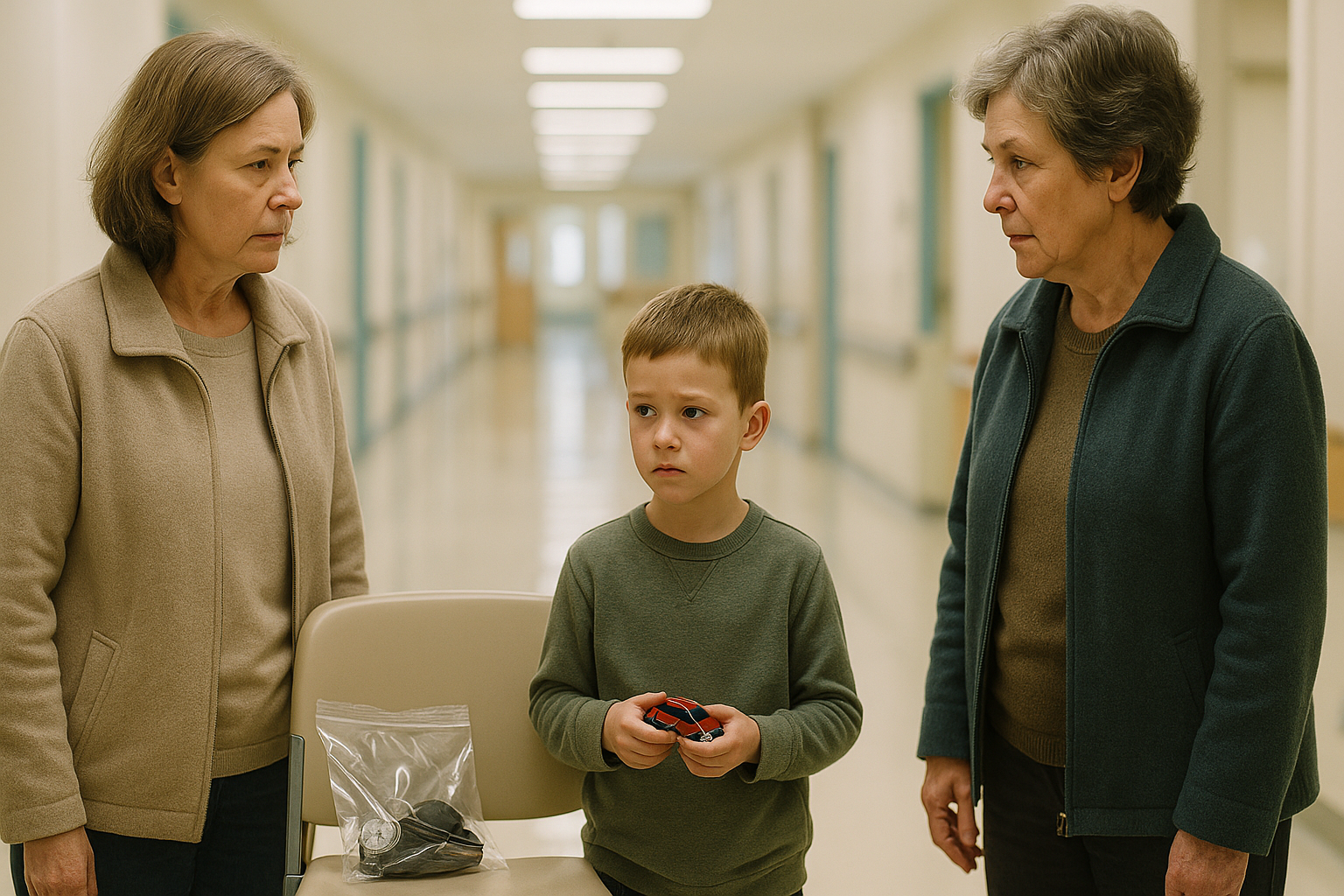
That night, we met them in the hospital corridor. The woman was smaller in real life than in the photos. She held Daniel by the shoulder. He was clutching a toy car, turning the wheels with his thumb.
When he saw my father’s name on the door, he whispered, “That’s my daddy.”
My mother’s fingers tightened on her handbag strap, but her face stayed blank. I realized I was the only one in the corridor who could say the same sentence.
We did not fight. No one raised a voice. The nurse brought out a plastic bag with his watch, his wallet, his keys. My mother pushed the bag toward the other woman.
“Take it,” she said. “He lived with you.”
The woman shook her head. “No. You were his wife.”
They stood there, both refusing to touch the bag. In the end, the nurse put it on the chair between them and left.
Two days later, at the funeral, there were two groups of people standing on opposite sides of the grave. My mother on one side, the woman and Daniel on the other. Neighbors and colleagues scattered in between, whispering, trying to understand who was who.
When the priest finished, Daniel broke away from his mother and walked around the grave to my mother. He looked up at her.
“Did he lie to you too?” he asked.
My mother nodded once.
“Then we’re the same,” he said.
She reached into her handbag, took out the folded birth certificate, and gave it to his mother.
“We’ll talk after,” she said. “He’s going to get what’s his.”
On the way home, she sat in the front seat, staring straight ahead. At one point she said, in a calm, almost bored voice, “I thought I was the only one he left alone in that apartment on Fridays.”
Now, every month on the first, I transfer money to Daniel’s account. My mother reminds me if I forget. She writes “For your studies” in the payment description.
She hasn’t taken off her wedding ring.
She also hasn’t said my father’s name in eleven months.