The call came from the nursing home asking why no one had visited Daniel for six months, but my father Daniel died two years ago. I remember staring at my phone, the nurse’s calm voice blending with the hum of the office printer, while my brain tried to stitch together words that did not belong in the same sentence.

“Ma’am? Are you still there?” the nurse asked, her accent soft, apologetic.
“My father… Daniel Carter… died,” I said slowly. “Two years ago. You must have the wrong person.”
There was a pause. Papers rustled on the other end.
“This is Maple Grove Care Center,” she said. “We have a resident named Daniel Carter, born March 5, 1954. Emergency contact: Emily Carter. That’s you, isn’t it?”
My stomach clenched. That was my father’s birthday. That was my name.
By the time I reached Maple Grove after work, my hands were shaking so badly I almost dropped my ID at the reception desk. The building smelled of antiseptic and something sweet, like overcooked oatmeal. A television in the lobby mumbled to a half-asleep man in a wheelchair.
The nurse who had called me, a woman with tired eyes and a badge that said “Sara,” led me down a long corridor. Doors stood open, showing small rooms with beds, photographs pinned to corkboards, cardigans hanging from the backs of chairs.
“I’m so sorry you had to find out like this,” she said quietly. “We tried calling several times. The number was right, but… maybe there was some confusion.”
“There is confusion,” I snapped, then immediately regretted my tone. “My father is buried. I picked out his suit. I held his hand when he—” My voice broke, and I pressed my lips together.
Sara nodded. “I understand. But you’ll see. Maybe then… it will make more sense.”
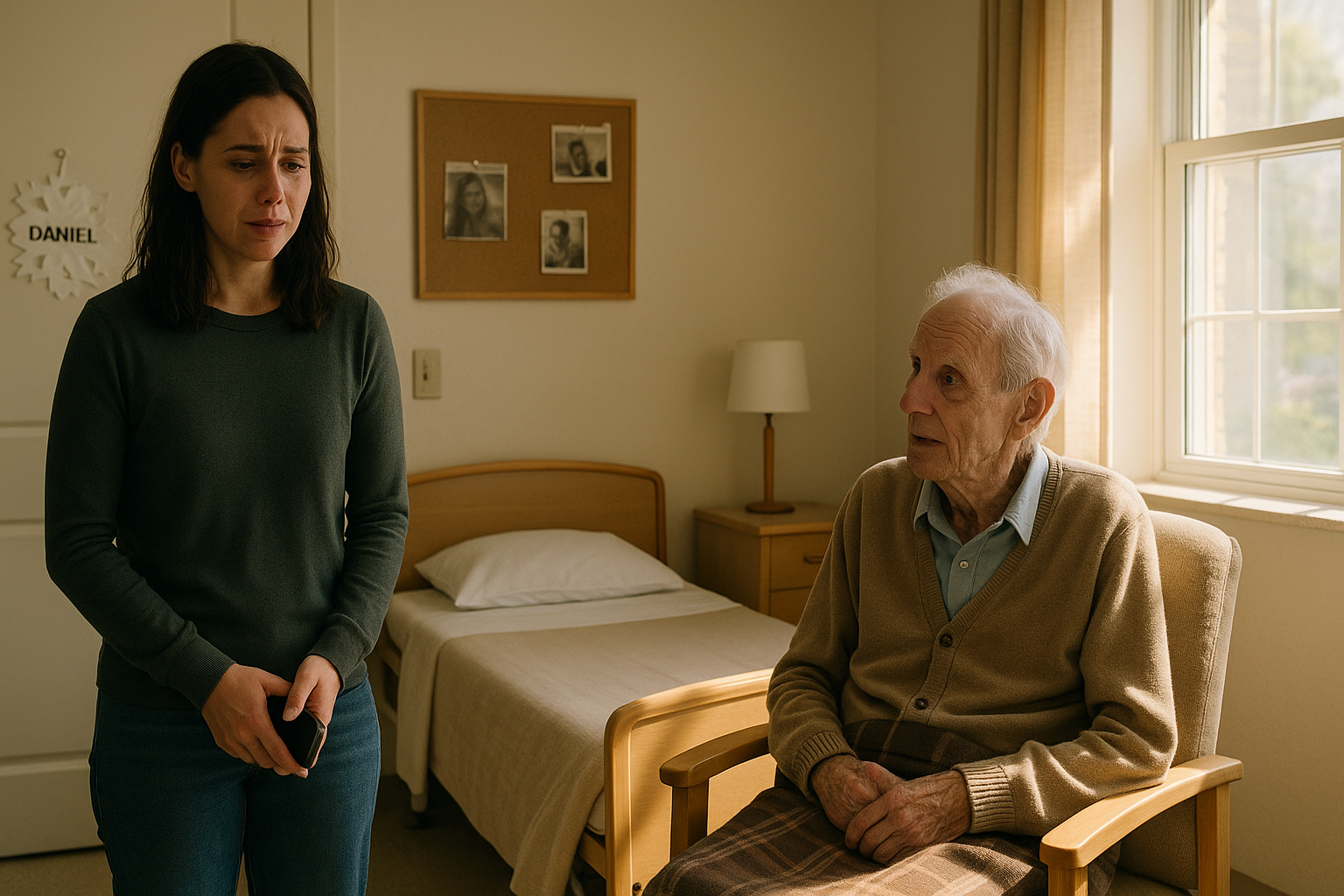
We stopped at a door with a paper snowflake taped to it, though it was already late spring. On the paper someone had written “DANIEL” in shaky blue letters.
She knocked gently and pushed the door open.
A thin man sat in an armchair by the window, his legs covered with a faded plaid blanket. Sunlight poured over his white hair, his hands, the book closed on his lap. He turned his head, squinting, as if the light hurt his eyes.
For a heartbeat I forgot how to breathe.
He had my father’s jawline. The same deep crease between the eyebrows. Even the way his hands curled slightly inward, as if still expecting a cigarette, was identical. But the eyes were a different color, lighter, washed-out blue instead of my father’s dark brown.
“Emily?” he asked, uncertain, as if tasting the name.
I took a step back. “No,” I whispered. “No, you’re not him.”
Sara looked from him to me. “Mr. Carter, your daughter is here to see you.”
He smiled, a slow, trembling movement. “You came back,” he said. Tears gathered in the corners of his eyes. “I knew you would.”
I felt anger rising, hot and confused. “Why did you put my name as his emergency contact?” I demanded, turning to Sara.
“We didn’t,” she said. “He did. When he arrived three years ago. He insisted his daughter’s name was Emily Carter. He had no documents, no address. Just that name. We tried to trace it and found your number. He was so sure.”
My knees almost gave out. Three years ago. That was one year before my real father died.
“I’ve never seen this man before,” I said, my voice flat.
The old man’s smile faltered. His hands trembled. “Em?” he whispered, using the nickname only my father had dared to use. “Don’t be angry. I… I know I forgot things. But I remember you. I remember the blue backpack with stars. You cried when the zipper broke, remember? I fixed it with tape.”
The room tilted. My first backpack had been blue with white stars. I was six. The zipper had broken on the second day of school. Dad had fixed it with silver tape, laughing that it looked like a rocket now.
“How do you know that?” I asked, barely audible.
He relaxed slightly, as if my question was a small mercy. “Because I was there,” he said. “I know I wasn’t… a good father later. I know I left. The woman… she said you’d be better without me. But I kept the picture of you with that backpack. You were missing your front tooth.”
My vision blurred. Somewhere far away, I heard Sara say, “I’ll give you two some time,” and the door clicked shut.
My father—my legal, official father—had never left. He had been there for every school concert, every dentist appointment, every broken heart. He had never mentioned another life, another child.
“Who are you?” I whispered again.
He blinked slowly, as if dragging memories up from thick mud. “I’m your father,” he said, voice breaking. “I’m Daniel. I held you when you were born. You had so much black hair the nurse laughed. I was scared to even change your diaper.”
“My birth certificate says my father is Daniel Carter,” I said mechanically. “Same birthday as you. Same name. But I grew up with him. He never abandoned me. He died two years ago from a stroke.”
The old man stared at me, confusion clouding his features. He pressed his palm to his forehead.
“I had a stroke too,” he muttered. “Here. Before I came. Or after. I don’t… I don’t know. They told me I forgot things. But I remember you. I remember your tiny shoes lined up by the door. Pink with little hearts.”
My breath hitched. My first shoes had been exactly like that. My mother used to joke that I walked like a duck in them.
“How many children do you think you have?” I asked, my voice sharp, desperate.
His eyes flitted to the window. “One,” he said quietly. “Just you. Emily. I left when you were eight. I was a coward. I thought I’d come back one day, when I had more money, when I was better. But time just… it ran away. When I got sick, I kept seeing your face. I told them your name so they would find you. So I could say I’m sorry before I forget you completely.”

I sank into the chair by the bed. My mind was a tangle of dates and faces and documents. Two men with the same name, the same birthday, the same intimate memories of my childhood.
My mother had always avoided talking about my early years. She would smile and say, “You were a difficult baby, but it was worth it,” and then change the subject. When I once asked if Dad was her first husband, she froze for just a second before saying, “Of course,” too quickly.
A terrible thought slid into place.
“What if,” I said slowly, “you are my biological father… and the man who raised me adopted me when you left?”
The old man’s shoulders shook. “Adopted,” he repeated, as if tasting the word for the first time. “He did what I should have done.”
Memories rearranged themselves in my head, scenes I had never questioned: my father signing papers in an office when I was about nine, saying, “Just some boring insurance stuff”; my mother crying in the kitchen on my eighth birthday; the way Dad sometimes looked at me with a love so fierce it almost seemed guilty.
My phone buzzed in my pocket. My mother’s name lit up the screen as if she had felt the disturbance in the air.
I stepped into the hallway to answer. “Mom,” I said without preamble, “did Dad adopt me when I was eight?”
Silence. Then a soft, broken inhale.
“Where are you?” she asked.
“At Maple Grove Nursing Home,” I said. “With a man named Daniel Carter who knows things about my childhood no stranger should know.”
On the other end, my mother began to cry.
“He was your father,” she whispered. “By blood. He left us. He drank, he lost jobs, he… he scared me. When you were eight, he signed away his rights. I married the Daniel you knew a year later. He insisted we keep your name the same so you wouldn’t feel different. He loved you as if you were his own flesh. We promised never to confuse you with the past.”
The hallway spun around me.
“So I had two Daniels,” I said hoarsely. “One who left me, and one who chose me.”
My mother sobbed. “Your real father—by heart—begged me never to tell you. He said the only thing that mattered was that you felt wanted. He died terrified you’d find out and think his love was less real.”
I pressed my free hand against the cold wall. Inside the room, I could see the old man through the glass, hunched in his chair, staring at the door like a forgotten child.
“Why didn’t you tell me he was still alive?” I asked.
“Because last we heard, he disappeared,” she said. “No address, no calls for twenty years. When your father—our Daniel—had his stroke, I almost told you. But I was selfish. I didn’t want anything to stain your memories of him. I thought the other Daniel was gone forever.”
I ended the call gently and stood in the doorway.
He looked up, hope and fear battling in his watery eyes.
“I’m not here to forgive you,” I said honestly, sitting back down. “I don’t even know how to feel yet. The man who raised me is my father. Nothing changes that.”
He nodded, tears sliding down his cheeks.
“But,” I added, my voice softer, “you are the man who gave me life. And you are old. And you are alone. No one deserves to die thinking no one remembers their name.”
He covered his mouth with his hand and sobbed, his frail shoulders shaking. It was an ugly, childlike sound, and it hurt to listen to.
“I don’t deserve this,” he whispered. “I don’t deserve even to see you.”
“Maybe not,” I said. “But I think… the man who raised me would want me to be kind. He always said, ‘We don’t repeat other people’s mistakes.’”
A weak, astonished smile crossed his face. “He sounds like a better man than me.”
“He was,” I replied. “But maybe you can still be something other than the worst thing you ever did. For what time you have left.”
We sat in silence for a long moment, the sunlight warm on our faces.
“Tell me about him,” the old man said suddenly. “The other Daniel. The one who stepped in when I stepped out. I want to hear what a real father looks like.”
So I told him. I told him about science projects at the kitchen table, about long drives with terrible singing, about the night my adoptive father slept in a plastic chair by my hospital bed when I had pneumonia. As I spoke, the man in the chair closed his eyes, not from sleep, but as if he were watching a film of a life that could have been his.
When I left, the nurse asked quietly, “Will you come back?”
I thought of my father’s grave, the fresh flowers I brought every month. I thought of the old man’s trembling hands, the way he said my name like a prayer and an apology.
“Yes,” I said. “I’ll come back.”
Not because he had earned it. Not because blood demanded it. But because somewhere, between the father who left and the father who stayed, there was a girl with a blue backpack who deserved the truth, and an old man in a small room who deserved, at least once before the end, to be called by his real name: Dad, the one who failed—and was still, somehow, forgiven just enough to not die completely alone.