The old man kept slipping notes under the neighbor’s door, asking to borrow a dog he had never even seen.

At first, Emma thought it was some strange joke. She had moved into the small apartment two weeks earlier, along with her eight-year-old son Oliver and their nervous rescue dog, Bella. Life was already heavy: a recent divorce, debts, and a new city where every face was unfamiliar.
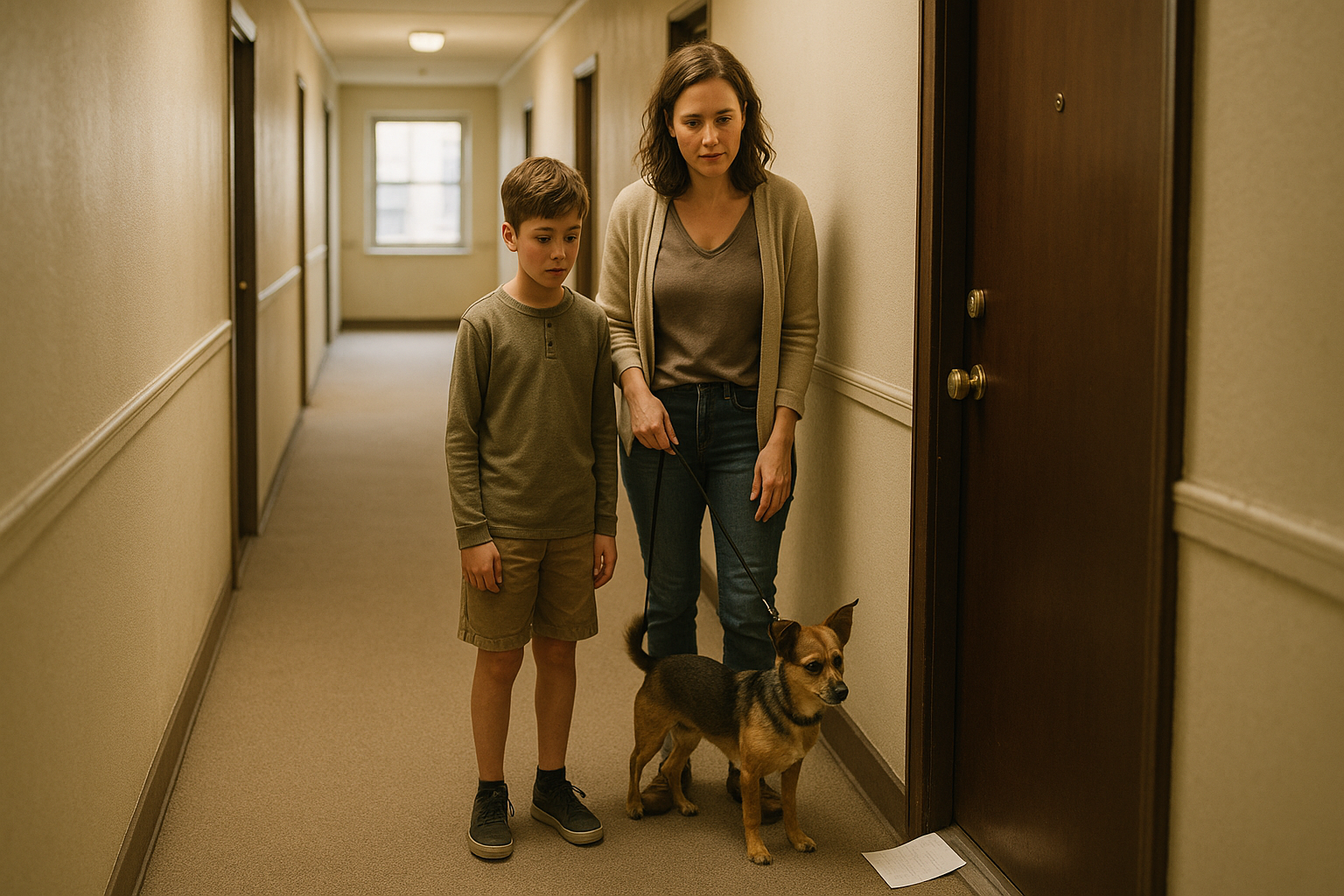
The first note appeared on a thin square of paper, slid halfway under her door. The handwriting trembled.
“Dear neighbor,
I heard you have a dog. Could I borrow him or her for just one hour someday? To walk together in the park. I will be careful. I am not dangerous. – From 3B”
Emma frowned. Who asks to borrow a dog from a stranger? She crumpled the note, then smoothed it back out, guilt prickling. Bella barked at her reflection in the window, as if sensing tension.
That night she asked the building manager about 3B.
“Oh, that’s Mr. Harris,” the manager said. “Lives alone. Quiet. Lost his wife a few years ago. Harmless, just… lonely.”
Lonely. The word landed like a stone in Emma’s chest. Still, Bella was timid, afraid of loud noises and sudden movements. Emma worried about trusting a stranger.
The second note came three days later, written more carefully, as though the writer had taken a long time.
“Dear neighbor in 4B,
I apologize if my first note made you uncomfortable. I love dogs very much. I used to have one, Max. I am old now and my legs hurt, but walking with a dog makes my heart feel lighter. If you say no, I will understand. I just thought… maybe we could walk together instead. – William from 3B”
Oliver found that note on the doormat.
“Mom, who’s William?” he asked.
“A neighbor,” she replied. “He wants to walk Bella.”
Oliver bent down to hug Bella. “Maybe we can all go. Bella likes people who talk softly.”
Emma hesitated. The world had taught her to be careful, to distrust unknown men, unknown stories. But the gentle letters, the shaky handwriting, the way the manager had said lonely…
On Saturday afternoon, she finally wrote back.
“Dear Mr. Harris,
Maybe we can all walk together tomorrow at 4 p.m. – Emma, Oliver, and Bella from 4B.”
When they knocked on the door of 3B the next day, it opened very slowly. A thin man in his late seventies stood there, leaning on a cane. His gray hair was carefully combed, his shirt neatly buttoned despite his trembling hands.
“You must be Emma,” he said, eyes brightening when he saw Bella. “And this is the famous dog.”
Bella, usually wary, sniffed his hand and then—unexpectedly—licked his fingers.
“She likes you,” Oliver said, surprised.
Mr. Harris’s eyes filled instantly with tears. He blinked fast and turned away for a second, pretending to adjust his glasses.
“Shall we?” he asked, voice unsteady.
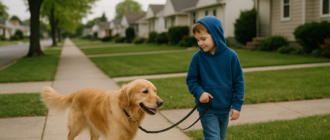
They walked to the small park two blocks away. The sun was soft and warm, the kind of afternoon that made the city look almost gentle. Mr. Harris walked slowly, one hand on his cane, the other holding Bella’s leash like it was something fragile and precious.
He talked more to Bella than to the humans.
“Good girl… You walk just like Max did, you know that?”
“Who was Max?” Oliver asked.
“My dog,” Mr. Harris replied. “He and my wife, Anna, kept me busy for many years. When Anna got sick, Max would lie next to her bed and only move to drink or eat. After she…” He paused. “After she left, it was just me and Max. Then his heart failed last winter. The apartment has been very quiet since.”
Emma’s throat tightened. She watched as Bella leaned her warm body against his leg whenever he stopped to catch his breath.
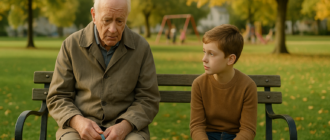
They walked together several times after that. Twice a week, then almost every day. Oliver would race ahead to the swings, and Emma would sit on the bench next to Mr. Harris as Bella lay at his feet, content.
Sometimes he brought old photos: a younger version of himself, smiling with a golden dog; his wife, holding a birthday cake with a sloppy dog paw print in the icing.
“You saved me, you know,” he told Bella one afternoon. “Both of you,” he added, glancing shyly at Emma and Oliver.
The twist came on an icy morning in January.

Emma overslept. No school, no urgent errands. She woke to frantic banging on her door. The building manager stood there, pale.
“Emma, can you come to 3B? It’s Mr. Harris. He asked for you. And the dog.”
Her heart dropped. She grabbed Bella’s leash and hurried down the stairs, Oliver still in his pajamas, running behind her.
Inside 3B, Mr. Harris lay on the couch, wrapped in a blanket. His face looked smaller somehow, swallowed by the pillow. There was an oxygen tank by his side, the tube running to his nose. His hands shook as he tried to sit up when he saw them.
“You came,” he whispered.
Bella jumped lightly onto the edge of the couch, resting her head on his chest. The old man’s hand found her fur and stayed there, unmoving, as if holding on to something slipping away.
“I’m fine,” he lied, catching Emma’s worried look. “Doctor says my heart is just tired. Like an old engine that doesn’t want to stop but knows it must.”
Oliver moved closer, eyes wide. “Are you going to the hospital?”
Mr. Harris studied Oliver’s face for a long moment. “Maybe. Maybe not. But I wanted to ask you something first.”
His gaze shifted to Emma.
“I left a letter with the manager for you,” he said softly. “In case… in case I couldn’t say this myself. But I’ll try. You gave me more than walks, Emma. You and this brave little boy and your sweet Bella… you turned the lights back on in my life. I was going to ask if… when I’m gone, you would take something of mine. Just a small box under my bed. It belongs with someone who understands what it means to feel lonely and still choose kindness.”
Emma shook her head, tears filling her eyes. “Don’t talk like that. We’re here. We can help—call someone—”
He smiled. “You’re already helping.”
The ambulance came an hour later. Bella barked anxiously as they lifted him onto the stretcher. Mr. Harris reached out, fingers brushing Bella’s ear.
“Walk for me today, okay?” he whispered.
He never came back.
A week later, the manager knocked on Emma’s door, eyes red.
“He passed peacefully,” he said. “In his sleep, at the hospital. He asked me again, before he lost consciousness, to make sure you get this.”
The small wooden box from under his bed was heavier than it looked. Emma opened it at her kitchen table with Oliver watching closely. Inside lay a faded collar with a rusted tag, a handful of photos, and a sealed envelope.
She unfolded the letter and read aloud:
“Dear Emma, Oliver, and Bella,
If you are reading this, then I have finally gone to walk Max and Anna somewhere with no stairs and no hospital smell.
Thank you for giving an old man the gift of ordinary days. The sound of paws on the floor, the tug of a leash, a child’s laugh in the park – these were the things I missed the most, and you brought them back.
I know life has not been kind to you lately, Emma. I heard it in your voice when you thought you were only talking about the weather. There is a small envelope under the photos. It is not much, but it is what I have: some savings I kept for ‘emergencies’. Loneliness was my emergency. You answered it.
Now let it answer yours.
Buy Oliver something that makes him feel brave. Buy Bella something that makes her tail wag. And buy yourself a coat that is warm enough for all the winters you will still live through.
Please remember me not as the old man you saw last, but as the one in these photos, laughing with a dog. Grief is heavy, but shared walks make it lighter.
With all my gratitude,
William Harris from 3B”
Emma stared at the second envelope, hands shaking. Inside was a stack of carefully folded bills. More money than she had seen at once in years.
Oliver reached for the faded collar and gently fastened it around Bella’s neck, above her own.
“Now she can walk for Max too,” he whispered.
That evening, they went to the park. The bench where they used to sit with Mr. Harris was empty, the air sharp with winter. Emma sat down slowly, Bella pressed against her leg, Oliver leaning on her shoulder.
“Mom,” Oliver said quietly, “do you think he can see us?”
She looked up at the pale sky and imagined an old man walking beside a golden dog, his steps no longer slow.
“I think,” she replied, voice breaking but sure, “he’s walking with us, every time we come here.”
Bella tugged the leash then, eager to move forward, the old collar glinting faintly in the fading light. And together—woman, child, and dog—they walked the path three times, just as he liked, leaving four sets of invisible footprints on the cold ground: theirs, and the memory of his.
The apartment building still felt small and tired, the debts still waited, the future was still uncertain. But on the door of 4B, there was now a new note, written in careful handwriting and taped where everyone could see:
“If you are lonely and need company for a walk, we live here with a friendly dog. We understand. Just knock. – From 4B”