The woman who came to adopt a puppy and quietly chose my father instead. That’s how our neighbor Maria explains it now, laughing through tears, but that day in the shelter waiting room, nothing about it felt funny to me.

I was 17 and furious. Furious at my father Daniel, who, three months after my mom died, had started talking to the plants and the TV instead of me. Furious that he’d sold Mom’s piano to pay bills without even asking. Furious that the only plan he had for my birthday was “maybe we can bake something, if we have flour.”
So when our old car refused to start and Dad said, “Let’s walk to the shelter instead, you could use the air,” I walked ten steps ahead of him, hands in my pockets, pretending I didn’t know the man shuffling behind me.
We weren’t going for a dog. We were going to give up one.
Buddy had been Mom’s idea. A golden mix with a silly grin, he’d slept on her feet during chemo and followed her from room to room as if he could guard her from the word “terminal.” After she was gone, he’d lie by the front door for hours, waiting. Then Dad lost his second job, the heating bill doubled, and the vet said Buddy needed surgery on his leg. I heard Dad whisper one night, “I can’t even keep the dog she loved,” and that broke something in me I didn’t know could break.
I hated him for giving up. I hated myself for understanding.
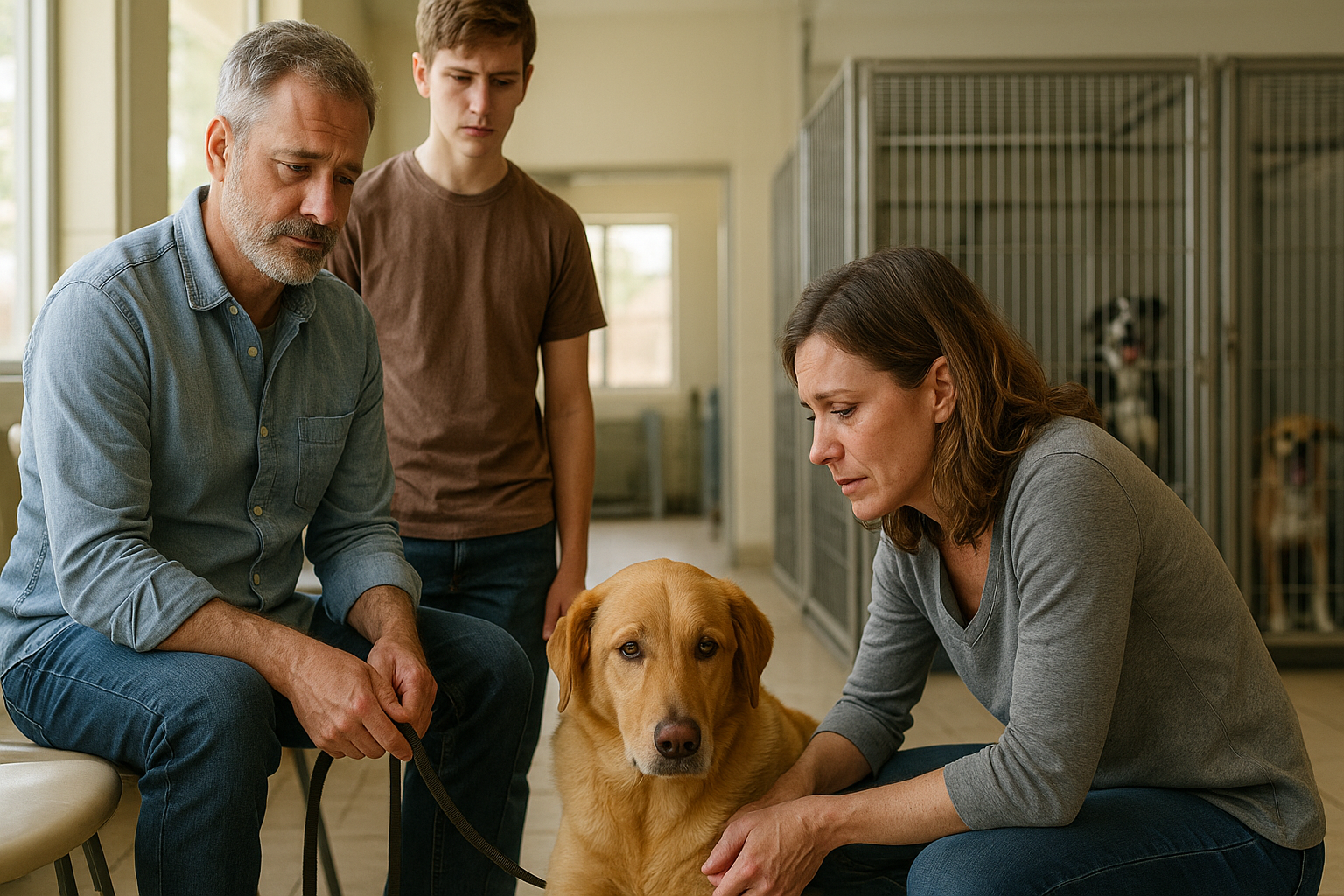
The shelter was louder than I’d imagined. Metal cages, barking, a sour mix of disinfectant and fear. We sat on plastic chairs, Buddy’s leash looped around Dad’s hand like a question mark.
That’s when she entered.
Maria looked like someone who had once slept well and hadn’t in a long time. Late thirties, maybe forty. Ironed blouse, but the cuffs were frayed. Her hands were empty, but her eyes… they scanned the room like she was searching for a very specific face in a crowd of strangers.
She noticed Buddy first. Everyone did; he had that kind of golden that seems to create its own light.
“Is he yours?” she asked, her voice too soft for a place so loud.
“He was my wife’s,” Dad answered, and the past tense hung in the air between us like a bad smell.
Maria crouched down, ignoring the dusty floor, and Buddy pushed his nose into her palm as if they had a secret. She smiled, but it wasn’t a happy smile. It was the kind you make when a memory hurts and comforts you at the same time.
“I came for a small dog,” she said, stroking Buddy’s ear. “My landlord won’t like someone this big.”
“Well,” Dad cleared his throat, “maybe you’ll find the right one today.” His voice cracked on the last word. He looked away, blinking too fast.
The shelter worker called my father’s name. “Intake for Buddy?” she said, not even looking up from her clipboard.
Buddy’s tail thumped once against the chair, then stopped, as if he understood English a little too well.
I stood up, then sat back down. My legs wouldn’t move.
“Actually,” Maria said suddenly, standing up, “could I… could I talk to you both for a second?”
The worker frowned, but nodded and moved on to the next person.
Maria took a breath, held it, and let it out slowly. “My son Luca would have loved him,” she said. “He begged for a dog every birthday. I kept saying, ‘When we move, when the time is right.’” Her lips trembled; she pressed them together like a child refusing to cry. “We never got to that ‘when.’”
The room blurred around us. Somewhere a dog barked, high and panicked.
“My husband left last year. Luca was sixteen when he…” She didn’t finish. She didn’t need to. The way her hand clutched the strap of her bag told the rest.
Dad nodded slowly, his fingers tightening around Buddy’s leash. “Our Emma was forty-two,” he said. “Cancer. Six months from diagnosis to goodbye.”
They looked at each other, two strangers whose grief recognized itself.
I wanted to shout, to run, to grab Buddy and drag him home. Instead I sat there, feeling like the youngest person in a world built for broken adults.
“I can’t have children anymore,” Maria whispered. “I can’t go home to that silence. I thought… a small dog. Something I can manage.” She glanced at Buddy. “But I see him with you, and I think maybe he doesn’t need another broken person.”
Dad let out a sound that wasn’t quite a laugh. “I don’t think he’s noticed I’m broken,” he said. “He still brings me his ball like I’m worth playing with.”
There it was—the twist, the knife turning in my chest. Buddy wasn’t just Mom’s dog. He was the last creature on earth still treating my father like he was more than his failures.

“Why are you giving him up?” Maria asked gently.
“Money,” Dad said, not dressing it up. “His surgery. The food. The vet. I sold everything I could. It’s not enough. He deserves better than watching me count coins for kibble.”
Maria’s eyes filled. “Do you think,” she said slowly, “if I helped… it could be different?”
I frowned. “Helped how?”
She turned to me for the first time, really seeing me. “I work at a bakery,” she said. “Mornings. There’s always food left over. I’ve been giving it to the shelter. And I have some savings that were… supposed to be for Luca’s driving lessons. He won’t need them now.” Her voice cracked; she swallowed hard. “Maybe they can help a dog instead. And maybe a family.”
Dad shook his head immediately. “I can’t take—”
“This isn’t charity,” she cut in, surprising all three of us. “This is me trying to breathe again without hearing an empty room echo back. Let me help you keep him. And maybe sometimes I can come by and… take him for a walk? Just to hear his paws on the pavement.”
I stared at her. This woman had walked into the shelter to adopt a dog and was now offering to partially adopt our problems instead.
“That’s insane,” I said, because it was.
“I know,” she replied quietly. “But so is giving up the only living things that still love us without asking questions.” She looked from me to Dad. “You think I’m doing this for you. I’m not. I’m doing it for me. And maybe for them.” Her eyes flicked upward, as if Mom and Luca were sharing some invisible balcony.
The shelter worker came back, impatient. “Are we doing this intake or not?”
Dad looked at Buddy, at Maria, at me. His shoulders sank, the way they did when he accepted one more small defeat. “I can’t take your money,” he whispered.
I stood up, my chair screeching on the tile. “Then take mine,” I blurted.
They both stared.
“I’ve been saving,” I said, words tumbling over each other. “From tutoring, and from that job at the grocery store last summer. It’s not much, but it’s something. And if Maria wants to help, then we’re not just taking. We’re… trading silence for barking.”
Dad opened his mouth, closed it again. For the first time in months, I saw tears in his eyes that weren’t only about Mom. They were about me. About the fact that I still, somehow, believed in us.
“We’ll make a plan,” Maria said quickly, as if afraid we’d change our minds. “I’ll talk to the vet. Maybe they’ll let you pay in parts. I’ll bring food. You let me visit Buddy sometimes. We’ll all pretend we’re less alone than we are.”
The shelter worker sighed. “So… no intake?”
“No intake,” Dad said firmly.
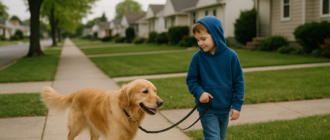
On the walk home, we walked side by side. Buddy trotted between us, leash in my hand for the first time in weeks. Maria walked on Dad’s other side, her fingers brushing Buddy’s fur now and then, like she was checking if he was really there.
“Your mom would have loved him,” Maria said softly.
“She already did,” I replied. “Maybe she sent you to make sure we don’t mess this up.”
Maria smiled through the tears she didn’t bother to hide. “If she did, I hope Luca’s with her, complaining that he still didn’t get his dog.”
Dad looked up at the gray sky, his mouth moving in a silent thank you to someone only he could see.
That evening, for the first time since the funeral, our table was too crowded. A stranger sat where Mom used to sit, laughing at Dad’s terrible jokes, crying when he accidentally said “we” instead of “I.” Buddy slept under the table, one paw resting on Maria’s shoe, the other on my father’s.
Maria had come to the shelter to rescue a dog. Instead, without quite meaning to, she’d rescued the man who was losing his family, and a boy who’d been angry at grief when what he really felt was fear.
And in a city full of people who looked away from each other, three broken hearts and one golden dog decided, quietly and clumsily, to be a family no one had planned for—but desperately needed.