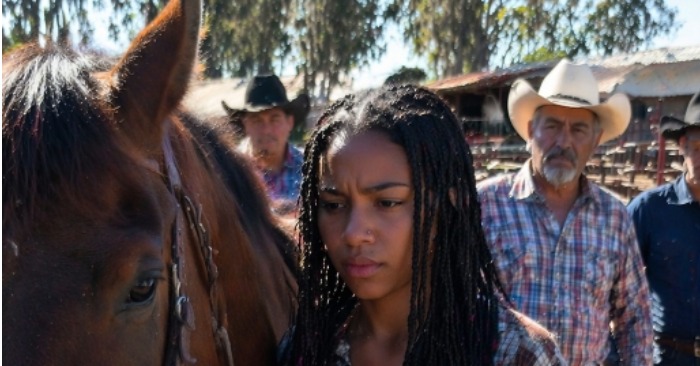
The sun scorched the parched earth of Valle de las Piedras, a tiny Mexican village in the heart of Jalisco, where the heat was suffocating and not even tequila could quench the thirst for justice. In that hidden corner of the world, the laws were not set by the mayor, but by Don Alejandro Villalobos. Seventy-two-year-old Don Alejandro was the master of the “La Herradura” hacienda, boasting more than 3,000 dairy and beef cattle, along with agave plantations stretching all the way to the horizon. He always wore a 5,000-peso Texas hat and crocodile-skin boots, and his hard stare forced every laborer to lower their eyes. To him, Mexican society was divided into two kinds of people: those born to rule and those born to serve.
Everything turned upside down that afternoon when Don Alejandro brought home Relámpago—Lightning—a black thoroughbred stallion he had paid 200,000 pesos for at an exclusive auction in Monterrey. The animal arrived in an air-conditioned horse trailer, accompanied by a veterinarian. Alejandro swore that this horse would become the jewel of Jalisco, win every charro festival, and grow into the most sought-after breeding stallion in Mexico. But Relámpago had very different plans. From the very first day, the horse showed uncontrollable fury. He kicked the heavy wooden fences until they splintered to pieces, bit at anyone who came near, and reared onto his hind legs with terrifying violence. In his dark eyes burned a deep rage, an ancient kind of hatred toward every human being who tried to force him into submission.
Driven by macho pride, Alejandro hired the three best horse trainers in the country. The first, a seasoned charro from Zacatecas, left after twenty seconds with a dislocated shoulder. The second lasted thirty seconds before taking a kick that sent him straight to the hospital. Every failed attempt struck Alejandro’s ego like a direct blow. In the village cantina and on the main square, the mockery grew louder. “The big boss threw away 200,000 pesos on a demon that’s only good for eating feed,” the ranchers whispered. Unable to endure the humiliation, Alejandro had dozens of posters printed and pasted around the village: “Open Challenge. 50,000 pesos cash to the brave soul who can tame Relámpago and ride him for two laps around the ring.” In a town where many families survived on less than twice the minimum wage, 50,000 pesos was an unimaginable fortune.
The news spread like wildfire to the edge of the village, to a miserable little farm of barely three hectares where twenty-two-year-old Ximena lived with her sick father, sixty-eight-year-old Don Mateo. The family’s situation was desperate. Mateo owed exactly 50,000 pesos to Don Alejandro’s store for the medicines they had used five years earlier in a failed attempt to save Ximena’s mother’s life. That same day, Alejandro’s foreman had left them a cruel ultimatum: if the debt was not paid within forty-eight hours, their small farm would be taken away and they would be thrown into the street.
Ximena was not a charro in the traditional sense. Since the age of seven, she had possessed an inexplicable gift for connecting with animals. Her only companion was Estrellita, an old, underfed mare no one else wanted, but who would walk obediently beside Ximena without a bridle, guided only by whispers. When the girl heard about the challenge, she immediately felt it was the only way to preserve her mother’s memory and save her father’s life. “That horse isn’t evil, Papa,” she told him that night in the kitchen with the leaking roof. “He’s just an animal that was hurt until he forgot how to trust. I won’t use force. I’ll go in there and talk to him.” Mateo wept in terror at the thought of losing his only daughter to a five-hundred-kilo beast, but hopelessness had cornered them.
By Saturday dawn, the whole village had gathered in the bullring of La Herradura. Banda music played, and the smells of roasted meat and mezcal drifted through the air. In the center, Relámpago snorted, drenched in sweat and fury. Fifteen of the toughest men in the region, armed with silver spurs and thick ropes, had tried to ride him. All fifteen ended up flat on the ground, some with broken bones, humiliated before the crowd of hundreds. When the announcer asked whether there was one final challenger, a funeral-like silence fell over the arena. That was when Ximena stepped up to the registration table, wearing her father’s faded plaid shirt, with a small piece of piloncillo—raw cane sugar—in her trouser pocket.
Ramiro the foreman, Alejandro’s trusted man, burst into sharp, mocking laughter. “Go home and wash dishes, little girl! This ring is for men, not for girls who play with ponies!” he shouted, drawing laughter from the crowd of more than five hundred people. Don Alejandro stepped closer, looked her over with contempt, and coldly warned her that if she died in there, he would not pay for her funeral. With clenched fists and a heart pounding wildly, Ximena ignored the ridicule. She picked up a thin rope—without saddle or spurs—and opened the heavy iron gate. A deep silence fell over the scene. Relámpago spun around instantly, his bloodshot eyes fixed on the fragile figure of the twenty-two-year-old girl, lowered his head, and pawed at the ground, preparing to attack her with all his deadly strength. No one could believe what happened next…
The air inside the ring became so dense it was almost impossible to breathe. Ximena took one step forward, then froze completely about ten meters from the five-hundred-kilo beast. She did not raise her arm, did not shake the rope, did not make a single threatening sound. She simply kept her gaze lowered to the dust of the arena, letting the rope hang harmlessly at her side. Her posture was small, humble, stripped of all the ego and arrogance the previous fifteen men had brought into the ring. Relámpago, who had already begun his brutal charge, stopped short and skidded across the dry ground. His ears, pinned back moments earlier in a sign of deadly attack, slowly lifted. He was confused. This small human did not smell of fear or aggressive adrenaline; she smelled of damp earth and calm.
For three endless minutes, neither of them moved. The crowd began whispering impatiently. From beside the fence, Ramiro shouted, “Get on him already or go home and cry!” But Ximena paid no attention to the men; she was completely attuned to the horse’s every movement. She heard the animal’s rapid breathing, the wild pounding of his heart inside that massive chest. She knew that Relámpago was not a monster, but a prisoner of war. Slowly, she slipped her trembling hand into her pocket and pulled out the dark piece of piloncillo. With an open palm, she stretched out her arm. The sweet scent of cane sugar drifted through the hot wind of Jalisco.
Relámpago took one hesitant step. Then another. When he was less than a meter away, the horse let out a massive snort, as if one last wave of distrust had washed over him, but Ximena did not retreat. She anchored her feet into the earth like roots reaching deep below the ground. At last, the stallion’s black velvet nose touched her palm. As the animal chewed the piloncillo, Ximena slowly raised her other hand and gently stroked the thoroughbred’s powerful neck.
At that exact moment, as her fingers slipped into the dark mane, Ximena’s eyes widened. Beneath the thick black hair, her hand felt the texture of horrible scars. These were not wounds caused by barbed wire in the pasture; they were fresh marks, precise and cruel cross-shaped cuts that could only have been made by one thing—a modified riding whip fitted with blades. A chill ran down her spine. She knew that mark. Everyone in the valley knew it. It was the punishment “signature” of Ramiro, Don Alejandro’s foreman, who used it to “break the spirit” of rebellious mules.
A rage rose in Ximena’s throat, a fury far older and deeper than fear. Suddenly, everything made sense. Relámpago had not arrived from Monterrey insane. He had been secretly tortured at night in the stables of La Herradura by the very same men who pretended by day that they were unable to ride him, all so they could make a fool of Don Alejandro and pocket extra wages for the so-called “training attempts.”
Tears in her eyes, but with a firmness that startled everyone, Ximena gently slipped the rope around the horse’s neck, making a simple loop. She pressed her face to the animal’s head, breathing in rhythm with him, sharing in his pain. “Easy now, my boy. No one will ever hurt you again,” she whispered. Then, without using spurs or a saddle, she grabbed a handful of his mane and, with a swift movement fueled by pure trust, leaped onto Relámpago’s bare back.
Hundreds of people held their breath at once. They expected an explosion. They thought the body of the twenty-two-year-old girl would be hurled into the air and smashed against the wood. Relámpago tensed the muscles of his hindquarters, the memory of pain urging him to shatter his rider with violent bucking. But Ximena did the exact opposite of what a traditional charro would do: instead of squeezing with her legs and yanking at his neck, she completely relaxed her body. She melted into him. Leaning forward, she buried her face in the horse’s neck. In answer to the absence of violence, the animal released such a long sigh that it stirred the dust on the ground. His muscles loosened entirely.
With a gentle pressure of her knee, Ximena encouraged him to walk. And Relámpago moved. The uncontrollable 200,000-peso stallion, the beast who had previously sent men to the hospital, now began trotting around the ring with majestic grace and elegance. He completed one full lap. Then another. The silence over the square was absolute, almost sacred. The women were crying, the men lifted their hats in disbelief. They were witnessing a miracle. Ximena stopped the horse precisely in the middle of the arena and softly slid back down to the ground.
The crowd erupted into deafening cheers. The bleachers trembled under the storm of applause. But the real storm came afterward.
Don Alejandro stepped down from his wooden platform, pale, holding bundles of banknotes totaling 50,000 pesos. With his macho pride wounded, yet keeping his word, he approached Ximena. “You did it, girl. You shut my mouth in front of all Jalisco. Here is your money,” he said, extending the cash to her.
But Ximena did not take the money right away. In her eyes, once humble, now burned the fire of justice. She looked at Alejandro, then pointed at Ramiro, who stood leaning against the fence, his face twisted in shock.
“I’ll accept the money, Don Alejandro, because my family needs it,” Ximena said in a voice that echoed across the whole ring, since the overwhelmed announcer had pushed the microphone stand toward the scene. “But you need to know the truth about why this animal was so impossible to handle. Relámpago is not a savage horse. He is a survivor.”
Ximena ran her hand through the horse’s mane, then suddenly lifted it, revealing the cruel cross-shaped scars on the animal’s skin before the horrified gaze of the owner and the hundreds of spectators. “These wounds were not made by nature. They were carved in with blades. A horse never forgets blood, sir. And these marks… all of Valle de las Piedras knows whose they are.”
The eyes of five hundred people turned like knives toward Ramiro. The foreman went pale, stepped back, and began stammering excuses. Alejandro, a man who could be many things but had never tolerated betrayal or cowardice among his own ranks, felt his blood begin to boil. In a single moment, he understood the conspiracy: his own men had been secretly torturing the animal, deliberately provoking his rage so the outside trainers would fail, allowing them to maintain their monopoly of fear over the estate. His own men had humiliated and robbed him for weeks.
“Ramiro!” Don Alejandro roared with such force the ground seemed to tremble. The foreman tried to flee, but three ranch hands—outraged by the cruelty and emboldened by the girl’s revelation—grabbed his arms and threw him into the dust. “You’re fired. You have one hour to get off my land before I hand you over to the rural police for theft and animal abuse,” declared the magnate, his face red with fury and shame.
Then Alejandro turned to Ximena. The most powerful man in the region, who had never bowed his head to anyone, slowly removed his 5,000-peso hat and pressed it to his chest. Before the hundreds recording on their phones, the great landowner admitted his defeat.
“Today, a twenty-two-year-old girl gave me the greatest lesson in humility I have learned in all my seventy-two years,” Alejandro said, his voice breaking with an emotion he had never shown before. “I was blind and arrogant, and I allowed cruelty to rule in my house. I judged you because you are a woman, and because you are poor. I ask your forgiveness, Ximena.”
Alejandro took the girl’s dirty, calloused hand and placed the 50,000 pesos into it. “This money pays off your father’s debts. Your farm is yours forever. But I want to offer you something more. I want you to become the stable master of La Herradura. You and Don Mateo will receive a new house, health insurance, and a decent salary. Because you have proven that greatness is not measured by the brute force used to break a living creature, but by the heart that is capable of healing.”
In the distance, at the entrance to the arena, Don Mateo dropped to his knees and wept uncontrollably. Tears streamed down his weathered face as he clutched his old hat. His little girl had not only saved both of their lives; she had restored her family’s honor and brought the most feared man in Jalisco to his knees, all by using nothing more than the power of empathy.
That Saturday was burned forever into the history of Valle de las Piedras. Ximena accepted the job. Relámpago was never again locked inside a trailer, and never again felt the lash of a whip. He became her protective shadow, following her without a bridle through the agave fields. The macho culture of the region suffered a fracture from which it never recovered, because everyone learned the lesson the hard way: brute force may force bodies to their knees, but only compassion and sincere respect can ever conquer a soul.