The old man from apartment 12B kept knocking on our door and calling my son by the wrong name, until the day my boy disappeared and I realized who he was really looking for.

The first time it happened, I was annoyed more than anything. It was a rainy Tuesday, groceries in my hands, my eight-year-old son Daniel doing his best to step in every puddle in the hallway. We reached our door, and there he was, thin as a stick, leaning on a cane, white hair like forgotten snow — Mr. Harris from 12B.
He peered at Daniel, eyes suddenly bright. “Ethan,” he whispered, voice trembling. “You came back.”
“His name is Daniel,” I corrected, forcing a polite smile. “We’re your new neighbors. We moved in last week.”
The light in his eyes flickered, then dimmed. He blinked, confused, as if the hallway had changed around him. “New neighbors,” he repeated, almost to himself. Then he shuffled away, mumbling.
I shrugged it off as dementia. The building manager had warned me: “He’s harmless, just lonely. Talks about his son a lot.” Still, something in the way his fingers trembled around the handle of his cane stayed with me longer than I liked.
Over the next weeks, it became routine. Almost every evening, a soft knock. I’d open the door and find him standing there, eyes searching.
“Ethan, I saved your favorite cookies,” he’d say, holding out a tin with shaking hands.
“I’m Daniel,” my son would answer, shy but gentle. “Thank you, sir.”
Sometimes Mr. Harris would remember. He’d frown, apologize, call himself a silly old man. Other times, he’d talk to Daniel as if he really was Ethan — about fishing trips, about a blue bicycle, about a birthday party with balloons on the roof of some long-gone house.
I tried to keep some distance. I was a single mother, working late, exhausted. I didn’t want my son getting attached to someone whose mind was slipping away.
But Daniel liked him.
“He’s sad, Mom,” my boy told me one night, hugging his pillow. “He keeps looking at me like he’s scared I’ll disappear.”
I promised myself I’d speak to the manager, maybe arrange some help for Mr. Harris. But promises are easy to make when you’re tired and the world feels like it will wait for you.
It didn’t.
The day everything changed was bright and ordinary. Saturday morning, sunlight on the kitchen table, cartoons humming in the background. I was folding laundry when I realized the apartment was too quiet.
“Daniel?” I called.
No answer.
I checked his room, the bathroom, the tiny balcony. Empty. My chest tightened.
“Daniel!” Louder now, panic rising. I rushed into the hallway, heart pounding.
The door of 12B was slightly open.
For a second, I couldn’t move. Then I pushed it gently. “Mr. Harris?” My voice cracked. “Is Daniel here?”
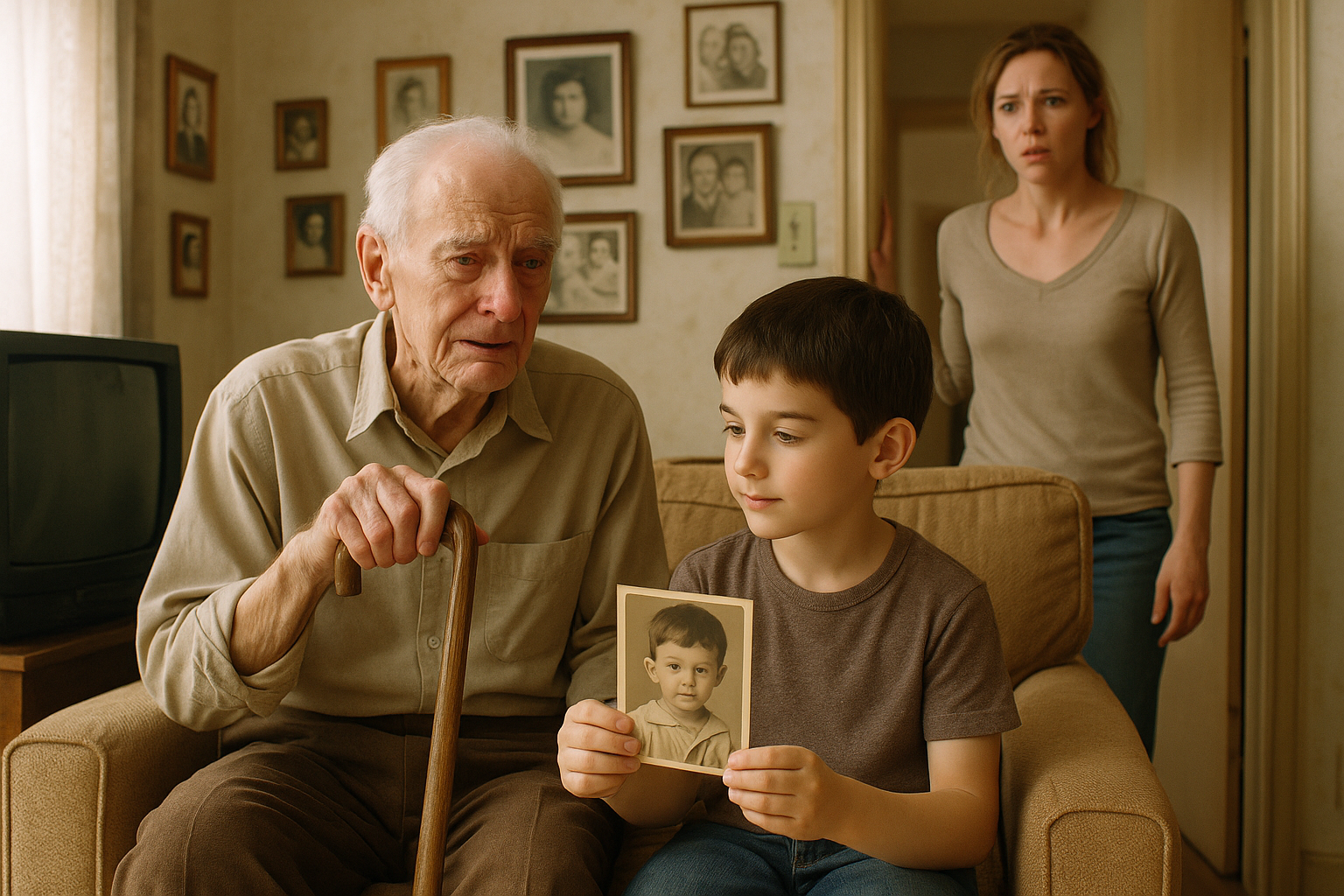
The smell hit me first — dust, stale air, something old and forgotten. The apartment was dim but clean, little framed photos covering the walls. And on the worn-out sofa, side by side, sat Mr. Harris and my son.
Daniel was holding a photo in his hands. In it, a boy about his age, dark hair, bright eyes, stood next to a younger, stronger version of Mr. Harris, both smiling with their arms raised like champions.
“Mom,” Daniel said softly, turning to me, “this is Ethan. He looks like me.”
My knees almost gave out with relief and anger and something else I couldn’t name.
“You can’t just take my son,” I snapped, voice shaking. “You scared me to death.”
Mr. Harris flinched, eyes filling with tears. “I… I didn’t take him,” he stammered. “He knocked. He said he wanted to see the photos. I thought… I thought…”
He looked at Daniel like a drowning man looks at air. “For a moment, I thought he really was Ethan. The way he laughs… the way he scrunches his nose…” His voice broke.

I wanted to stay angry. I really did. But then Daniel tugged my sleeve.
“Mom, can we stay a little?” he whispered. “Please? He’s really lonely. And… I think he misses Ethan a lot.”
I glanced around the room. Every surface carried a memory: Ethan as a baby, Ethan with missing front teeth, Ethan in a school uniform. Then the photos stopped suddenly around the age of twelve.
“Where is he now?” I heard myself ask.
Mr. Harris stared at his hands. “He went out on his bike one afternoon,” he said quietly. “I told him to be careful. He said, ‘I’ll be right back, Dad.’” His lips trembled around the word “Dad” as if it hurt to say it. “There was a truck… wet road… they said he didn’t feel anything. That was twenty-five years ago.”
Silence settled, heavy and fragile.
“Since then,” he whispered, “sometimes I hear a knock and I think… maybe this time he came back. I know it’s not real. I know. But when your mind gets old, it starts making bargains with your heart.”
My anger dissolved into something that felt like guilt.
We stayed that day. Daniel listened to stories about Ethan’s love for rockets, his fear of thunderstorms, the time he’d painted the dog blue. I listened too, and somewhere between the second and third story, I realized that this wasn’t just about an old man confusing faces.
It was about a father who never got to say goodbye properly.
From then on, I made a rule: Daniel could visit, but only if I was there. We brought cookies and board games. Sometimes we just sat and listened. Daniel would ask questions about Ethan, and Mr. Harris’s eyes would light up with a mixture of joy and unbearable sorrow.
One day, as we were leaving, Mr. Harris stopped me at the door.
“You know,” he said, his voice steadier than usual, “I don’t think he’s Ethan anymore. I know your boy is Daniel. It’s just… when I hear him laugh in the hallway, for a second, it’s like time gives me my son back.”
He hesitated. “Thank you for letting an old man borrow that sound once in a while.”
Weeks turned into months. Daniel drew a picture of three people on a park bench — “Me, you, and Mr. Harris” — and stuck it on our fridge. I started stopping by with soup or a bag of groceries, pretending it was nothing.
Then, one quiet morning, there was no knock.
The building manager found him in his armchair, a faded photo of Ethan in his hand. The TV was on, volume low, like he’d just closed his eyes for a moment.
At the small funeral, only a handful of people came. A nurse from the clinic. The manager. An old neighbor. And us. Daniel stood very straight, clutching a single white flower.
That night, back in our apartment, my son climbed into my bed.
“Mom,” he whispered into the dark, “do you think Ethan met him when he… you know… got there?”
My throat tightened. I wrapped an arm around him.
“I hope so,” I said. “I really, really hope so.”
A few days later, the manager slipped an envelope under our door. Inside was a small photo of Ethan and Mr. Harris, smiling in front of a lake, and a note in shaky handwriting:
“To Daniel and his mom. Thank you for letting me be a father again, even just for a little while. — Arthur Harris”
I sat at the kitchen table, the paper blurring through my tears, while Daniel traced the letters with his finger.
“Mom,” he said quietly, “I think he finally remembered who he was really looking for.”
And for the first time, I understood that sometimes the people who knock on our doors, even the ones who scare us or annoy us, are really just trying to find their way back to someone they lost long ago.
We pinned the photo to our fridge, next to Daniel’s drawing. Two boys in different times, two fathers in different worlds, and a thin, fragile thread of kindness stretching between them — long enough, somehow, to bring a lost goodbye home.