The old man kept sitting every day on the same bench with a faded blue leash in his hands, and one morning a little boy finally dared to ask where the dog was.

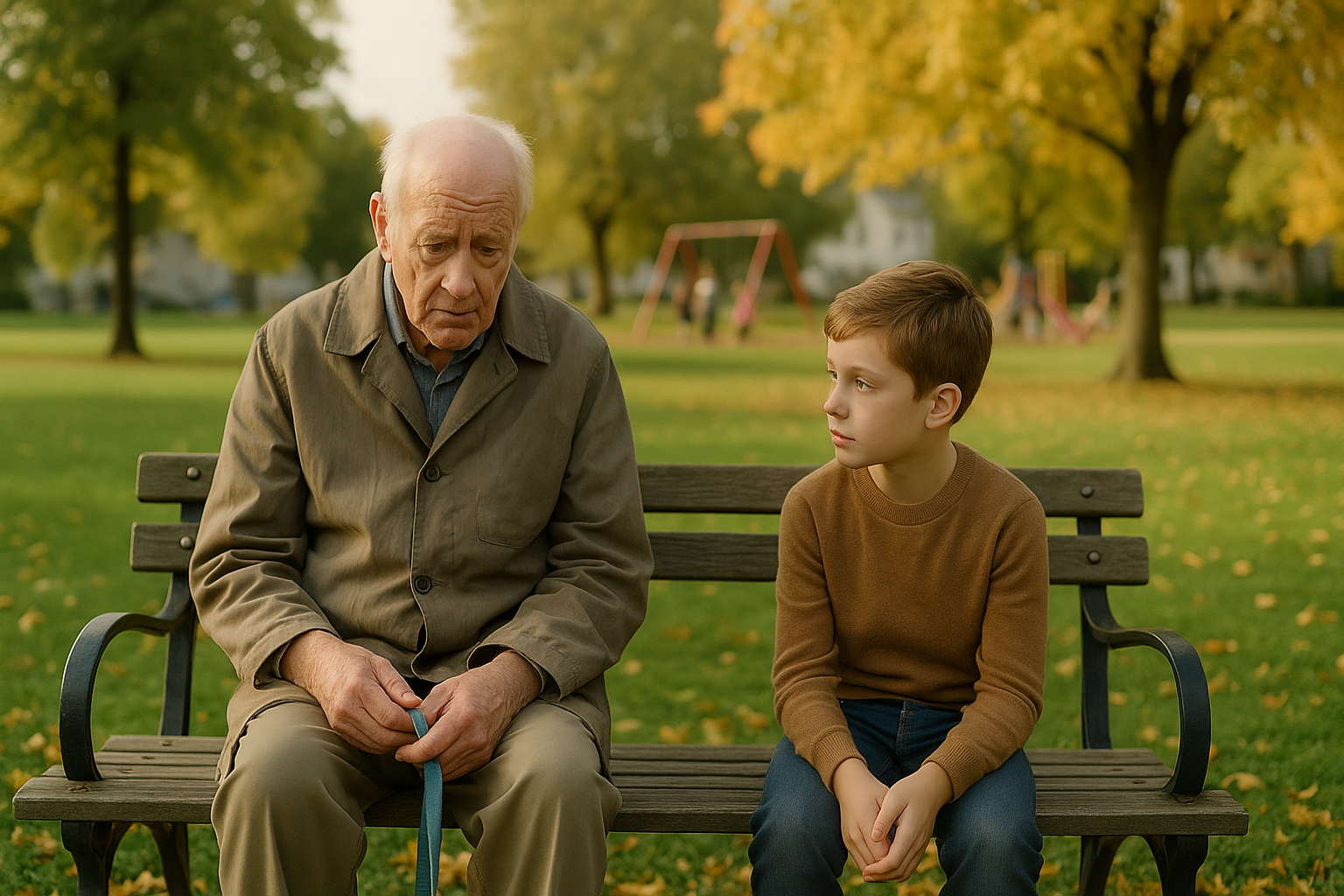
It was early autumn in a small town park. The grass was still green, but the first yellow leaves were already gathering under the benches. People passed by the old man without really seeing him: he was just another lonely figure in a wrinkled grey coat. Only the leash in his hands caught the eye: carefully wrapped around his fingers, metal clip polished from constant touch.
The boy’s name was Leo. He came to the park with his mother every afternoon. He loved dogs and always watched them from afar, too shy to ask strangers if he could pet them. But this old man never had a dog, only the leash. Leo had been watching him for a week.
On the eighth day, curiosity became stronger than shyness.
Leo slipped away from his mother, who was busy on her phone, and slowly approached the bench. The old man was staring somewhere above the trees, as if listening to something only he could hear.
“Sir?” Leo said quietly.
The old man twitched slightly and looked down. His eyes were pale, washed-out blue, but very attentive. Leo suddenly felt like he had stepped into something important, like a quiet room where someone was praying.
“Yes?” the old man asked.
Leo pointed at the leash.
“Where’s your dog?”
The question hung in the air. The old man’s fingers tightened around the leather. For a moment Leo thought he had made a terrible mistake.
“She’s… resting,” the old man said slowly. “Her name was Daisy.”
“Was?” Leo repeated, not yet fully understanding.
The old man smiled, but the smile barely touched his lips.
“She was my best friend for fourteen years. Longer than some marriages last.”
Leo carefully sat down at the very edge of the bench. He didn’t know what to say, but he had a feeling he shouldn’t just walk away now.
“Where is she resting?” he asked after a pause.
The old man looked toward the far corner of the park, where a few old trees stood close together.
“Over there, under that big oak,” he answered. “We used to sit there every day. When she got very tired, I brought her blanket and stayed with her until the very end.”
Leo imagined a dog lying under a tree, breathing slowly. His chest tightened strangely.
“So why do you still hold the leash?” he blurted out.
The old man looked at the leather strap again, as if seeing it for the first time that day.
“Because my hands don’t know what to do without it,” he said quietly. “For fourteen years, every morning, I took this leash, and Daisy pulled me out of the house. After my wife died, Daisy was the only one who forced me to go outside. Now… if I leave the leash at home, I’m afraid I won’t go anywhere at all.”
Leo swallowed. He thought of his grandmother, who had died last year, and how his mother sometimes sat at the kitchen table, staring at her empty chair.
“My grandma died,” Leo said suddenly, almost apologetically.
The old man turned to him.
“I’m sorry,” he said. “It hurts, doesn’t it?”
Leo nodded, biting his lip.
“My mom cries in the bathroom,” he whispered. “She thinks I don’t hear.”
The old man sighed, a long, tired breath.
“Adults often hide their tears from children,” he said. “We think we’re protecting you. But really, we’re just afraid to admit how lonely we feel.”
They sat in silence for a while. Children were laughing near the playground, a bicycle bell rang somewhere, a dog barked joyfully in the distance.
“Did she suffer?” Leo asked suddenly. “Daisy?”
The old man’s jaw tightened. His next words came out slowly, as if he had to push each one through a narrow doorway.
“The last night was hard,” he said. “She couldn’t stand up. I slept on the floor next to her. I kept my hand on her chest to feel her breathing. At dawn she looked at me… it was like she was asking if it was okay to go. I told her I would be fine.”
He paused, and his voice broke for the first time.
“I lied,” he whispered. “I have not been fine. Not for a single day.”
Leo’s small fingers moved nervously on his knees. He wanted to do something, anything, but he didn’t know how to comfort an old man with a broken voice.
Then, in a halting, childlike impulse, he asked:
“Can I… hold the leash?”
The old man looked surprised. For a moment he didn’t move. Then, very carefully, as if handing over something made of glass, he placed the folded leash into Leo’s hands.
The leather was warm. Leo felt the weight of the metal clip and suddenly imagined Daisy: soft ears, bright eyes, a tail that wagged so hard it shook her whole body.
And then the twist cut through the quiet afternoon like glass breaking.

“Grandpa?” came a sharp voice from behind them.
Leo turned around. A woman in her thirties stood on the path, holding a small paper bag from the pharmacy. She looked tired and angry. Her name, as Leo would soon learn, was Emma.
“What are you doing here again?” she demanded, walking up to them. “Dad, we talked about this. You can’t keep coming here every day, waiting for that dog. Daisy is gone.”
The old man flinched as if slapped. Leo’s fingers reflexively tightened around the leash.
“I know she’s gone,” the old man said quietly.
“No, you don’t,” Emma snapped. “Yesterday you told the nurse you had to go out because Daisy was waiting. You forgot you were in the clinic. Do you remember that?”
Leo stared at the old man in confusion. The words “clinic” and “forgot” swirled in his head.
Emma finally noticed the boy.
“Where’s your mother?” she asked sharply.
Leo pointed mutely to the playground, where his mom was already looking around, searching for him.
Emma sighed, then turned back to her father.
“Dad, you can’t just sit here with that leash all day,” she said, but her voice softened. “You missed your pills again. The doctor said your memory will only get worse if you keep skipping them.”
The old man’s shoulders sagged. He looked at Emma with the same lost expression he had worn when he stared above the trees.
“I remember Daisy,” he said stubbornly. “I remember her better than anything.”
Emma pressed her lips together. For a moment her anger cracked, and Leo saw fear underneath.
“I know,” she whispered. “That’s what scares me. You remember the dog… but sometimes you forget my name.”
The words hung in the air like cold mist. Leo felt something twist painfully inside his chest. He had thought the saddest thing was losing a dog. Now he realized there was something worse: when people you love start slowly disappearing while still sitting right beside you.
Emma reached for the leash, but Leo clutched it tighter.
“Please,” he blurted out. “Can he stay a little longer?”
Emma looked at him in surprise. Leo’s eyes were wet, his cheeks flushed.
“He was telling me about Daisy,” Leo said. “And about my grandma. I mean… not my grandma, but… it helped.”
Emma’s gaze softened. She looked at her father, who sat hunched, his empty hands trembling slightly, and then at the boy, who held the leash like a treasure.
“Ten minutes,” she said quietly. “Then I’ll walk him home.”
She stepped back and sat on a nearby bench, watching them.
Leo carefully returned the leash to the old man.
“Maybe…” Leo said hesitantly, “maybe tomorrow I can come again. And you can tell me more about Daisy. I can… remember her with you. In case you forget something.”
The old man looked at him, and for a heartbeat his gaze cleared, sharp and bright.
“You would do that?” he asked.
Leo nodded.
“My grandma said,” he murmured, repeating half-remembered words, “that people and animals die twice. Once when their heart stops, and once when everyone stops talking about them. I don’t want Daisy to die twice.”
The old man’s lips trembled. He swallowed hard, then covered Leo’s small hand with his own, knotting both their fingers around the leash.
“Then she won’t,” he said hoarsely.
They sat like that until Leo’s mother called him, panic in her voice. He ran back to her, turning around again and again to wave. The old man lifted the leash a little, like a quiet salute.
As Emma helped her father stand up, she whispered:
“Who was that boy?”
The old man blinked.
“I don’t know,” he admitted. “But for a moment… when he held the leash with me… it felt like Daisy was here again. And like I… hadn’t forgotten everything yet.”
Emma’s eyes filled with tears, but she quickly wiped them away.
“Tomorrow,” she said, more to herself than to him, “we’ll come a bit earlier.”
She took his arm gently—not leading him, but walking beside him. The old man clutched the blue leash and looked once more at the oak tree in the distance.
Under the rustling leaves, an invisible dog seemed to run in wide circles, and somewhere, a little boy was already planning to come back and listen, so that at least in one small park, one old man and one old dog would not be completely forgotten.