The day Daniel wrote “I’m not your son anymore” and pressed send, Mark quietly put his phone on the table, stood up, and walked to the room he had been avoiding for three years.

The message had popped up while he was rinsing a chipped mug. Fourteen words, each one heavier than the last. His hands shook so much he almost dropped the phone into the sink. For a long minute he just stared at the screen, at the tiny green circle showing Daniel was online, waiting to see if his father would type.
Mark didn’t. He couldn’t.
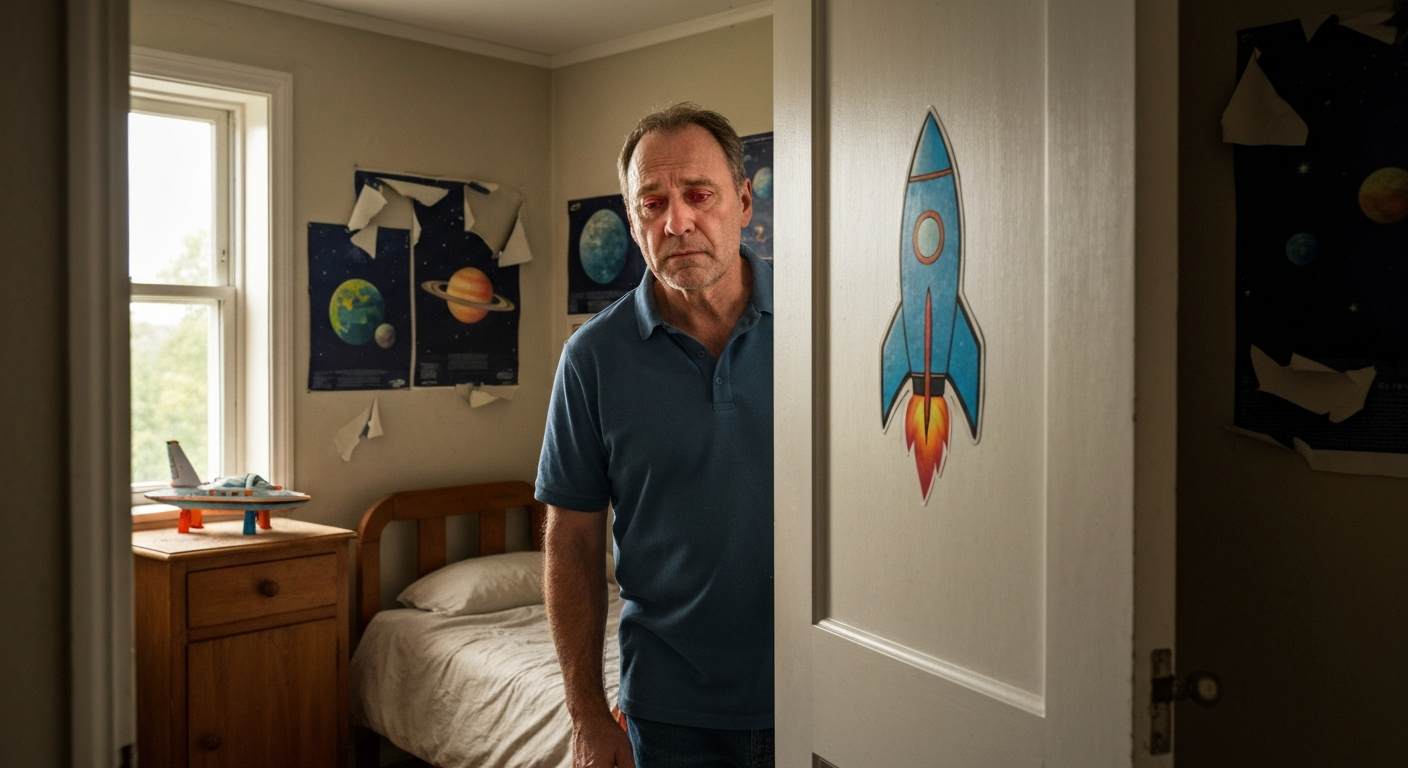
Instead he walked down the narrow hallway, past the closed door with the faded sticker of a blue rocket ship. Daniel had stuck it there when he was seven, insisting his room was now a “launch base”. Mark had promised they would build a treehouse that summer. Then work had called, and he had stayed late at the office again and again, telling himself there would always be another summer.
There hadn’t been another summer. At least not one together.
He pushed the door open. Dusty light fell across the small bed, the crooked bookshelf, the posters of planets peeling at the corners. Everything was frozen in the year his wife, Elena, had packed Daniel’s things into suitcases and left, slamming the front door so hard a picture had fallen from the hallway wall. Divorce, lawyers, accusations – and a twelve-year-old boy who had watched his parents tear each other to pieces.
Mark had thought he was fighting for Daniel back then. Late-night calls with his lawyer, folders of documents, emails printed and highlighted. He had won “visitation rights” on paper and lost his son in reality. Daniel stopped picking up. Birthdays passed with unanswered messages. Mark had told himself teenagers were like that, they came back when they were older.
Until today.
“I’m not your son anymore.”
He sat on the edge of the bed, the springs creaking under his weight. Somewhere outside, kids shouted and a dog barked. Inside, the house felt like someone had pressed a mute button.
On the bedside table lay a dusty model spaceship, half-painted. A tiny brush still stuck in the dried blue paint. The last thing they had done together before the final fight. Mark picked it up. His throat burned.
“Hey, commander,” he whispered to the empty room. “We never launched, did we?”
His phone buzzed again in the kitchen. He forced himself to go back. Another message from Daniel.
“Stop texting me every birthday like everything is fine. You weren’t there. You never were.”
This time Mark typed. He erased. Typed again. Everything felt wrong, too small for the weight of the years between them.
Daniel, I’m sorry.
He deleted it.
You have every right to hate me.
Deleted.
Finally he wrote: “Can I see you once? Just once. No excuses, no pressure. I’ll come wherever you want. If you say no, I’ll never bother you again.”
His finger hovered, then tapped send. The little “delivered” mark appeared. Then nothing.
Minutes stretched into an hour. Mark made coffee and forgot to drink it. He paced between the kitchen and the rocket door, glancing at the phone on the table as if it might explode.
When the reply came, it was a single, cruel mercy.
“One hour. Mall food court. 5 pm. Don’t be late like you always were.”
He checked the clock. 4:07 pm.
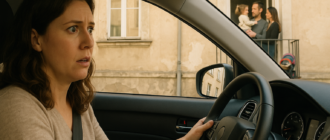
Traffic blurred into a smear of red lights and honking. Mark’s fingers dug into the steering wheel. Every time a car cut him off, he heard Elena’s voice in his head: “You’re always late, Mark. Always choosing something else over your family.”
At 4:59 he rushed into the bright, echoing mall, the smell of frying oil and sugar hitting him at once. The food court was crowded with families, kids begging for ice cream, teenagers scrolling on their phones. For a moment, panic clawed at his chest. What if Daniel had already come and left? What if this had all been some cruel test he had already failed?
Then he saw him.
At a corner table, next to a pillar, a tall, thin young man sat with his arms crossed. Dark hair, headphones around his neck, a backpack at his feet. The same eyes as when he was five and had begged for one more story before bed, now colder, guarded.
“Daniel,” Mark said, the name breaking in the middle.
Daniel looked up slowly, as if he had expected a stranger. His gaze flicked to the clock on the wall, then back.
“You’re on time,” he said flatly. “Miracle.”
Mark sat opposite him, suddenly aware of the stains on his worn jacket, the gray at his temples. He didn’t know where to put his hands. On the table? In his lap? He settled for curling them around the edge of the plastic chair, as if it might keep him from falling apart.
“You cut your hair,” he blurted, then hated himself for it. Of all the things to say.
Daniel’s jaw tightened. “It’s been six years. Of course I cut my hair.”
Silence thickened between them. Nearby, a little girl laughed as her father pretended to steal her fries. Daniel’s eyes flicked to them for a second. Something like envy, or grief, passed across his face, then vanished.
“You wanted to see me,” he said. “So talk. Say whatever speech you’ve been rehearsing.”
“I… didn’t rehearse a speech,” Mark answered softly. “Everything I tried to come up with sounded too clean. This isn’t clean.” He swallowed. “I was a terrible father to you, Daniel.”
A bitter smile. “Wow. That was fast.”
“I thought… providing money, paying for your school, sending you gifts… I told myself that was enough, that I was ‘responsible’. But I wasn’t there when you were sick. I missed your first school play because of a meeting. I let your mother and I turn you into a trophy in a war we both refused to stop.” His voice cracked. “I remember you standing in that hallway, crying, asking if it was your fault. And I didn’t even kneel down to look you in the eyes. I just told you to go to your room.”
Daniel looked down at the table. His fingers tapped a restless rhythm.
“You remember that?” he muttered.
“I remember every horrible thing I did more clearly than anything else,” Mark said. “I don’t remember the projects that kept me at the office. I don’t remember what was so important I had to miss your soccer final. But I remember your face when you realized I wasn’t coming.”
The twist hit Daniel like a slap: he had spent years telling himself his father had simply forgotten.
“You remember that?” he repeated, louder. “Then why didn’t you come? You knew and you still didn’t come.”

Mark’s eyes filled. He didn’t wipe them.
“Because I was a coward,” he said. “Because every time I chose work, or sleep, or just not dealing with your mom’s anger, it was easier. And then one day it wasn’t just one missed game, it was five years. I kept telling myself I’d fix it when things calmed down. They never did. I only realized how far I’d gone when you stopped answering. And by then…” He spread his trembling hands. “By then I had taught you you couldn’t rely on me.”
Daniel’s throat ached. He had come here ready to hear excuses: “I was busy”, “your mother made it hard”, “you’ll understand when you’re older”. He hadn’t expected this naked confession, this man in front of him looking smaller than he remembered.
“You text me every birthday,” Daniel said hoarsely. “Like clockwork. ‘Happy birthday, champ. Miss you.’ You don’t miss me. You miss some idea of me you had before you decided I was second place.”
Mark flinched.
“You’re right,” he whispered. “Those messages were for me. To make myself feel like I was still… connected. Like I hadn’t completely failed. You don’t owe me forgiveness. You don’t even owe me this conversation.”
“Then why ask to see me?” Daniel demanded. “To ease your conscience before you die or something?”
Mark hesitated. For the first time, Daniel saw real fear in his father’s eyes.
“I had a check-up two weeks ago,” Mark said quietly. “Heart. The doctor said if I don’t change everything – stress, food, the way I live – I might not have a ‘later’ to fix things. He didn’t say I’m dying tomorrow. But for the first time I believed I might actually… not have time. And the only thing I could think about, sitting there in that sterile room, was that if I died, you would hear from someone else. Maybe a lawyer. And the last words you ever said to me would be ‘I’m not your son anymore’.”
Tears spilled over now, running down his unshaven cheeks.
“I deserved that message,” he said. “But I couldn’t bear the thought of leaving you with it. Not for me. For you. I don’t want that sentence to be a stone you carry for the rest of your life.”
Daniel stared at him, his own eyes burning. He had imagined his father’s death many times, angrily, almost wishing for it so the waiting, the hoping, would stop. He had never imagined this: a scared, aging man, hands shaking, terrified not of dying but of what he would leave inside his son.
“So what?” Daniel whispered. “You want me to say I forgive you so you can… go in peace?”
“No,” Mark said firmly, surprising them both. “I want you to know that I won’t stop trying while I’m still here. You never have to call me Dad again. You can walk out of here and block my number. I’ll respect it. But I needed you to hear, from my mouth, not a text, that I am sorry. Not sorry-you’re-angry. Sorry-I-destroyed-things. Sorry-I-left-you-alone.”
A small boy at the next table dropped his ice cream. It splattered on the floor. He burst into tears. His mother rushed to comfort him, promising another one. Daniel watched the scene as if through water.
“I used to wait by the window on Fridays,” he said slowly. “Bag packed. Shoes on. Mom told me not to, said you’d cancel again. I defended you. Every time. I told her you were just busy, that you loved me, that you’d come. And then you didn’t. Over and over. Do you know what that does to a kid?”
Mark’s shoulders shook.
“Yes,” he said. “It teaches him he isn’t worth showing up for. I taught you that. And that… that’s what I hate myself for most.”
The food court noise swelled around them: clattering trays, announcements, laughter. At their small plastic table, two lives balanced on a fragile edge.
Daniel looked at his father’s hands – older, veined, a small scar on the knuckle from when he had cut himself opening a toy spaceship on Christmas Eve years ago. Hands that had carried him on their shoulders once. Hands that had also let go.
“I can’t just… erase everything,” Daniel muttered. “It still hurts. A lot.”
“I don’t want you to erase it,” Mark replied. “If we ever have anything again, it has to stand on truth, not pretending. I just…” He swallowed hard. “If there is ever a day when you want me to be there – for a game, a concert, a bad day, anything – I will come. Even if you don’t speak to me. I’ll sit in the back and I’ll be there. That’s all I can offer now. Showing up, finally.”
Daniel let the words sink in. Part of him wanted to stand up, to throw his chair back and walk out, to protect the scar tissue he had spent years growing over that small boy by the window. Another part, quieter but stubborn, whispered: Just once, let him try.
He blew out a shaky breath.
“I don’t forgive you,” he said at last.
Mark nodded, tears falling freely. “I understand.”
“But,” Daniel added, voice trembling, “I also don’t… want the last thing I ever said to you to be that I’m not your son. Because… I am. Whether I like it or not.”
Mark choked on a sob.
“So,” Daniel continued, looking him straight in the eyes for the first time, “I can’t promise anything. I can’t promise I’ll call, or that I won’t disappear again. But… I have a college game next Saturday. Last one of the season.” He swallowed. “If you’re really going to ‘show up’ now… there’s a seat number on the ticket. I’ll text it to you. If you’re not there when I look up from the field…” His voice broke. “I’m done, Mark. For real this time.”
He used his father’s name like a test, like a shield.
Mark nodded so fast his neck hurt.
“I’ll be there,” he whispered. “I will be there, Daniel.”
They sat in silence a few more minutes. Then Daniel stood, slinging his backpack over one shoulder.
“I have to go,” he said. “Bus.”
Mark nodded again, afraid to move, afraid any sudden gesture would scare his son away.
Daniel took a step, then paused.
“Don’t text me every day,” he said without turning. “I… can’t handle that. Just… wait for Saturday.”
“Okay,” Mark replied. “I’ll wait.”
Daniel walked away, swallowed by the crowd. For a second he disappeared behind a group of teenagers. Then, as he reached the escalator, he glanced back.
Their eyes met across the noise and the distance. Daniel didn’t smile. But he didn’t look away either.
It was the smallest of mercies. And for Mark, it was everything.
That night, back home, he opened the door with the rocket sticker and sat in the dim room until the first light of morning. On the bedside table, he placed two things: the half-painted spaceship and a printed ticket email, already creased from where he had held it too tight.
He didn’t know if Saturday would be a beginning or an end. But for the first time in years, he set an alarm not for work, not for a doctor, but for his son.
And when the alarm rang, he promised himself, he would not be late.