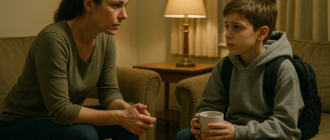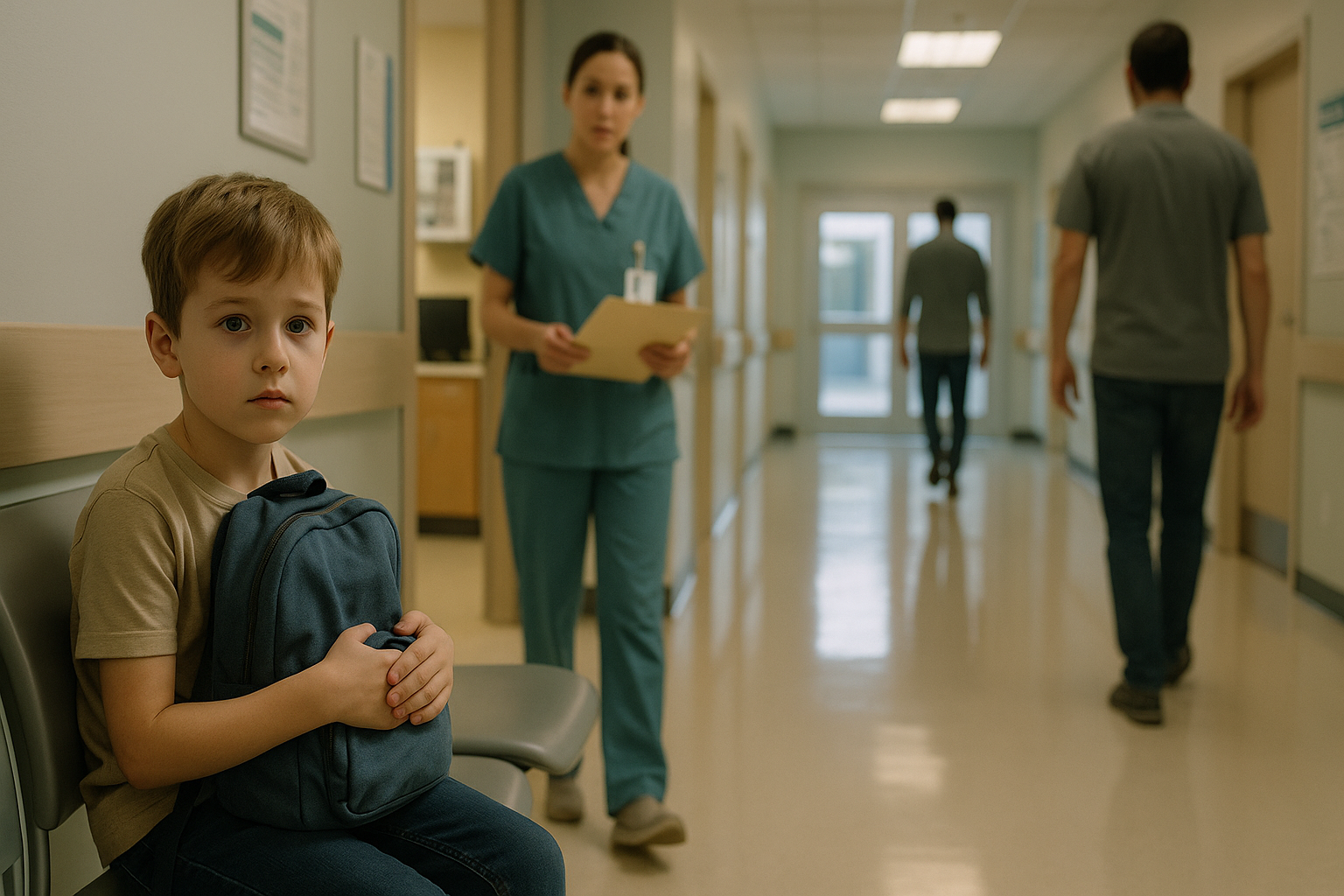
The day Mark left his 6-year-old son in a hospital corridor and walked away as if he didn’t know him, the nurse dropped the clipboard. The boy did not cry. He just sat very straight on the metal bench, legs not reaching the floor, clutching a faded blue backpack like it was the last solid thing in his world.

They had arrived an hour earlier. Mark’s face was gray with exhaustion, his hair uncombed, dark circles under his eyes. Little Liam clung to his sleeve, coughing in short, dry bursts that made his thin shoulders shake. It was the kind of cough that made strangers turn their heads.
At the reception, Mark filled out forms with a shaking hand. “Mother deceased,” he wrote in a box he had hoped never to touch. Under “Emergency contact,” he hesitated, then left it blank. The clerk did not notice. Or pretended not to.
Doctor Elena Carter met them near Pediatrics. She had seen too many fathers with this look: stubborn, angry fear wrapped in cheap pride.
“Liam, right?” she crouched to the boy’s eye level.
He nodded, eyes huge. “My chest hurts when I run,” he whispered.
Mark flinched at the word “run,” as if it were an accusation.
Tests were ordered. Blood work, X-rays. Liam watched everything with an unnerving quietness, as if he knew that any loud sound could break the thin shell holding his world together.
While they waited, Mark paced the corridor, phone buzzing in his hand. Unread messages stacked up from his boss, from his landlord, from a number saved as “Mom,” which he had not answered in six months.
“Mr. Harris?” Dr. Carter called him into a small office, leaving Liam with a cartoon playing silently on the wall-mounted TV.
She laid the X-ray on the lightbox. A cloudy mass bloomed where there should have been clean, dark space.
“It’s serious,” she said carefully. “We need more tests, but I’m very concerned about his lungs. It could be treatable, but he’ll need to stay. Possibly for a while.”
Mark’s jaw tightened. “How much?”
She named a rough estimate, softening the number with words like “insurance,” “assistance programs,” and “we’ll try.” The number did not soften.
He laughed once, a sound like something breaking. “I can’t pay that. I’m already behind on rent. I’m working nights. His mother—” His voice cut off on the word.
Dr. Carter lowered her voice. “We have social workers. We can help. But he needs treatment, and he needs a parent here.”
Mark stared at the X-ray. At the white cloud in his son’s chest. At every hour he had spent on double shifts while Liam slept at a neighbor’s. At every time he had said, “We’ll play later, buddy,” and never did.
He walked back into the corridor. Liam looked up, hopeful.
“Are we going home?” the boy asked.
“Not yet.” Mark’s voice came out hoarse. “You need to stay here for a bit. The doctors will fix your cough.”
Liam’s hand found his. “You’ll stay too?”
The question hung between them like a knife. Mark felt his phone buzz again in his pocket: FINAL NOTICE.
He knelt so they were eye to eye. Up close, he could see the light freckles on Liam’s nose, the tiny scar on his eyebrow from when he had fallen at the playground and Anna—God, Anna—had kissed it better.
“I have to… sort some things out,” Mark said. “Just for a little while. The nurses are really nice. They’ll take care of you. I’ll… I’ll call.”
Liam’s fingers tightened. “I can be quiet. I won’t bother you. I can sleep in the chair if you have to work. I’ll be good, Dad. I promise.”
The word “Dad” almost undid him. Almost.
He pried the small fingers from his own, one by one. Stood up. Turned to the nurse at the desk, his voice wooden. “I need to step out. I’ll be back later.”
Liam watched him walk down the corridor. At the door, Mark stopped. His shoulders shook once. Then he squared them and kept going.
He did not look back.
The nurse, Hannah, stared after him, then at the boy on the bench. Liam was sitting very straight, as if good posture could anchor him.
“Sweetheart,” she said gently, sitting beside him. “Do you want some water?”
He shook his head. “My dad’s coming back. He just has to work. He always has to work.” He sounded like he was repeating something he’d been told many times.
Hours passed. The cartoon looped twice. The sky outside the hospital windows dimmed, then brightened. Hannah finished her shift and started another.
Mark did not return.
The twist came not from Mark’s absence—that, sadly, was too ordinary—but from what arrived instead.
On the second day, a small, trembling woman hurried into Pediatrics, clutching an old purse to her chest. Her hair was gray at the temples, her hands red from cold. She scanned the corridor until her eyes landed on Liam, who was coloring alone at a table with donated crayons.
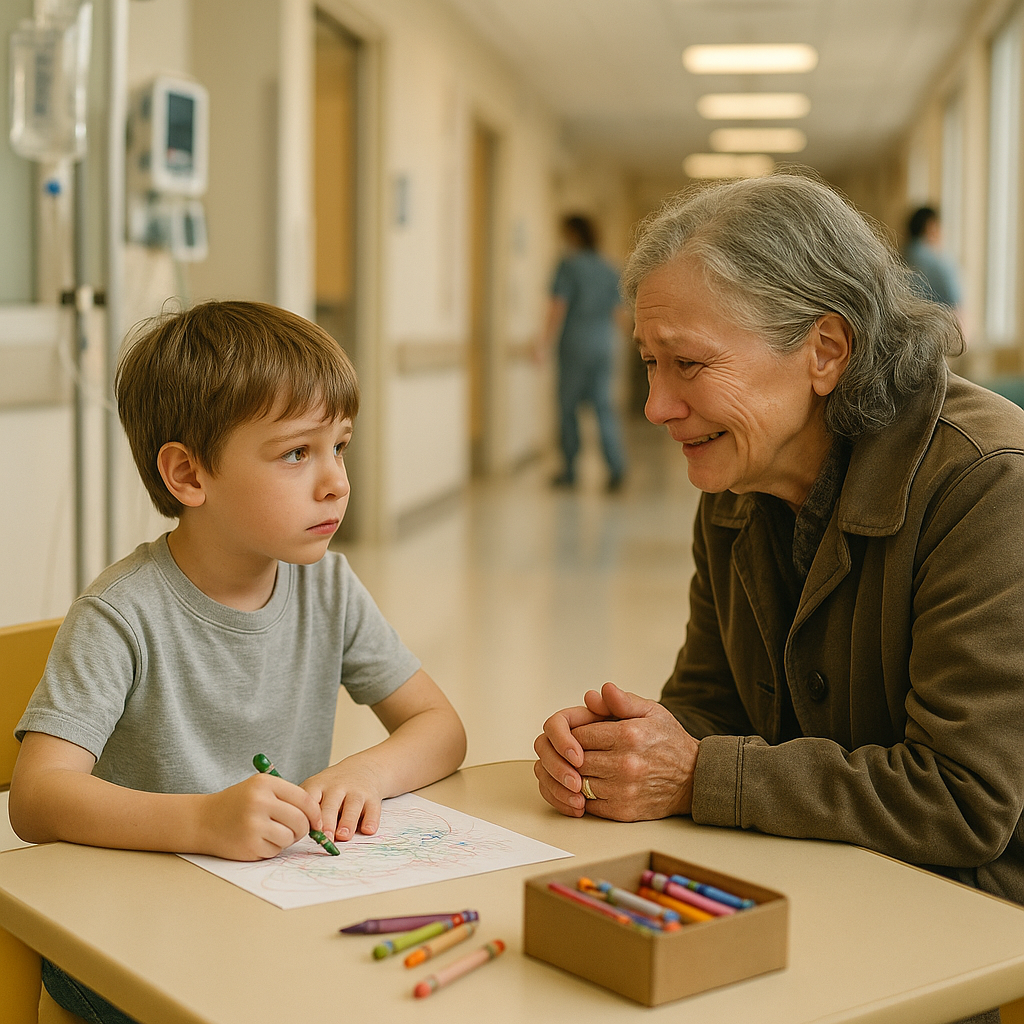
“Liam?” Her voice broke on his name.
He looked up, puzzled. “Yes?”
She sank onto the chair opposite him, tears already spilling. “I’m your grandmother,” she said. “Anna’s mother.”
Liam blinked. “Mom’s… mom?” He had seen her only in a few photos in a dusty album. Mark had cut off contact after Anna’s funeral.
Behind her, in the doorway to Dr. Carter’s office, Mark stood, eyes red, fists clenched. He had come back at dawn, slept in his car in the parking lot, then forced himself to walk in.
He had not come to stay. He had come to sign papers.
“I can’t do it,” he had told Dr. Carter earlier, voice hollow. “I can’t be what he needs. I can’t even keep a roof over our heads. He… he deserves better than watching me fail every day.”
He had expected judgment. Instead, she had asked a quiet question: “Is there anyone who loves him and has been begging to help, but you were too proud to call?”
The image of Anna’s mother had stabbed him. The way she had clutched Liam’s photo at the funeral. The way he had turned away when she asked, “Can I see him sometimes?”
He had made the call with shaking hands. She had arrived in three hours, breathless and scared and already fiercely protective.
Now Mark stood in the doorway, watching his son tilt his head.
“Why didn’t I know you?” Liam asked his grandmother.
She looked past him, straight at Mark. Her eyes were not kind. They were wet, furious, and full of a love that had been locked out for too long.
“Because some grown-ups,” she said, voice trembling, “make very big mistakes when they’re hurting. But I’m here now. If you’ll let me be.”
Liam studied her face, searching for his mother. He found the same shape of eyes, the same way her mouth shook before a laugh.
“Will you stay?” he asked.
She did not hesitate. “Yes. As long as you want me to.”
He put his crayon down, slowly. “Then I’m not alone,” he said, as if testing the words.
From the doorway, something inside Mark finally shattered. He covered his face with his hands, shoulders heaving. For the first time since Anna died, he let himself cry where someone could see.
Dr. Carter stepped beside him. “It’s not too late,” she said quietly. “Not if you walk back there and sit down.”
“But I was going to sign him over,” he choked. “I was ready to walk away.”
“And you didn’t,” she answered. “You called her. You came back. That counts for something. For him, it could count for everything.”
He looked at his son, now leaning closer to his grandmother, listening to a story about a young woman who once painted stars on her bedroom ceiling and promised her baby boy that he would never be alone.
Mark walked back down the corridor—the same corridor where he had left his child two days earlier. Every step felt heavier and, strangely, lighter.
He stopped at the table. Liam looked up, surprise flashing across his face, followed by something that hurt more than any accusation: hope.
“Hey, buddy,” Mark said softly. “I’m… I’m sorry I left. I was scared. Of money, of hospitals, of… everything. But I was mostly scared of failing you.”
Liam’s lip trembled. “Are you leaving again?”
Mark sank into the chair beside him, leaving a small, respectful space. “Not if you’ll let me stay. Your grandma and I… we can both be here. If you want two people to bug the nurses and bring you bad jokes and terrible sandwiches.”
Liam’s eyes darted between them. His grandmother nodded, tears streaming freely.
“You can stay,” he whispered.
Mark exhaled like he’d been underwater for months. He nodded, pressing his palms flat on the table so he wouldn’t reach out too fast.
Outside, the morning sun flooded the corridor with bright, almost harsh light, showing every crack in the walls, every shadow under their eyes. Nothing was magically fixed. There would be treatment, fear, bills, long nights on plastic chairs.
But on that hard bench in the pediatric wing, a boy who had been left in a hospital corridor now had two people sitting beside him.
And for the first time in a very long time, all three of them felt, in their different, broken ways, that they were not completely alone.