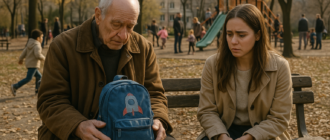
The old man came to the school concert with a framed photograph in his hands, and when the teacher tried to escort him out, the principal suddenly turned pale.

He stood in the doorway of the brightly decorated auditorium, clutching the frame so tightly his knuckles were almost white. Children in paper crowns ran past him, parents searched for seats, someone laughed too loudly. He just stood there, small and confused in his worn gray coat, his eyes roaming over the rows as if he had lost something.
“Sir, this event is for students and their families,” said Mia, the young music teacher, forcing a polite smile. “Which student are you here for?”
The old man blinked, as if the question needed time to reach him. Slowly, he lifted the frame. Inside was a photo of a teenage boy with messy dark hair, grinning into the camera, a cheap plastic medal around his neck.
“For him,” the old man answered. His voice was quiet but steady. “For Daniel. My grandson.”
Mia hesitated. She knew almost all the parents by sight. She had never seen this man before. The name Daniel meant nothing to her.
“Sir, we don’t have a Daniel in our seventh grade choir,” she said gently. “Are you sure it’s the right school?”
The old man frowned at the photo, then at the hall, as if the walls had been moved behind his back.
“It was here,” he whispered. “Always here. Front row, third seat from the left. His mother… she sat there.”
A boy brushed against the old man’s arm and muttered a quick apology. The frame shook. Mia instinctively reached out to steady it.
“Let me help you find a seat,” she tried. “But we really need to know which child—”
“What is going on here?” The calm but firm voice of the principal, Mr. Harris, cut through the noise.
Mia straightened. “This gentleman says he’s waiting for his grandson, but—”
The old man turned toward the principal, and the overhead light hit his face. Harris froze. All color drained from his cheeks.
“Ethan?” he breathed.
The old man narrowed his eyes, searching the principal’s face. “Lucas?” he said slowly, as if pulling the name from very far away.
Several parents turned to look. The chatter dimmed.
Mia glanced from one man to the other. “You… know each other?”
Harris’s jaw worked, but no sound came out. Finally he reached for the frame in Ethan’s hands. His fingers shook as he tilted it toward the light.
The smiling boy in the picture wore the same school logo that hung on the banner above the stage.
“That’s our old uniform,” Harris whispered. “From… years ago.”
He looked up at Ethan, and in that moment Mia saw not a principal, but a man suddenly dragged back into a past he had tried to bury.
“Daniel was my student,” Harris said hoarsely. “In ninth grade.”
The auditorium seemed to shrink. The music from the speakers became a distant, tinny noise.
“Was?” Ethan’s fingers tightened around the frame. “What do you mean, was?”
Mia felt a cold shiver run down her spine. She looked at the boy in the photo again, trying to understand.
Harris swallowed. “Mia, take the kids backstage for a moment,” he said quietly. “Please.”
But Ethan suddenly stepped forward, surprisingly fast for his age, blocking him.
“No,” the old man said. “No more sending people away. Tell me where my grandson is. I have been coming every year. They said… they said he would sing.”
Mia stared at him. “Every year?”
“Since they brought him here,” Ethan replied. “Social workers. They said his mother was… gone. They said he would stay with a foster family and go to school here. They wouldn’t let me see him, said I was too old, too poor. But I know this building. I waited outside the gate. I saw him once, through the fence. He waved at me. He had this medal…” His voice broke. He touched the glass over Daniel’s smiling face.
Mia felt her throat tighten.
“I promised I would come to every concert, every game, until he saw me again,” Ethan went on. “But they never let me in. They kept saying, ‘Wrong day, wrong place, come later.’ I thought… maybe today… now that he’s older…”
He looked around helplessly, as if Daniel might still appear from behind the curtain.
Harris closed his eyes for a moment, then opened them, shining with unshed tears.
“Ethan,” he said softly, “Daniel died. Six years ago. There was a car accident, on a school trip. I was there. I tried… I tried to call you, but the number in the file didn’t work. I went to the last address they had. You had moved. We never found you.”

The words hung in the air like smoke.
Ethan’s lips parted, but no sound came. His gaze dropped to the photograph. His hands trembled so violently that Mia feared the glass would shatter.
“No,” he whispered. “No, no. He was going to sing. They told me he was doing well in school. That he liked music. That he would be on this stage.”
His knees buckled. Mia grabbed his elbow, and Harris, shaking, took his other arm. Together, they eased him into the nearest chair.
Around them, the auditorium had gone almost completely silent. A few children peeked from behind the curtain, their eyes wide.
“I am so sorry,” Harris said, voice cracked. “I should have tried harder. I thought… maybe you didn’t want to be found. The social worker said there was no contact.”
Ethan pressed the heel of his hand to his forehead, as if trying to push back a wave of pain.
“I sold my house,” he murmured. “To move closer. They changed the rules, the offices, the signatures. I filled out forms I couldn’t read. They said they’d call. I waited by the phone. Every ring…” His breath hitched. “I thought it was him.”
Mia felt tears sting her eyes. She had spent weeks rehearsing cheerful songs, worrying about costumes and microphones. None of it seemed to matter in the face of this man, who had been standing outside the life of his only grandson, watching shadows on the wall.
“Why did no one tell me?” Ethan asked suddenly, looking straight at Harris. There was no anger in his voice, only a bottomless, exhausted grief.
Harris flinched. “Because we failed you,” he said simply. “The system failed you. I failed you. I told myself it was too late. That you would not want to hear. I was a coward.”
A small hand tugged at Mia’s sleeve. One of the choir girls, Anna, stood there, her eyes wet.
“Miss,” she whispered, “can we… sing for him? For his grandson?”
Mia swallowed hard and nodded.
She walked to the microphone, her legs unsteady.
“Dear parents,” she said, her voice wavering through the speakers. “We will start the concert in a different way today. We have a guest who came to hear someone who is no longer with us. We would like to dedicate our first song to Daniel, who once studied in this school, and to his grandfather, who never stopped waiting for him.”
There was a rustle in the hall, then an unusual, respectful silence.
The curtain opened. The children stood in uneven rows, looking small and suddenly very serious. Mia lifted her hands, and the first notes floated into the air.
Ethan sat alone in the front row, the framed photograph on his knees. Light from the stage fell across the glass, making it difficult to see the boy’s face, but Ethan did not look away.
As the children sang, his shoulders began to shake. Not with the violent sobs Mia expected, but with a quiet, exhausted weeping—the kind that comes after too many years of hope stretched too thin.
Harris sat down beside him, not touching him, simply sharing the same hard plastic chair, his own eyes red.
When the song ended, the hall remained silent for a long moment, as if no one dared to be the first to clap. Then, slowly, people rose to their feet. It was not applause for a performance, but a fragile attempt to surround one broken old man with something like warmth.
After the concert, parents filed out, speaking in hushed tones. Some came to Ethan to squeeze his shoulder, to mumble awkward condolences. He nodded, but his gaze stayed on the empty stage.
“Ethan,” Harris said quietly, “there is a memorial plaque for Daniel in the hallway. We made it after… after the accident. Would you like to see it?”
The old man stood up slowly, clutching the frame.
“Yes,” he said. “I have been walking these corridors for years and never knew he was on the wall.”
They walked together to the end of the corridor. On the wall, among photos of sports teams and science fairs, was a small metal plaque with Daniel’s name, a date, and the words: “He loved to sing.”
Ethan traced each letter with a trembling finger.
“He did,” he murmured. “He sang in the kitchen, with a spoon as a microphone. He said one day he would sing on a real stage. I told him I would be there.”
He looked at the plaque, then at the framed photograph in his hands.
“I was late,” he said simply.
“No,” Harris replied, his voice raw. “We were late. But you are here now. And as long as we remember him, he is not entirely gone.”
Ethan did not answer. He just stood there, an old man in a too-big coat, finally facing the truth that had been kept from him for six long years.
Outside, the winter evening settled over the town. Parents drove home with sleepy children in the back seats, humming the songs they had just sung. Inside the empty school, under cold fluorescent lights, a grandfather pressed his forehead gently against a metal plaque and whispered a name he had never stopped saying in his prayers.
And for the first time since the accident, the principal allowed himself to cry not as an administrator, but as a man who had finally seen the full weight of a promise broken—not only to a boy who loved to sing, but to the old man who had never stopped waiting in the doorway, holding a photograph.