After a devastating loss, Claire is barely keeping her head above water – until her body can no longer keep up and her mother-in-law suddenly steps in with an unexpected solution. But when Claire returns home, what she finds behind her front door changes everything.
I used to think I knew what grief was – until the hurricane took Mark.
They called it “a storm that a generation only experiences once,” the kind that tears entire places apart and leaves only silence behind. We heard the warnings, stocked up on supplies and charged batteries. When the sky turned gray and the wind sounded like it was screaming, I grabbed the kids and drove to a safe place.
My husband Mark stayed behind to secure the windows and fasten the shutters.
He promised to follow.
He never came back.
I still remember the sirens, the rain pounding against the roof like fists, and the silence afterward. When I returned home, half of our roof was gone, water ran down the walls, and the air was heavy with mold and things I couldn’t name.
Mark’s boots were still standing by the door.
That was a year ago.
The house was technically livable. We had temporarily sealed the worst leaks, cleared away debris and made sure the children had beds they could sleep in. But every wall I looked at, every strip of peeling wallpaper or every water-stained corner on the ceiling whispered the same thing: Everything changed here.
Here the storm struck, here their father died, here we all broke a little. I wasn’t just repairing a house – I was trying to protect my children from the grief embedded in the drywall. And with every day that everything stayed the same… I felt like I was failing them.
Since then, I have somehow survived.
I am 37, a widow, and raising three children – Mia, 12; Ben, 10; and little six-year-old Sophie. Every day began before the sun even rose. I worked mornings at the diner, refilling regulars’ coffee and pretending not to flinch when my knees locked from exhaustion.
In the evenings, after dinner, homework and baths, I stayed up and edited texts for clients I had never seen – legal documents, academic papers, manuscripts about lives I had never lived.
Every single dollar went back into this broken house. I replaced floorboards Mark had planned to fix “next summer.” I scrubbed mold until my hands cracked.
I tried to glue wallpaper back on that peeled from the walls like skin, but the paste never held long. Still, I kept going. I just wanted the children to have a home that didn’t feel like it was collapsing under the weight of memories.
I didn’t care how tired I was. I didn’t care if my hair grew thinner, if my back burned when I bent too quickly, and I didn’t care if I had to cry in the shower just to somehow let it all out.
I just wanted my children to feel safe. As if their world hadn’t ended the night the storm swallowed their father.
But one afternoon, as I dragged what was left of our sagging sofa to the curb, my body gave out.
I collapsed onto the asphalt, and the sun spun above me as if it had lost its orbit.
“Mom!!” Ben screamed.
And then everything went black.
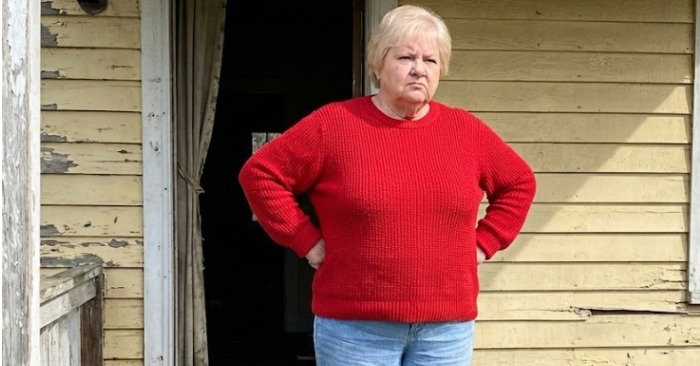
When I came to, I was lying in a hospital bed, my vision blurred, every sound too sharp. Monitors beeped steadily beside me. A tube ran into my arm. And Helen, my mother-in-law, sat by the bed, her face calm, barely readable.
“Claire, you’re killing yourself if you keep this up, darling,” she said quietly and evenly.
I tried to sit up and grimaced in pain.
“I don’t have time to stop, Helen,” I said. “I have to fix the house. I have to make sure the kids have everything. I have to… do everything.”
Helen did not react. Not even a blink.
“Claire, the doctor told me everything. You are in a pre-stage right before a stroke. If you don’t rest now, you might not be here to finish anything. This house can wait. But your children can’t. They must not lose another parent.”
Her words settled into my bones, and for a moment I just wanted to sink into the ground beneath me and cry.
Then Helen reached into her handbag and pulled out an envelope. Thick. Heavy. She slid it across the small table by the bed.
“What is that?” I asked, even though it was obvious.
“Help,” Helen said simply.
Inside the envelope were bundles of cash – and it was not a small amount.
“I booked you a stay,” Helen continued, ignoring my shock as I flipped through the envelope. “Three weeks, my darling. A warm place. Real beds. Food you don’t have to cook yourself. You have to breathe, Claire. You have to grieve too, yes? And when you’re done, we’ll be here waiting for you.”
I blinked, confused and dizzy.
“Helen, I can’t,” I said. “I can’t just… leave. I can’t leave the kids alone – they’ve barely processed Mark’s death. I can’t disappear while everything is still falling apart.”
“You are not disappearing,” she replied, her hands neatly folded in her lap. “I’ll stay with them. They are safe, Claire. And believe me: You need this.”
I wanted to protest, but at that moment the doctor came in. He looked at Helen, then at me.
“Claire,” he said kindly but firmly. “If you don’t rest, I cannot guarantee your health. Your blood pressure is high enough to trigger a stroke. Your body is screaming for help. You need this break.”
Something inside me buckled. I wanted to scream that I was fine, that I could endure like always. I wanted to explain that mothers don’t get breaks. Not when piles of laundry grow, school forms need to be signed and water is still dripping through the roof into the hallway.
Instead, I whispered, my voice breaking: “I don’t have time for a break. There’s still so much broken.”
Helen stood up. She leaned forward and placed her hand on mine – warm and unyielding.
“If you are no longer here, Claire, there will be nothing left for you to fix,” she said.
I cried. I said no. I searched for excuses. But in the end, I nodded.
Not for me. For the children.
Helen never mentioned the money again. She also did not explain how she could suddenly afford such a luxurious retreat. And I was far too exhausted to ask. I told myself she had maybe dipped into her savings.
Or sold something from the living room.
It didn’t matter.
The retreat was beautiful – clear sea air, soft beds and food served by people who smiled with their eyes. But the first days were pure torture.
My hands twitched for a broom. My shoulders tensed for stress that never came. I couldn’t truly rest.
What if Sophie cried? What if Mia forgot her inhaler? What if Ben locked himself in the school bathroom because of his hatred for fractions?
But Helen called every evening, calm and competent.
“Mia finished her science project.”
“Sophie brushed her teeth all by herself. And she didn’t complain once!”
“Claire, I didn’t know Ben eats everything except broccoli and peas. He specifically asked me not to buy peas.”
For the first time in months, I slept through the night.
Toward the end of the second week something strange happened – I laughed. Someone in yoga told a terribly flat joke, and I truly laughed. One morning I stood waist-deep in the sea, the waves pulling at my calves, and I lifted my face to the sun.
For a few minutes I forgot the burden I had been carrying. I felt like someone I hadn’t seen in a long time – like myself.
Three weeks passed too quickly and at exactly the right time. When Helen picked me up at the airport, she looked refreshed too – calm, composed, but there was something in her eyes I couldn’t interpret.
“Ready to see your home?” she asked, reaching for my bag.
“I’m afraid that while I was gone, something finally fell apart for good,” I said and laughed briefly, thinly.
She did not answer. She just gave me that gentle smile as we walked to the car.
When we turned into the driveway, I first noticed the small things. The lawn was cut. The flowerbed I had long given up on was blooming again. The front windows shone in the afternoon light.
“Helen…” I murmured. “Did you…?”
“Why don’t you go inside?” Helen asked and turned off the engine.
I stepped through the front door – and everything stopped.
The first thing that hit me was the scent. Not damp walls or traces of mold, but lavender and something warm – maybe wood polish. The floor beneath my feet was clean, smooth, gleaming, as if it belonged in a home magazine.
I stared into the living room, almost as if I expected it to disappear before my eyes. The sagging sofa cushions and peeling wallpaper were gone. Instead: soft cream-colored walls, a plush rug I didn’t recognize, and framed family photos I had never hung up.
I stumbled forward, my heart pounding wildly.
The kitchen gleamed. Cabinet doors closed softly, without squeaking. Countertops sparkled. Even the faucet was new. I pulled open a drawer – spice jars, neatly sorted, cleanly labeled. Nothing sticky. Nothing chaotic.
“This… this isn’t real,” I whispered. “This isn’t my house.”
“Welcome home, darling,” Helen said, stepping into the kitchen.
I wanted to say something, but my knees gave way. Everything blurred, and then it went black.
When I came to, I was lying on the new rug, and my children were kneeling around me.
“Mom!” Mia cried, tears in her eyes.
“You fainted again,” Ben said with wide eyes. “You’re really dramatic, Mom.”
“Everything okay, Mama?” Sophie asked and patted my cheek.
I pulled them close, overwhelmed, trembling.
“I’m okay,” I whispered. “Really… I’m okay.”
Helen gently helped me onto the sofa.
Then she handed me a cream-colored envelope.
“What is that?” I asked, my head lightly pounding.
“Proof, darling,” she said.
Inside the envelope were neatly folded receipts, contractors’ invoices, furniture orders – everything detailed, everything orderly. On top lay a handwritten note in Helen’s elegant script.
“Claire,
I paid for everything. Every repair, every brushstroke, every pillow. I know you wanted to do everything alone, but your health had to come first. You were drowning, my darling. Now you are home. And your children have a safe place to grow up again.
With love, Helen.”
I sat there with that note as if an hour had passed, and read it again and again until the ink blurred behind my tears.
Later I learned the rest.
Helen had not only taken care of the children while I was away – she had moved in as planned, slept in the guest room so their routines would not be disrupted. Every morning she dressed them, packed lunches, supervised homework – and still managed to meet with contractors, make decisions and coordinate deliveries without the children feeling as if they were living in the middle of a construction site.
She kept everything running so smoothly that during our phone calls I did not suspect a thing. Not once did she let anything slip or reveal what she was doing in the background.
And the money?
Every dollar came from the portion of Mark’s insurance that he had set aside for her. As much as Mark wanted to protect us, he had also made sure his mother was secure. But Helen had her own savings anyway.
She didn’t need his money to live comfortably. So she used it to rebuild what we had lost.
“I didn’t want it,” she told me quietly one evening over a plate of pasta. “Not when you and the children need it so much more. Mark would have wanted it that way. You know that.”
Then, on a quiet morning, as I was just making pancakes for the children, Helen came with a small stack of papers in a folder. She placed them on the table, with a gentleness that tightened my chest.
“There’s something you need to see,” she said.
“What is that?” I asked, looking from the folder to her face.
“This is Mark’s life insurance,” she explained, sitting down next to me. “Mark set up a trust for you and the children. After the storm, it got lost – in estate matters, deadlines, paperwork chaos. But I found it and got everything released. For me, because of my age, it was easier to access my share, Claire. And the amount – it was more manageable. But now everything is accessible. For college, medical emergencies, groceries from the most expensive stores… whatever you need, my darling.”
Slowly I reached out, my fingertips brushing the edge of the folder.
“You… you did all this alone?” I asked.
“I promised Mark that I would look after you,” Helen said. “And I promised him I would catch you if you stumbled. So I kept my word.”
“But what about you? You spent your share on this house, Helen! How much was that? Tell me! Take it back from me, for your security.”
She only smiled faintly.
“I have my own reserves, darling,” she said. “I am not a woman who needs much – and certainly not at the expense of her grandchildren. Mark left that money so we would all be safe again. That is how we honor him properly. And who knows… if I ever need a home: You have a wonderful guest room here.”
“Anytime, Helen!” I said. “Whenever you want. This door will always be open for you.”
I stood up and hugged her. For the first time I did not cry from exhaustion or grief. It was gratitude – deep into my bones, into my soul – for a woman who had quietly lifted my entire life back into place.
A month later we were sitting in the living room, sunlight dancing across the walls, the children lying on the floor with board games, laughing as if the air itself were music.
“I told you your mama would be okay again,” Helen said as she came in with a tray of freshly baked cookies.
And she was right.
I would never have thought I would one day call my mother-in-law a heroine. But she didn’t just restore a house. She helped us rebuild our lives. And she gave us back something I no longer believed in – a new beginning.
My mother-in-law sent me on vacation – when I came back and opened my front door, I collapsed