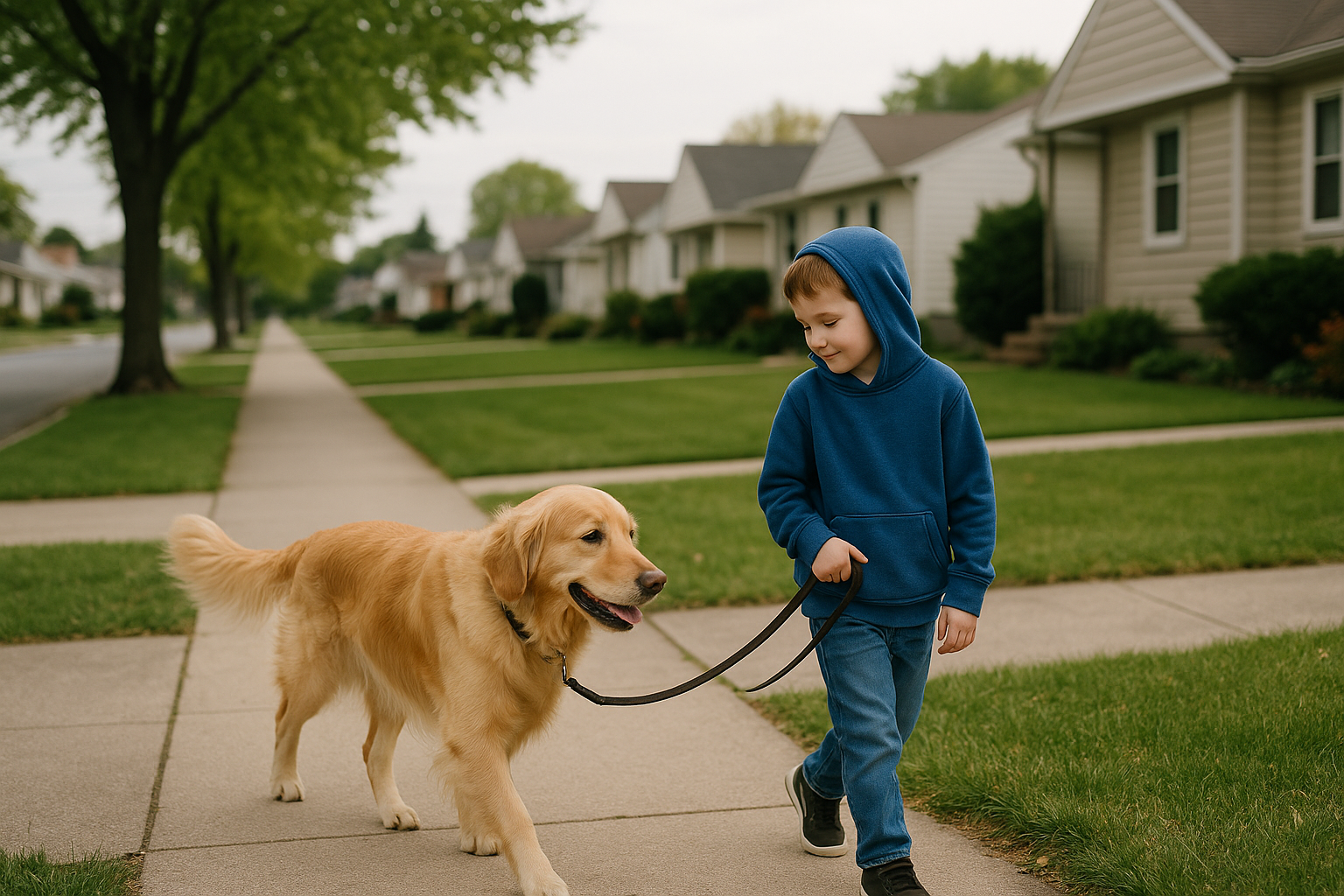
The boy who rang our doorbell every Sunday asked if he could borrow our dog for one day – only later did we learn why he always returned her with tear‑swollen eyes.

The first time he came, it was raining. A small, thin boy in a faded blue hoodie stood on our porch, his sneakers soaked, his hands trembling as he held out a crumpled note.
“Hi… my name is Daniel. I live two streets away. I wanted to ask… Can I walk your dog for an hour?”
I glanced at our golden retriever, Molly. She stared back at the boy with her usual gentle curiosity, tail quietly thumping against the hallway wall.
“Did your parents send you?” I asked. It felt strange. Who goes door to door asking to borrow a dog?
He swallowed. “My mom knows I’m here.” He didn’t say anything about a dad.
There was something in his eyes – a mixture of shyness and a kind of desperate hope – that made it impossible to simply say no. My husband, Mark, came to the door, took one look at the boy and shrugged.
“If Molly’s okay with it, I’m okay,” he said, clipping on her leash and kneeling to look Daniel in the eye. “You bring her back in an hour, alright? She doesn’t like to miss dinner.”
The boy nodded so quickly his hood fell back, revealing a badly cut patch of hair and a faint bruise on his temple. He noticed us noticing and yanked the hood up again.
They disappeared down the street, Molly trotting beside him as if they’d known each other for years.
Exactly one hour later the bell rang again. Molly rushed in, pressing herself against my legs, but Daniel stayed on the threshold, eyes red, nose pink from the cold.
“Thank you,” he whispered, then hurried away before I could say a word.
It became a ritual. Every Sunday at two o’clock, Daniel would appear. Sometimes it was sunny, sometimes snowflakes clung to his hoodie. Sometimes he had a backpack, sometimes just empty hands shoved deep into his pockets. Always the same question:
“Can I walk Molly for a while, please?”
Molly adored him. She’d run to the door the moment she heard his steps on the gravel, whining impatiently. After each walk she came back tired and happy, her fur smelling of grass and wind. Daniel, however, always looked as if he’d been crying.
I tried to ask gentle questions.
“Everything okay at home, Daniel?”
“Yes, ma’am.” Eyes averted.
“Do you have a dog of your own?”
“I used to,” he said once, then immediately bit his lip and changed the subject, asking if Molly could eat carrots.
Mark thought maybe his parents couldn’t afford a dog, or that they lived in a building that didn’t allow pets. It was easy to accept such explanations and not look deeper. We left it alone.
Until one Sunday, he didn’t come.
At first we joked that Molly looked offended. She sat by the door, head tilted, every time a car passed. By evening she was restless, pacing from window to window. A strange unease settled in my chest.
On Monday evening, as I was bringing in the trash cans, I saw an ambulance two streets over, blue lights now dark, only yellow tape fluttering in the wind. Neighbors stood in little clusters, whispering. My heart thudded as I recognized the house from the address on Daniel’s first note.
I left Molly with Mark and walked over, pulse in my throat.
An older woman in a nurse’s uniform stood by the gate, her eyes puffy with exhaustion. I introduced myself, stumbling over my words.
“I’m… I’m Anna. I live nearby. A boy, Daniel, sometimes… he walks our dog. Is everything okay?”
Her face softened with a kind of painful recognition.
“You’re the family with the golden retriever,” she said quietly. “He talked about your dog all the time.”
My knees went weak. “What happened?”
She took a breath that seemed to hurt. “His little sister, Emily… She passed away last night.”

The world tilted. “I… I didn’t know he had a sister.”
The nurse nodded toward the house. “She’d been sick for a long time. Leukemia. I’m the home nurse who used to come. Daniel was always trying to be strong for her.” Her eyes glistened. “Every Sunday he took your dog to the park. He said he wanted to bring her the ‘outside’ somehow. He’d sit under her window with the dog and tell Emily what Molly was doing, what she smelled, what she saw. Sometimes Emily was too weak to get up. He said if she couldn’t go to the world, he’d bring a little piece of it to her.”
A hot wave of guilt and tenderness washed over me, leaving me breathless.
“He never told us,” I whispered. “Why didn’t he tell us?”
The nurse gave a small, sad smile. “He didn’t want pity. He just wanted your dog. He said Molly made Emily smile even on the days she couldn’t open her eyes properly.”
I imagined my dog sitting under a half‑open window, her golden head on Daniel’s lap, while a pale little girl listened from inside. Suddenly every Sunday made sense: the tears, the urgency, the way he always checked the time.
“Where is he now?” I asked.
“With his mother. They’re… making arrangements.” She hesitated. “He blames himself, of course. Kids always do.”
That night I couldn’t sleep. Molly paced, unsettled, as if she felt the absence of that small, determined hand on her leash. Around midnight I made a decision.
The following Sunday, instead of waiting for the bell that would not ring, Mark and I walked with Molly to Daniel’s house. The curtains were drawn. A withered bouquet leaned against the fence. My heart pounded as I rang the bell.
It took a long time, but finally the door opened a crack. Daniel stood there, thinner than before, his eyes rimmed with the kind of redness that doesn’t fade after one day of crying. His hoodie hung on him like it belonged to someone else.
Molly whined softly and pushed her nose into his hand.
He froze, then crumpled, dropping to his knees on the doorstep, arms curling around her neck. No words, just a raw, soundless sob that shook his whole body. I stepped back, giving him space, tears blurring my own vision.
“I’m sorry,” he choked at last into Molly’s fur. “I couldn’t… I couldn’t bring her the outside yesterday. She was gone.”
I knelt beside them. “Daniel,” I said as gently as I could, “you gave her more outside than most people see in a lifetime.”
He shook his head, but he didn’t pull away when I placed a hand on his shoulder.
“Listen,” I continued. “You don’t have to come ring our bell anymore. Molly and I… we’ll come to you. Whenever you want. You don’t have to ask.”
He looked up at me then, eyes full of a grief so big it barely fit in that small, thin face.
“But why?” he whispered. “She… she’s not here to listen anymore.”
“For you,” I said simply. “And for her. I think she liked knowing you were out there with Molly.”
Behind him, in the dim hallway, I noticed taped to the wall a childish drawing of a golden dog and a stick figure boy under a window. Above it, in shaky letters: “Daniel + Molly + Emily’s Outside.”
Something inside me broke and settled at the same time.
In the weeks that followed, Molly and I visited that house almost every day. Sometimes we just sat on the front steps with Daniel, not talking, watching the clouds drift by. Sometimes he told us memories of Emily: how she loved yellow balloons, how she named every bird that landed on the tree outside her window, how she’d giggle when Molly sneezed.
Gradually, his tears became less frequent. He started bringing treats for Molly, then brushing her fur, then laughing quietly when she rolled on her back for belly rubs.
One afternoon, as the sun poured warm light over the street, he pointed up at Emily’s now‑empty window.
“I think,” he said slowly, “I’m going to open it again next Sunday. Not for her. For me. And maybe she’ll still hear me. I can tell her what Molly sees.”
Molly leaned against his leg as if she understood.
I realized then that our dog hadn’t just been a borrowed comfort for a sick girl. She had become a fragile bridge between a boy’s unbearable grief and a world that kept turning without her.
To this day, when I see Daniel and Molly walking down the street together, heads bent toward each other as if sharing a secret, I think of the little girl behind the curtain, listening to their stories of the outside. And I silently thank a small, rain‑soaked boy who once knocked on our door and asked, in a shaking voice, if he could borrow our dog for just one hour.