The day Emma brought home the old man who kept saying my mother’s name, my carefully arranged life fell apart in one afternoon.

I was stirring pasta in the kitchen when the front door opened. Our golden retriever, Molly, rushed out, tail whipping the walls. I heard Emma’s soft voice, a stranger’s shaky reply, and the scrape of something heavy across the floor.
“David, can you come here?” Emma called.
There was something in her tone that made me lower the heat and wipe my hands too slowly, almost as if I knew that if I hurried, my life would split into “before” and “after” a few seconds earlier.
In the hallway stood Emma, cheeks flushed from the cold, next to a thin, stooped old man holding onto a dented metal walker. His coat was two sizes too big. His eyes — a washed-out blue — kept roaming the walls like he was searching for a familiar picture.
“I found him at the bus stop,” Emma said quietly. “He’d been sitting there for hours. People just walked by.”
The old man turned his head toward me. His lips trembled. “Lena?” he whispered.
My heart stopped. Lena was my mother’s name.
“No, sir,” I said carefully. “My name is David.”
He frowned, confused, then looked at Emma again. “Lena will be angry if I’m late,” he murmured. “She made soup.”
Emma’s eyes met mine over his shoulder. I saw the plea there: don’t send him back into the cold.
“We’ll call someone,” I said, more to myself than to her. “The police, a care home, something.”
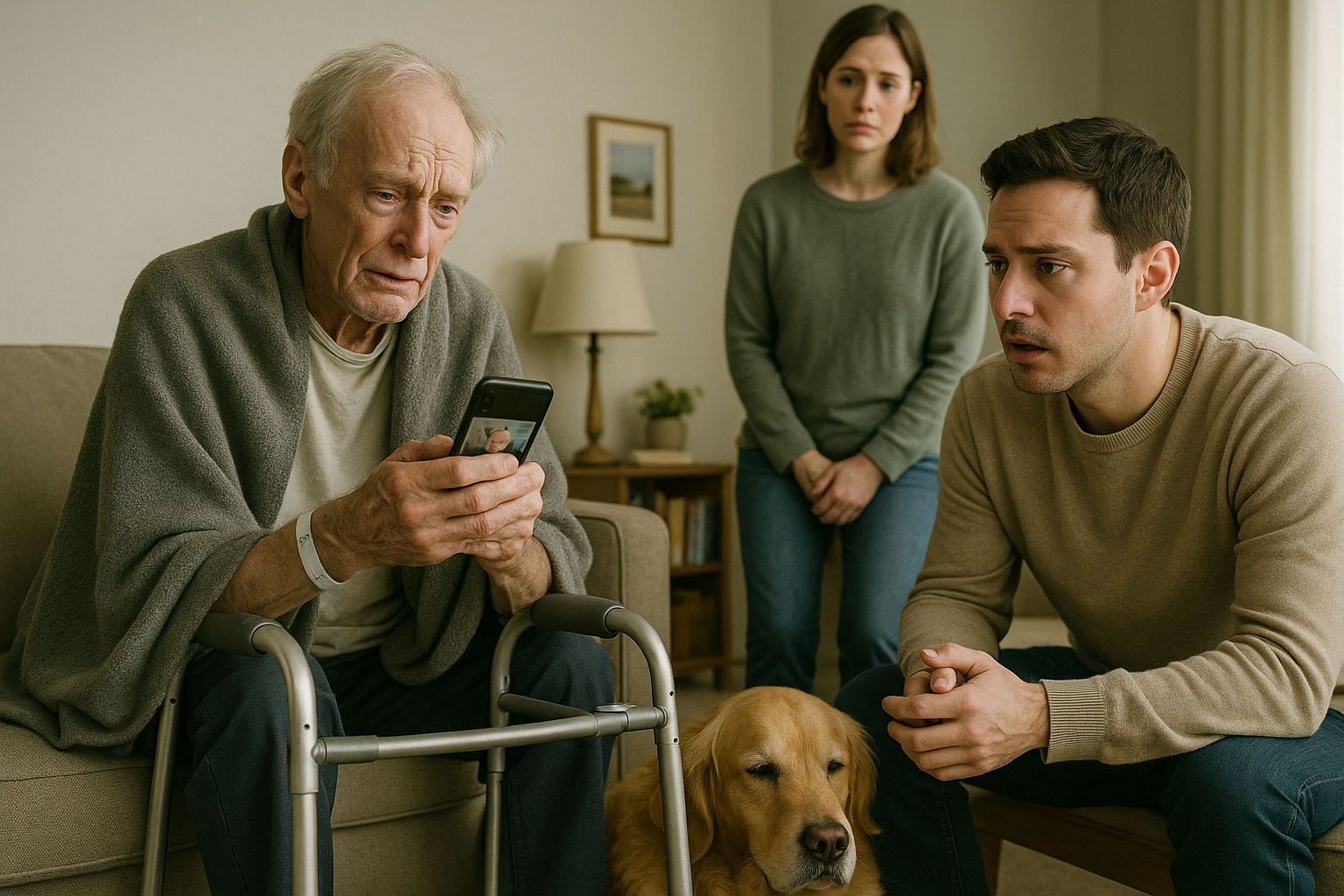
He shuffled past me, Molly sniffing his shoes. When his sleeve slipped, I saw a hospital band still around his wrist. The plastic tag read: “Thomas Miller, 78”. Underneath: “Memory Care Unit”.
My chest tightened. I had spent my whole adult life running from anything that smelled like hospitals, like long corridors, like the slow fading of someone you loved.
Like my mother.
Emma guided Thomas to the couch. He moved with the clumsy caution of someone who had fallen too many times and remembered every bruise. I dialed the number on the band. It rang and rang, then a recorded voice told me the line was closed for the weekend.
“Try the police,” Emma said.
Half an hour later, a bored-sounding officer told me they were “aware of the escape” and that someone would come “as soon as a unit is available”. No time estimate. No urgency.
“He’s safe with you, right?” the officer asked.
I looked at Thomas, who was now carefully petting Molly’s head with both hands, as if she might dissolve if he pressed too hard.
“Yes,” I said. The word felt heavier than it should.
Emma made tea. She wrapped Thomas in our thick grey blanket, the one we usually saved for movie nights. He held the mug with both hands, staring at the steam like it was a message he was trying to read.
“Lena always made chamomile,” he said suddenly. “For my nerves. She said I worried holes into the air.”
I froze in the doorway. My mother used to say the same thing to my father, long before he left.
“Where do you live, Thomas?” Emma asked gently.
He blinked, lost. “Here,” he said at last. “With Lena.”
Emma glanced at me. I shook my head. This was some coincidence. There were thousands of Lenas in the world. My mother was gone. I had buried her. I had packed the apartment, signed the papers, donated the clothes.
Still, something gnawed at me.
I brought my laptop to the coffee table. “Thomas Miller,” I murmured, typing. City, age. The search spat out a list of names, obituaries, public records. Then one link made my stomach lurch.
A local news article from two years ago: *“Man, 76, Searches For Daughter Given Up For Adoption: ‘I Just Want To Say I’m Sorry’.”* Under the headline was a photo of a younger Thomas, standing in front of a hospital. In his hands, a faded black-and-white picture of a newborn baby. The caption: “Baby Lena, 1967”.
My hands started to shake.
Emma leaned over my shoulder. “David…?”
I scrolled. The article described a girl born in a small town, placed for adoption, the papers sealed. The mother: a 19-year-old named Maria. The father: not listed.
Halfway down the page, a sentence burned my eyes: *“Thomas believes his daughter may have been renamed Elena by her adoptive family, based on a letter he received years later.”*
Elena. My mother’s full name.
The living room blurred. I heard my own voice from far away: “This is not possible.”
Behind us, Thomas cleared his throat. “You look like her when you are angry,” he said softly.
I turned. “Like who?”
“Lena,” he answered. “She had this wrinkle here.” He pointed between his brows, the exact place where my skin tightened when I was upset. “And she stirred the soup too fast.”
The smell of my childhood kitchen slammed into me: burnt onions, cheap spices, my mother’s tired smile. Her rare stories about “a man who had to leave” and “papers that couldn’t be changed.” She never spoke his name.
I sat down opposite him, legs suddenly weak. “Thomas,” I said, my voice a rasp, “did your daughter move to this city?”
He squinted at me. “She sent a card once. Little boy with a missing front tooth.” He smiled faintly. “She wrote, ‘This is David. He likes trucks and hates soup.’”
My throat closed. I had a photo like that, in a box I never opened. A card with shakier letters at the bottom: *Love, Mom.*
Emma’s hand found the back of the couch, gripping it hard.
“You’re saying…” I whispered. “You’re saying your daughter had a son named David?”
Thomas nodded slowly. “My grandson,” he said, the word breaking on his tongue. “But Maria said… said I had no right. I drank too much. I left too much. I… forgot too much.” He tapped his temple weakly. “Now this does the forgetting for me.”
Tears stung my eyes.
“David,” Emma murmured, “I think—”
“I know what you think,” I cut her off, too sharply. “This is crazy. It’s a story he told some reporter. It doesn’t mean—”
But the pieces were already slotting into place, one by one, cruel and inevitable.
My mother’s refusal to talk about her father.

The sealed file in the social worker’s folder I saw by accident.
The way she stared at the window on my tenth birthday and whispered, “He doesn’t know you exist.”
I stood up so fast the mug on the table rattled. “I need air,” I said, heading for the door.
Behind me, I heard Thomas’s voice, thin and frightened. “Don’t go, Lena. Don’t leave again.”
I stopped with my hand on the doorknob.
I wasn’t Lena. I wasn’t his daughter. I was the boy who had watched cancer eat his mother in a hospital bed while distant relatives argued about inheritance in the hallway. I was the boy who had promised never to need anyone who could leave.
And yet… he had found his way to my doorstep, clutching nothing but a hospital band and a name.
I turned back. The old man’s hands were shaking. Molly had laid her head on his knee, as if she knew something I didn’t.
“David,” Emma said quietly, “you always said you wanted to know where you came from.”
“I wanted information,” I snapped. “Not a… person.”
Thomas’s eyes filled with tears. “I’m sorry,” he whispered. “I was late. I got lost. I’m always lost.”
The anger drained out of me, leaving only something heavy and aching.
I sat down again, this time closer. Close enough to see the thin white scar above his eyebrow — the same place I had a tiny mark from falling off my bike at seven.
“Thomas,” I said slowly, tasting the name. “What was your daughter like?”
His face lit up, for a moment younger, clearer. “She laughed with her whole body,” he said. “She cried quietly. She always forgave me faster than I deserved.” His gaze met mine. “Are you… are you her boy?”
I didn’t have proof. No DNA test, no documents. Just stories that lined up too perfectly, a name that echoed through two lifetimes, and a stranger who looked at me like I was the last page of a book he’d been trying to read for fifty years.
My voice shook. “My mother’s name was Elena,” I said. “She called herself Lena. She died five years ago.”
Thomas’s face crumpled. He pressed his hand to his mouth, shoulders quaking with silent sobs. Emma reached for a tissue, then stopped herself, letting him have the space to break.
“I missed everything,” he choked out. “Her school. Her wedding. Her boy.” His eyes searched my face helplessly. “Can… can I at least remember you before I forget you too?”
The cruelty of it hit me like a punch: he had finally found us at the exact moment his mind was slipping away.
I could have said no. I could have called the police again, insisted they take him back to white walls and nameless nurses. Pretended this day had never happened.
Instead, I reached for my phone, opened the gallery, and scrolled to the photos I never showed anyone: my mother in the garden with dirt under her nails; my college graduation, her eyes shining; the last picture, her in a hospital chair, wrapped in a knitted shawl, trying to look brave.
I turned the screen toward him.
“This is her,” I said. “Your daughter. My mother.”
His hands trembled as he took the phone. His thumb brushed the glass like he was afraid to smudge her.
“My girl,” he whispered. He touched the picture of me next to her. “My boy.”
Tears blurred my own vision. Emma’s soft sniffle came from behind me.
We sat like that for a long time, three strangers bound by a woman who wasn’t there to explain any of it.
By the time the knock came — two hours later, sharp and official — Thomas was asleep on our couch, Molly curled at his feet. He had fallen asleep mid-sentence, telling me how Lena used to steal apples from the neighbor’s yard. I had heard that story before, from the other side.
The care home nurse at the door looked exhausted. She apologized too many times. Protocol this, understaffed that. I signed the forms with a hand that didn’t feel like mine.
“Do you want to say goodbye?” she asked.
I looked at the frail figure under our grey blanket. At the man who might be my grandfather, who had finally found his family only to be taken back to a place where every face was a question.
I walked over and knelt beside the couch.
“Thomas,” I said softly.
He stirred, blinking awake. For a moment his eyes were clear, startlingly present.
“Dad,” he said.
Then he focused and corrected himself. “David.”
The word hung between us, heavy with everything we would never have time to fix.
“They’re taking you back,” I said. “But I’ll come visit. I’ll bring photos. I’ll tell you about her. About me.”
A tear slid from the corner of his eye into the wrinkles of his cheek. “Don’t be late,” he whispered. “I… I forget fast.”
My throat burned. “I’ve already been late my whole life,” I said. “I won’t be anymore.”
He smiled, a small, tired curve of his mouth. “You stir the soup too fast,” he murmured, and for a second, I heard my mother’s voice laughing in our cramped kitchen.
When they wheeled him out, the hallway felt too big, too bright. The door closed with a soft click that sounded like the end of something and the beginning of something else.
Emma slipped her hand into mine. “Are you okay?” she asked.
“No,” I said honestly. Then, after a moment: “But I think he needs me to be.”
The house was quiet again. The pasta on the stove had overcooked into a sticky mess. I threw it away and filled the pot with fresh water.
As it boiled, I took out a notebook and wrote at the top of a clean page: “For Thomas.” Underneath, I started with the only story that made sense.
“My name is David,” I wrote. “I hate soup. But I’m going to learn how to make it the way your daughter did.”
For the first time in years, as the water bubbled and steam fogged the window, I felt something unfamiliar creeping into the spaces where resentment and emptiness had lived.
It felt a little like family.