The old woman in the fourth-floor window kept waving at my son every morning, until one day he asked, “Dad, why is she crying if she says she’s fine?”

We moved into that gray apartment block in late autumn, when the trees were almost bare and the city felt like a place that had forgotten how to smile. My son, Leo, was six, with a backpack almost bigger than him and the kind of curiosity that makes adults both proud and scared.
The first morning, as we hurried to school, Leo suddenly stopped in the courtyard and pointed up.
“Dad, look. She’s waving.”
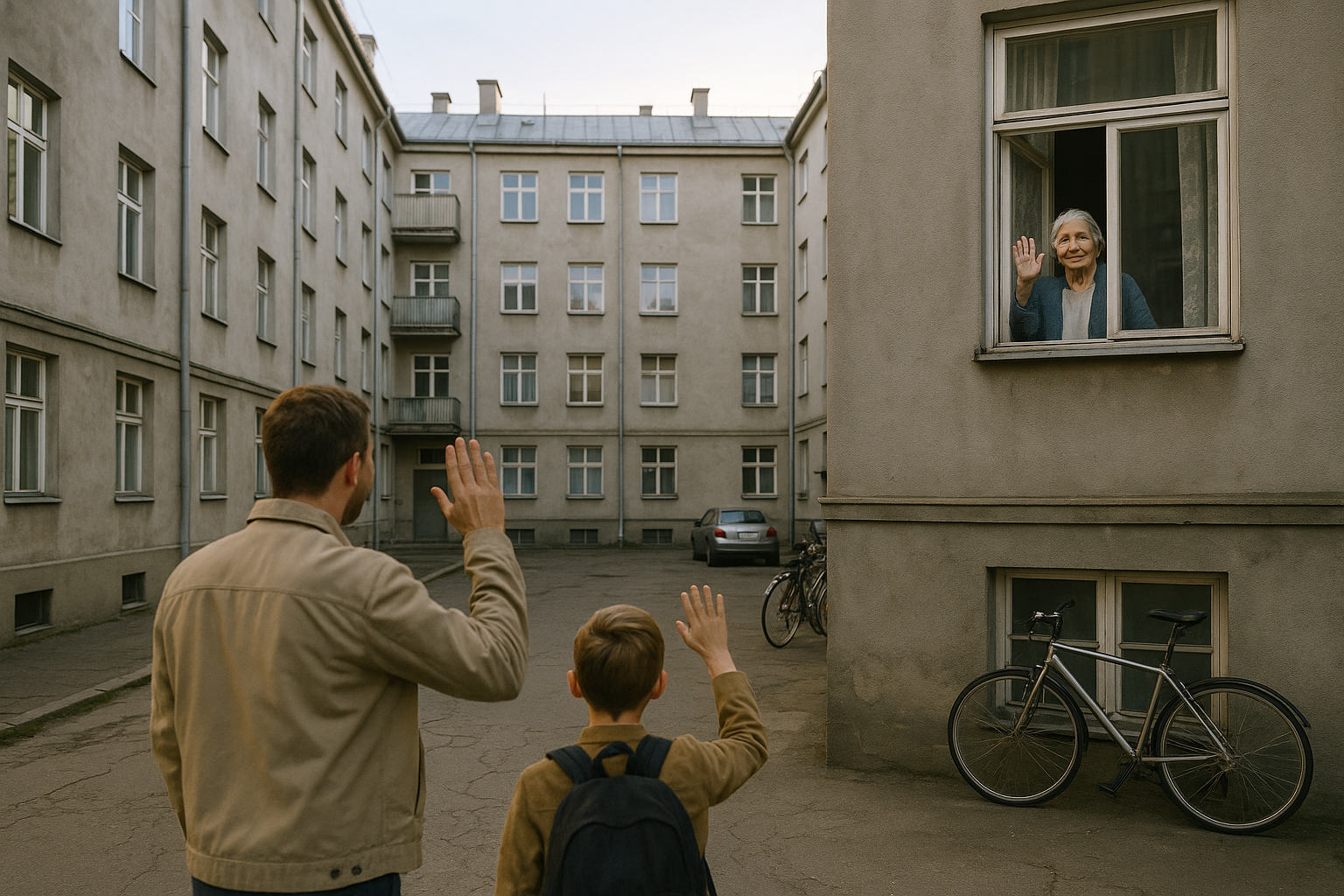
In the fourth-floor window of the opposite building, behind pale lace curtains, stood an elderly woman. Thin shoulders, a faded blue cardigan, silver hair in a loose bun. She really was waving—small, careful movements, as if afraid her hand might break. I hesitated, then lifted my hand and waved back. Her face lit up in a way that felt strangely personal, like she’d been waiting for this exact moment.
From that day on, it became a ritual. 8:05 a.m., we crossed the cracked asphalt between the blocks, and there she was, in her window. Leo would jump and wave with both hands.
“Good morning, lady!” he shouted every time, though she surely couldn’t hear.
She would smile, press her hand to the glass, and nod. Sometimes she lifted a small porcelain mug, as if toasting us.
A week later, when rain lashed against our umbrellas, I noticed something new. On the fogged window there were little smiley faces drawn in the condensation. One big one and one small one. Leo squealed.
“Dad, that’s us! The big one is you, the small one is me!”
I laughed, but my chest tightened.
The following Monday, we were running late. I was stressed, half-dressed, searching for my keys, when Leo appeared in the hallway already in his jacket.
“Hurry, Dad! She’ll be waiting.”
Those words landed heavier than they should have. Waiting. For who? For us?
We rushed downstairs. The courtyard was empty, the sky low and cold. Leo scanned the building.
“She’s not there,” he said, disappointed.
I looked up. The window was dark, curtains closed.
“Maybe she overslept,” I muttered.
That afternoon, coming back from work, I saw her again. This time she was leaning on the window frame, no lace curtain between her and the world. When she noticed me, she hesitated, then opened the window a crack despite the chill.
“Excuse me!” she called in accented English. “The boy… is okay?”
“Yes, of course,” I replied, surprised. “He’s at his grandma’s today.”
Her shoulders relaxed. Up close, she looked even smaller. Her eyes were a strange mix of bright and tired.
“He is… very kind,” she said slowly. “Reminds me of my Daniel when he was little.”
I smiled politely, not sure what to say.
“Thank you for waving to him,” I managed.
“Oh no,” she shook her head. “You don’t understand. Thank you… for waving to me.”
Something in her voice made me look closer. The room behind her was dim but clean. On the wall, I noticed a row of picture frames, all tilted at slightly odd angles, as if often touched, often straightened.
“Have a good evening,” I said, and she nodded, closing the window with great care.
That night at dinner, Leo asked, “Dad, what’s her name?”
“I don’t know,” I admitted.
“You should ask,” he said seriously. “We can’t wave forever to someone and not know their name.”
The next morning, Leo was ready ten minutes earlier than usual. He practically dragged me outside. The window was open already, as if she’d been waiting.
Leo cupped his hands around his mouth. “What’s your name?” he yelled.
She laughed, a small, surprised laugh, and leaned closer.
“My name is Maria!” she called.
“Hi, Maria! I’m Leo! This is my dad!”
“Hello, Leo! Hello, Dad!” she answered, pronouncing “Dad” with a careful softness.
From then on, she was no longer “the old woman in the window.” She was Maria. She began leaving little signs on her glass: a drawn sun on bright mornings, a clumsy heart on Fridays. Leo started drawing little stick figures on paper and holding them up as we passed. She would nod and put her hands together like in prayer, touched by every simple drawing.
It might have stayed just that—small gestures in a cold city—but then came the day Leo asked me the question that changed everything.
We had overslept badly. I was snapping at him to hurry when he became very quiet, tugging at my sleeve.
“Dad,” he whispered, “Maria’s crying.”
I looked up, annoyed at first. Then I saw it.
Maria stood in the window as always, but her smile was gone. Her face looked gray. Her hand trembled against the glass. And even from the courtyard, I could see the wet tracks on her cheeks.
She lifted her hand in a wave, but it was slow, heavy.
Without thinking, I shouted, “Maria, are you okay?”
She nodded too quickly, then shook her head, a tiny, defeated movement. I saw her lips form words I couldn’t hear.
“Dad,” Leo said, his voice small, “why is she crying if she says she’s fine?”
I didn’t have an answer.
At work I couldn’t focus. The image of her thin shoulders, the way she pressed her forehead against the window, wouldn’t leave my mind. At lunch, instead of eating, I went to the building office and asked the manager if he knew anything about a woman named Maria on the fourth floor.
He frowned, then his expression softened.
“Ah, yes. Mrs. Maria. Lives alone. Her son moved abroad years ago. I think… she doesn’t get many visitors.”
“Does anyone check on her?” I asked.
He sighed. “Sometimes a nurse comes. She refuses a care home. Says she is ‘waiting for family.’”
On my way home, I bought a small box of cookies and a cheap bouquet of yellow flowers. It felt childish, but I had to do something.
“Dad, we’re going to see her?” Leo asked, eyes wide.
“If she wants,” I said.
We climbed the narrow staircase, the air smelling of dust and old paint. Her door was the last one in the corridor, a little crooked, with a worn welcome mat.
I knocked.
There was a pause, then a cautious shuffle of feet. The door opened a crack. One familiar eye appeared.
“Yes?”
“It’s us,” I said awkwardly. “From the courtyard. Leo and… Dad.”
The chain slid back. The door opened fully.
She looked even smaller up close. Her cardigan hung loosely from her shoulders, and her hands shook slightly as she held onto the frame.
“We brought… cookies,” Leo said, suddenly shy. “And flowers.”
For a second, she didn’t move. Then her fingers flew to her mouth, and her eyes filled instantly with tears.
“For me?” she whispered.
“For you,” I said.
Her apartment was simple but very tidy. Lace doilies on the table, an old armchair by the window, a tiny kitchen that smelled faintly of tea and something like cinnamon. On the wall were dozens of photographs: a young woman at a seaside, a boy with messy hair, a graduation, a wedding. The same faces aging, smiling, drifting away into distance.
“That’s my Daniel,” she said, noticing me looking. “He lives… very far.” She tapped one picture of a young man with a backpack and hopeful eyes. “He said he will come when he can.”
“When did you last see him?” I asked gently.
She stared at the photo for a long moment.
“Ten years,” she said quietly. “But he calls sometimes. He is… busy.”
Leo squirmed on his chair, glancing between us.
“Do you have any grandchildren?” he asked.

Maria’s smile wobbled.
“No,” she replied. “Not yet.” She paused, then looked at him with a softness that hurt to see. “But now, maybe, I have one small friend.”
Leo straightened proudly. “I can be your grandchild,” he said.
It was such a simple, childish offer. But Maria’s face crumpled as if he had just lifted the world from her shoulders. She covered her eyes with both hands and sobbed—quietly, like someone who hasn’t allowed themselves to cry in years.
I stood there, useless, with the cookies in my hands, feeling something inside me twist.
We stayed for an hour. We drank tea—too sweet, with lemon slices—and Leo showed her his school notebook. She listened to every word as if it were the most important story in the world.
When we finally left, she walked us to the door, clutching the flowers like a treasure.
“You will still wave from the courtyard?” she asked, almost afraid.
“Every day,” Leo said firmly.
From then on, the window ritual changed. It was no longer just a wave. Some mornings, I saw the silhouette of her lifting a small mug and knew she was drinking her tea with us. On weekends, we visited. Sometimes for ten minutes, sometimes for hours. Leo told her about school, about his fears of math, about the kid who took his pencil. She told him about her childhood village, about her dream to be a singer, about the first time she saw the sea.
Winter came. One snowy morning, we went out as usual. Leo looked up, already waving.
“Good morning, Maria!” he shouted.
But the window was empty.
No curtains, no silhouette, just the pale reflection of the gray sky.
My stomach dropped.
“Maybe she’s in the kitchen,” I said quickly. “Or sleeping in.”
Leo didn’t answer. His hand fell slowly to his side.
All day I checked the window in my thoughts. When I came home in the evening and still didn’t see her, I told Leo I needed to “talk to someone at the building.” He nodded, pretending not to be worried.
The corridor on the fourth floor was cold. Her door was closed, the welcome mat neatly in place. I hesitated, then knocked.
No answer.
I was about to turn away when I heard a door open behind me.
“She went to the hospital this morning,” a neighbor said quietly. “Ambulance came. Heart, I think.”
My throat tightened.
“Which hospital?” I asked.
An hour later, I was standing in a white corridor that smelled of antiseptic. I found her room. She was lying there, smaller than ever against the big pillows, a thin tube of oxygen under her nose. Her eyes were closed.
I stepped closer.
“Maria?” I whispered.
Her eyes fluttered open. When she saw me, her lips curled into a faint smile.
“Dad,” she said with effort. “Where is Leo?”
“At home,” I said. “It’s late. I didn’t want to scare him.”
She nodded slowly.
“You came,” she murmured. “I thought… maybe I only dreamed you. The boy in the courtyard. The waving.”
“You didn’t dream,” I said. “We’re real.”
She reached for my hand, her fingers light as paper.
“I was… so afraid to die alone,” she whispered, eyes filling. “But now… maybe I won’t. Because someone will remember I was here.”
I swallowed hard.
“We will remember,” I said. “I promise.”
She closed her eyes, still smiling.
Maria didn’t come back to the fourth-floor window.
A few days later, a nurse called to say she had passed away quietly in her sleep. No family had visited. There would be a simple, short funeral arranged by the city.
I sat on the edge of my bed, phone in hand, and stared at the wall, trying to breathe.
“How do I tell Leo?” I thought.
In the end, he made it easier for me.
As I walked into the living room, he was standing by the window, looking out into the courtyard.
“She’s not coming back, is she?” he asked without turning.
I froze.
“Why do you think that?” I said softly.
He pointed to the opposite building.
“Her window is open,” he said. “But there’s no mug. And no curtain. It looks… empty.”
I came closer and put my hand on his shoulder.
“Leo,” I said, my voice shaking, “Maria got very sick. She went to the hospital. And… she died.”
He didn’t cry right away. He just stood there, very still.
“Did she die alone?” he asked after a moment.
I thought of her hand in mine, of her quiet words.
“No,” I said. “She knew we were with her. She wasn’t alone.”
Leo’s shoulders trembled.
“We have to wave anyway,” he said stubbornly. “In case she can still see.”
So we did.
The next morning, at 8:05 a.m., a man and a small boy stood in a cold courtyard and waved at an empty window on the fourth floor.
We did it the next day. And the next. After a week, Leo drew a big smiley face on a piece of paper, taped it to our own window and said, “Now she can see us from both sides.”
Months passed. The city slowly remembered how to smile again. New curtains appeared in Maria’s old window. A young couple moved in, then a baby’s cry began to echo in the stairwell.
One evening, as we were clearing the table, Leo said quietly,
“Dad, when I’m big and you’re old, I’ll come visit you. I won’t forget like her son did. I promise.”
I felt my throat close up.
“Okay,” I managed. “I’ll be waiting at the window.”
He nodded, serious.
“Then you won’t be afraid,” he said.
I looked out at the fourth floor, at the now-familiar window that belonged to someone else.
For most of my life, it had just been glass.
Now, every time I pass a building and see an old person looking out, I slow down. Sometimes I wave. Sometimes they wave back, surprised, almost shy.
And I can’t stop thinking: how many Marias are out there, behind their windows, waiting for someone to notice that they exist?
All it took was a child’s wave to make one of them feel less alone.
And sometimes, when the morning light hits the glass just right, I could almost swear I see a thin hand, in a faded blue cardigan, still waving back.