Richard Harrison was a man many admired… and at the same time feared.
He was one of New York’s self-made multimillionaires — flawless suits, sharp instincts, and a reputation built on one simple truth: Richard did not become rich by being weak.
His penthouse apartment rose high above the city like a fortress of glass. His calendar was filled with meetings. Markets reacted when he signed something. And yet, every evening, when the lights went out and the city lights became a distant glow… Richard’s life felt painfully empty.
After his divorce, only one person remained who meant more to him than money.
His nine-year-old daughter, Emily.
Emily was a smart, curious little girl — and as lonely as a child should never be. Richard tried to compensate with the best of everything: elite school, piano lessons, expensive toys that arrived faster than love.
And in this carefully controlled world, there was someone who was always present.
Margaret Brown.
Emily’s nanny.
She was fifty-two, Black, calm like a sunrise — always patient, always kind. With gentle hands she braided Emily’s hair. In the evenings she read her stories, giving each character a different voice. When Emily woke from nightmares, Margaret sat beside her bed on the floor and stayed there until the little girl’s breathing calmed.
Richard told himself Margaret was simply good at her job.
Nothing more.
Lately, however, small details had started to become unsettling.
Margaret often skipped meals in the house. She carefully packed leftovers and put them into a box “for later.” Her shoes were so worn that the heel was almost torn apart. Her coat had patches on the elbows. And although Richard believed he paid her well — Margaret did not spend on herself.
Richard’s thinking did not begin with kindness.
But with motives.
MAYBE SHE HANDLES MONEY BADLY. MAYBE SHE IS HIDING SOMETHING. MAYBE SHE IS SENDING IT TO THE WRONG PLACE.
Suspicion — he told himself — kept people like him alive.
So one cold evening, after Margaret said good night to Emily and stepped into the elevator, Richard did something he had not done in years.
He began to follow someone.
He waited until Margaret left the building, got into his car, and followed her from a distance as she moved through the city. The streets glistened under the lights. The air was sharp. Margaret walked with purpose — not toward the subway, not toward a friendly neighborhood.
But toward parts of the city that Richard had only seen from behind tinted glass.
Twenty minutes later, Margaret stopped in front of a crumbling brick building.
Above the door hung a faded sign:
HOPE COMMUNITY CENTER
Richard frowned.
This was not an apartment.
Not a bar.
It did not fit the story he had built in his head.
Margaret entered — and in that moment the building came to life.
Children ran toward her as if sunlight had arrived.
Their faces lit up. Their voices filled the room.
“MAMA MARGARET!” “MAMA MARGARET!” “MAMA MARGARET!”
Richard froze on the sidewalk.
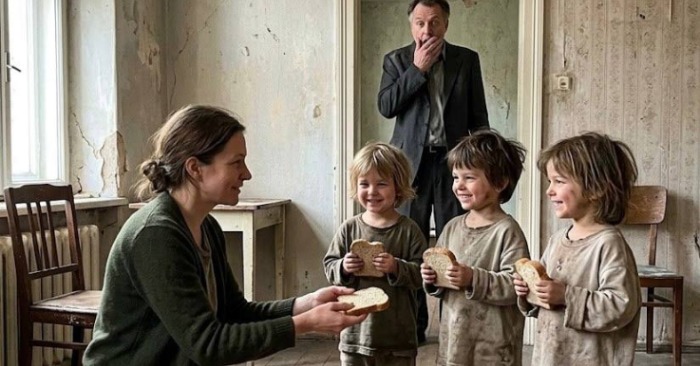
Through the dusty windows he saw Margaret kneel down and open her bag.
Sandwiches wrapped in napkins.
Bags of rice.
Carefully folded used clothes.
Notebooks.
Pencils.
A little boy in torn shoes limped toward her. Margaret immediately crouched down and tied his shoelaces as if all the time in the world belonged to her.
A teenage girl stood by the wall with her arms crossed, pretending not to care.
Margaret hugged her anyway.
A baby began to cry, and Margaret picked him up, rocked him, and kissed his forehead — as if it were the most natural thing in the world.
RICHARD STOOD THERE, MOTIONLESS.
Because the food Margaret had taken from his house…
Was not for herself.
But for these children.
Children who looked at her as if she was everything to them.
And suddenly the “worn shoes” and the “skipped meals” no longer seemed suspicious.
But like sacrifice.
Richard felt something begin to sting his eyes.
HE HAD NOT CRIED IN YEARS.
Not during his divorce.
Not at his father’s funeral.
Not even when his daughter once quietly asked why he was always working.
But now, as he saw a woman who gave so much with so little…
His throat tightened.
And yet the tears came.
That evening he did not go inside.
He drove home like a man returning from a world he had never known. He stepped into the penthouse, looked at the shining floors, the artwork, the silence…
And for the first time, he did not see success.
BUT EMPTINESS DRESSED IN EXPENSIVE CLOTHES.
The next day Richard could not concentrate.
The numbers blurred. Phone calls felt meaningless. A seven-figure deal landed on his desk, and for the first time he did not find it exciting.
Only Margaret’s image filled his mind — her hands working, her heart giving, feeding children who had nothing.
When Margaret arrived for work, Richard asked her to come into his study.
Margaret entered slowly, cautiously. She probably expected a complaint.
Or worse.
Dismissal.
RICHARD CLOSED THE DOOR.
“I followed you last night,” he said.
Margaret froze. Her face turned pale.
“Sir, I—”
“No,” Richard interrupted. “Don’t explain yet. I saw everything.”
Margaret lowered her gaze.
“The center. The children. The food… the clothes.”
Richard swallowed.
“WHY DIDN’T YOU TELL ME?”
Margaret clasped her hands tightly.
“Because it’s not your burden,” she said softly. “Those children have no one. And if I can give them something — a little warmth, a meal, a notebook — then I have to do it.”
Richard looked at her for a long moment.
“You skip meals,” he said. “You wear broken shoes… because of them?”
Margaret met his gaze, tired but clear.
“Mr. Harrison,” she said gently, “money is just paper. But kindness… kindness is what children remember when they grow up.”
Richard’s chest tightened.
“AND EMILY?” — MARGARET ADDED CAREFULLY. “EMILY HAS EVERYTHING. I JUST WISH THE OTHERS HAD AT LEAST HALF OF THAT.”
That sentence fell on him like a weight.
Because for the first time he heard what Margaret had not said out loud.
Emily has everything…
Except presence.
Richard slowly sat down.
“I thought I paid you,” he whispered. “But it turns out… you gave me something I didn’t even know I had lost.”
Margaret’s face softened.
THAT AFTERNOON, RICHARD SURPRISED EMILY.
“Put on your coat,” he said. “We’re going somewhere.”
“Where?” Emily asked, her eyes shining.
Richard hesitated for a moment.
“We’re going to see Margaret’s special place.”
At the Hope Center, Emily stopped in the doorway.
Not because it was frightening.
But because it was real.
CHILDREN SAT ON THE FLOOR DRAWING WITH BROKEN CRAYONS. A LITTLE GIRL HELD A WORN TEDDY BEAR AS IF IT WERE HER ONLY TREASURE. THE ROOM WAS SMALL, THE PAINT WAS PEELING, THE CHAIRS DID NOT MATCH.
And yet it was full of life.
Margaret gently introduced Emily to the others.
Within minutes, Emily was already laughing.
She shared pencils. Played tag. Folded a paper star for a shy little boy.
Richard watched silently.
And something changed inside him.
He realized what he had taken from his daughter — not out of cruelty, but out of neglect.
HE GAVE HER LUXURY.
But not meaning.
On the way home, Emily leaned against him in the back seat.
“Dad,” she said softly, “Margaret’s children are wonderful.”
Richard looked into the mirror.
“Can we help them more?” Emily asked.
Richard gripped the steering wheel.
“Yes,” he said. “We will help a lot.”
THE FOLLOWING WEEKS PASSED FASTER THAN ANY BUSINESS DEAL.
Richard did not just donate.
He showed up.
He listened.
He asked questions.
And he did what he always did when something became important to him:
He built.
A few months later, the old center was completely transformed.
IN ITS PLACE STOOD A BRIGHT, MODERN BUILDING: CLASSROOMS, A LIBRARY, A DINING HALL, A PLAYGROUND, AND A MEDICAL ROOM. SUNLIGHT POURED THROUGH CLEAN WINDOWS. THE WALLS WERE COVERED WITH CHILDREN’S DRAWINGS.
Above the entrance, large letters read:
MARGARET BROWN ACADEMY
At the opening, Margaret stood with trembling hands.
The children cheered. Volunteers applauded. Cameras flashed.
Richard stepped forward with Emily by his side.
“This woman,” he said, “taught me that true wealth is not a bank account.”
He looked at Margaret.
“SHE GAVE WHEN SHE HAD ALMOST NOTHING. SHE CARRIED PEOPLE WHEN NO ONE WAS WATCHING. AND SHE REMINDED ME OF SOMETHING I HAD FORGOTTEN LONG AGO.”
He paused.
“A rich person is not the one who has a lot. A rich person is the one who can give.”
Fighting tears, Margaret cut the ribbon.
Not for the attention.
But because the love she had quietly given the world had finally become visible.
The Academy soon became a place of hope in the city.
Children who once had nowhere to go now received books, food, teachers, and safety.
AND MARGARET WALKED AMONG THEM EVERY AFTERNOON JUST AS SHE ALWAYS HAD.
She hugged them.
Encouraged them.
And quietly always said the same thing:
“You matter.”
Richard continued to run his company.
But he no longer lived as if his calendar was more important than his daughter.
He showed up at the Academy. Read stories. Mentored teenagers. Watched Emily become a girl who not only receives —
But gives.
One evening, as the sun set behind the Academy, Margaret sat on a bench.
Richard sat down beside her.
For a long time, neither of them spoke.
Then Margaret spoke softly:
“I never imagined a life like this.”
Richard smiled.
“Neither did I,” he said. “I learned from you what it really means to be rich.”
AND IN THAT SILENCE, RICHARD FINALLY UNDERSTOOD:
Wealth was not the penthouse.
Not the cars.
Not the empire.
Wealth was seeing his daughter laugh with children the world had forgotten.
And realizing that his legacy could not be measured in money.
But in love.