I was 42 years old when I understood that some truths hide not in documents or conversations, but in the snow, on a street soaked with cold, next to a trash container. Until that day I thought that my family history was simple, maybe even boring. I was wrong.
That morning I was driving to work earlier than usual. It had started snowing during the night, and the city looked frozen. People were hurrying with their heads down, each taking care only of themselves. I was one of them.
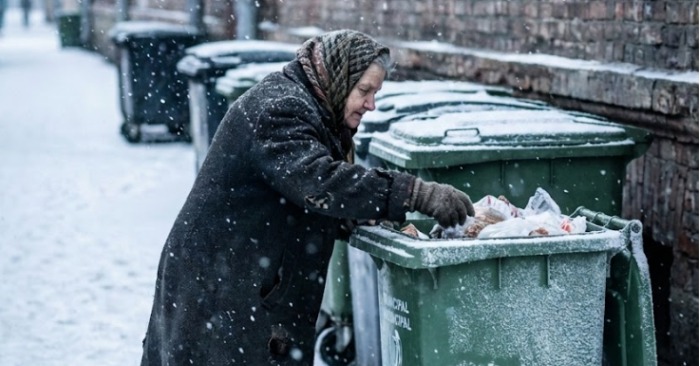
I saw her by accident. At first just a movement to the side. An elderly woman was standing by a green container, trying to open it. Her movements were slow, careful. She looked too weak to fight the cold, but she was still standing there.
I could have walked away. Many would have done that. But something stopped me. Maybe her posture. Maybe the fact that she looked too neat for such a place.
I went up to her and asked if she needed help. She got scared. Tried to close the lid and said that everything was fine. Her voice was trembling not only from the cold.
I offered to buy her food. She was silent for a long time, then said that she only needed bread. Nothing more.
We went to a nearby store. She walked slowly, but tried to keep her back straight. She introduced herself as Elena. She was 78 years old.
She spoke in short sentences. That her pension was not enough. That her son lives in another city. That she does not want to bother him. She repeated these words several times, as if convincing herself.
When I said my last name, she suddenly stopped. Looked at me for a long time, carefully. I thought that she had simply become weak.
Then she asked whether my father’s name was Jonas.
I said “yes”.
She lowered her eyes and said that she was my father’s mother.
I was speechless. My father had always told me that his mother died long ago. That she left the family. That there was nothing to talk about.
Elena told a different story. About how after her husband’s death she was left alone with a child. About how my father left to study and never returned. About letters that remained unanswered.
She never asked for help. She said that she did not want to be a burden.
I understood that my entire understanding of family had been built on silence. On a convenient truth.
That day I took her to my place. We drank tea. She sat quietly, as if afraid to take up too much space.
Later I contacted my father. The conversation was difficult. Long. Full of pauses. But it was necessary.
Today Elena no longer lives alone. She no longer searches for food in trash containers. And I know that sometimes one accidental meeting can destroy a lie that lived for decades.
Do you think that family truths should always be told, even if they hurt?