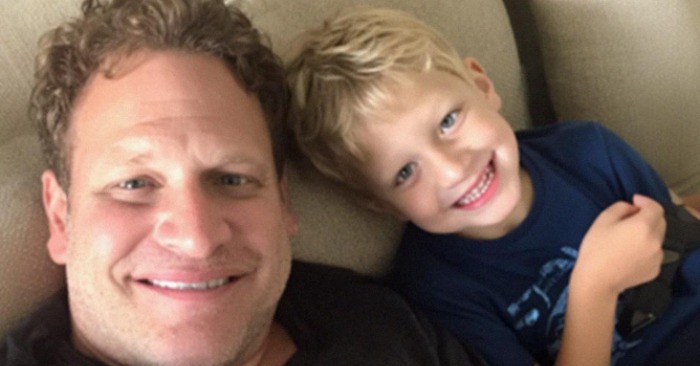
After losing my wife and daughter in a tragic accident, I adopted a five-year-old boy, which felt like fate. We were strangers and became a family overnight. But then a routine medical test revealed something that made me question my past, his past, and fate itself.
My name is Ethan, and I was just 32 years old when life cruelly took my wife and daughter from me.
Ten years ago, a drunk driver ran a red light. My wife, Sarah, and our three-year-old daughter, Emma, were on their way home from a birthday party. They died at the scene.
The police officer who stood at my door that day kept saying, “I’m sorry,” but the words didn’t reach me. It was as if someone had grabbed my chest and ripped out everything that made me human.
For me, grief felt like drowning in cement—heavy, cold, final.
I was just going through the motions. I went back to work. I attended dinners that friends organized for me. I nodded when my mother suggested for the fourth time that I start therapy.
But inside? I was empty.
My friend Marcus tried to set me up with women. “You’re too young to give up on life, man,” he said.
I tried. I met a woman in a café. She was nice, easy to talk to. But in the middle of our conversation, she laughed at something I said—and that laugh reminded me so much of Sarah that I had to apologize and escape to the restroom.
I never called her again.
Then I met another woman. And another. But somehow, they all reminded me of what I had lost.
I had loved Sarah so completely that loving someone else felt like a betrayal. How could I hold another woman’s hand? How could I wake up next to someone who wasn’t her?
So I stopped trying. I built walls around my heart, so high that no one could cross them.
But what no one tells you about grief is this: Eventually, the edges soften. The pain transforms into space. A hollow, aching space where something used to be.
And one morning I realized that this room wasn’t meant for a new wife.
It was meant for another child.
I had always dreamed of being a father.
Even after Emma’s death, that desire never left me.
One Tuesday morning in April, I got in my car and drove to the Sand Lake Children’s Home. I didn’t call ahead. I just went, knowing that otherwise I would only put myself off.
Inside, there were children everywhere. They were playing, watching TV, running around. After years of silence, the noise was overwhelming.
A woman named Mrs. Patterson greeted me. “I’d like to find out about adoption,” I said.
She looked me over. “Are you married?”
“Widowed.”
Her gaze softened. “Come with me.”
We walked through the common rooms. She introduced me to several children, and each one was wonderful—but none of them felt right.
Then we entered the art room.
In one corner, a small boy sat alone at a table, drawing with a short blue crayon. He wasn’t laughing with the others. He was silently creating his own world on the paper.
“This is Liam,” Mrs. Patterson said softly. “He’s five. He’s been with us for about four years.”
Liam looked up. His eyes were warm, deep brown, and held something ancient within them, something that struck me to the core.
We looked at each other across the room, and something shifted between us. Perhaps recognition. Perhaps destiny. Perhaps hope.
My heart, which had been silent for ten years, suddenly remembered how to beat.
“May I meet him?” I asked.
Mrs. Patterson introduced us. Liam shook my hand with touching sincerity.
“Hello,” he said softly.
“Hi,” he said quietly. “I’m Liam.”
“Hey, buddy, I’m Ethan. That’s a cool drawing. What is it?”
He looked at his paper. “A family. A dad, a kid, and a dog.”
My heart ached. “That sounds like a lovely family.”
“Yeah.” He picked up his pen again. “One day I’ll have one like that, too.”
I sat down next to him. “What kind of dog?”
His face lit up. “A big one. Like a Golden Retriever. They’re sweet and always love a hug.”
We talked for an hour. About dogs, his favorite food, superhero movies. He was clever, witty, and hopeful in a way that broke your heart.
When it was time to leave, Liam hugged me without hesitation.
“Will you come back, Ethan?” he asked.
I crouched down. “Yes, buddy. I’ll be back.”
“Promise?”
“I promise.”
I kept that promise. For two months, I visited him every week while the paperwork was processed. Background checks, home visits, parenting classes—the system was thorough.
Then, one sunny afternoon in July, the judge signed the papers.
Mrs. Patterson cried as we left. “Take care of each other,” she said.
Liam held my hand the entire drive home. “Is this really forever?” he asked.
“This really is forever,” I replied.
His big, toothless grin hurt in the most beautiful way.
Life with Liam filled my quiet house with cartoons, dinosaur toys, and bedtime stories that always lasted longer than planned.
He was attentive and gentle. He sat beside me while I worked, painted, and hummed songs. At night, he would fall asleep holding my sleeve, as if afraid I might disappear.
“Daddy?” he asked one evening at dinner. After the first month, he started calling me that.
“Yeah, buddy?”
“Are you glad I’m here?”
I put down my fork. “Liam, you’re the best thing that’s happened to me in a very long time.”
He nodded earnestly. “Good. Because I’m happy too.”
We found our rhythm. Pancakes on Saturdays. Park or beach on Sundays. Homework during the week.
Then October came, and Liam developed a cough that just wouldn’t go away.
“Probably nothing serious,” the pediatrician said. “But since his medical history is incomplete, I’d like to create a genetic health profile. That way we can identify any potential hereditary risks.”
“Anything that’s necessary,” I said.
The nurse handed me the paperwork. One section caught my eye: “Optional: Activate kin matching for comprehensive genetic mapping.”
I checked the box without thinking.
“DONE,” she said. “THE RESULTS SHOULD BE READY IN ABOUT A WEEK.”
“Done,” she said. “The results should be here in about a week.”
Liam dangled his legs off the table. “Can we have some ice cream afterward?”
I ruffled his hair. “Absolutely.”
A week later, I was cooking in the kitchen when the email arrived: “Your genetic test results are available.”
I opened it casually, expecting technical jargon about allergies or vitamin deficiencies.
Instead, it contained something that made my blood run cold:
DIRECT COPIAL MATCH FOUND
Relationship: Parent/Child – 99.98% Match
ASSEMBLED PERSON: ETHAN ******
Assigned Person: Ethan ******
My last name. I read it three times. Then a fourth time. Then I picked up the phone and called the testing lab.
“This must be a mistake,” I said when someone answered. “I’m looking at the results for my adopted son, and it says I’m biologically related to him.”
“One moment, please.” Typing. “Sir, according to our data, there is a parent-child relationship between the DNA of patient Liam and the DNA we have stored under your name. The accuracy is 99.98 percent.”
My legs went weak. I collapsed onto the kitchen floor.
“That’s impossible. He’s adopted. I only adopted him a few months ago.”
“Our system only reports genetic matches. I can’t comment on the circumstances. The science is clear. Would you like to speak with a genetic counselor?”
“Yes. No. I… I need to think.”
I hung up.
Liam sat in the living room watching cartoons, completely unaware that my world had just been turned upside down. I looked at him through the doorway—this little boy I had chosen, this child I had fallen in love with—and tried to grasp the impossible.
He was mine. Not just legally.
Biologically.
My son.
But how?
I didn’t sleep that night. After Liam was in bed, I pulled out all the adoption paperwork. Medical records, application forms, case files. Most of the information about his birth parents was redacted, but one detail had slipped through.
Mother’s first name: Hannah.
I felt sick.
Hannah. There was only one Hannah in my past—a woman I’d briefly dated about six years ago. We’d met in a grief support group. She’d lost her father. I’d lost my family. We understood each other’s pain in a way no one else could.
But I was still broken. Incapable of giving her more than fragments of myself. After a few months, she accepted a job offer on the coast and moved away. We said goodbye over coffee, both knowing it wasn’t meant to be.
Could it be the same Hannah?
I searched for three days. Public records, social networks, old contacts. Finally, I found a phone number connected to her last known address in a small coastal town two hours away.
My hand trembled as I dialed.
One ring. Two. Three.
Then a voice I hadn’t heard in years. “Hello?”
“Hannah,” I said. “This is Ethan.”
Silence. Then a sharp breath.
“Ethan? Is everything… has something happened? Where did you hear…?”
“I need to talk to you. It’s about a boy. A five-year-old boy named Liam.”
The silence lasted so long that I thought she’d hung up.
“Please,” I said softly. “I need the truth.”
“Where are you?” she asked, her voice trembling.
“At home. But I can come to you.”
“No… I’ll come. Tomorrow. Is that okay?”
“Yes. Tomorrow.”
She came the next afternoon. I had sent Liam to Marcus’s house and told him I had boring grown-up things to do.
Hannah looked older, thinner, with dark circles under her eyes. We sat across from each other, and for a long time neither of us said a word.
“Is he mine?” I finally asked. “Is Liam my son?”
She closed her eyes. “Yes.”
“Tell me everything,” I said.
After she moved to the coast, she discovered she was pregnant. She had tried calling my old number, but I had changed it when I changed jobs.
“I was so scared,” she said. “My family disowned me. I had no money, no support. The pregnancy was difficult, and after the birth, I completely broke down.”
She wiped her eyes.
“I couldn’t take care of him, Ethan. I tried. But every time I looked at him, all I saw was my own failure. I had thoughts that terrified me.”
“So you gave him up,” I said quietly.
She nodded. “The social worker kept asking about the father. I said he was unknown. Not because I wanted to erase you, but because I thought you would have moved on with your life. And I didn’t want to drag you into my chaos.”
“Hannah…”
“I know it was wrong. But I wasn’t thinking straight. I just wanted him to have a chance. A real home.”
I leaned back and processed everything. All I felt was deep, painful sadness—for all of us.
“He’s happy,” I said. “He’s safe and loved. He calls me Dad—and he means it.”
Tears streamed down her cheeks as she clutched Liam’s teddy bear. “This is all I ever wanted.”
“Would you like to see him?”
She hesitated. “Would that be fair? He doesn’t know me. He has you.”
“That’s your decision. But if you ever change your mind, the door is open.”
She stood up slowly. “Thank you. For being the father I couldn’t give him sooner.”
Before she left, she turned around one last time. “Maybe I couldn’t raise him because he was meant to find his way back to you.”
After she drove off, I sat alone in the quiet house, processing the impossible truth.
Ten years ago, I had lost a family. For a decade, I believed I would never be whole again. Then I found a little boy in a foster home who needed a father—just as much as I needed a son.
And against all odds, he was mine.
When Liam came home that evening, he threw himself into my arms.
“Dad! We went to the arcade, and I won the car race!”
I picked him up. “That’s awesome, buddy.”
“Are you okay? You look sad.”
I sat down with him on the sofa. “I’m not sad. I’m really, really happy.”
“Why?”
“Because I get to be your dad,” I said.
He hugged me tightly. “You’re the best dad in the world!”
“And you’re the best son in the world.”
He looked at me with those warm brown eyes—eyes that I now realized looked just like my mother’s.
“Forever?” he asked.
“Forever,” I promised. And this time, I meant it with every fiber of my being.
Perhaps love will find its way back to us, even when we’ve given up all hope. It fills the spaces we thought would remain empty forever.
Every morning when Liam asks what’s for breakfast, and every night when he falls asleep holding my hand, I’m reminded that second chances are real.
I once lost a family. But somehow, in the most impossible way, I found my way back to fatherhood.
And this time, I’ll never let go. Never.