That sound wasn’t a growl.
It was thinner, broken, almost human — a strained hiss that could hardly be linked to a massive dog whose ear had been torn and whose muzzle was marked by a deep scar.
Tor didn’t leap.
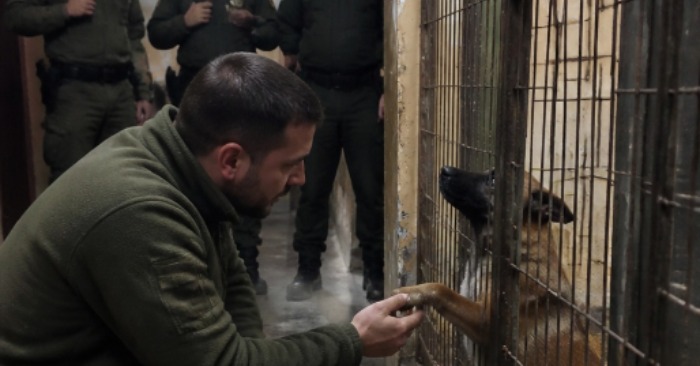
He stood in front of Maxim, trembling, his whole body shaking, staring at the outstretched palm as if he were afraid to touch it.
The trainers froze.
One held his shield too high, another gripped the choke collar so tightly his fingers turned white.
Maxim didn’t see any of this.
He only heard the dog’s breathing. Dense, uneven, hot.
AND HE ALSO HEARD A WOMAN SOMEWHERE BEHIND HIM WHISPER SOFTLY:
“Oh my God…”
Tor took a step forward.
His claws scraped against the concrete. Maxim didn’t pull his hand back.
The dog came so close that his nose touched Maxim’s fingers.
Then Tor suddenly lowered his head.
Not obediently. Not neatly, the way he had been trained.
But with effort, as if a rope that had held back all his anger had finally snapped.
HE INHALED MAXIM’S SCENT AND FROZE.
No one in the corridor moved.
Maxim slowly ran his fingers through the dog’s fur. It was rough, warm, matted in places.
Under the chin, he found the mark of an old scar.
Tor flinched, but he didn’t bare his teeth.
Only a quick exhale escaped him, like someone who had held their breath for far too long.
“It’s me,” Maxim repeated, more quietly.
The dog suddenly sat down.
RIGHT IN FRONT OF HIM.
Huge, dangerous, condemned, almost as if already sentenced to death.
And he let out a low whine.
Not loud. Not pleading, like other dogs.
This was the sound of a dog that didn’t just recognize a scent — but felt a loss.
The older trainer was the first to recover.
“Maxim, slowly step back,” he said, trying to stay calm.
But his voice trembled.
MAXIM DIDN’T MOVE.
He kept his palm resting on Tor’s head.
“No,” he said.
A single word, quiet, yet so firm that no one knew how to respond.
“You don’t understand,” someone whispered. “He’s already torn three people apart.”
“I do understand,” Maxim replied.
And for the first time in months, his voice no longer sounded like that of a man people pitied.
It sounded like a commander’s.
TOR PRESSED HIMSELF AGAINST MAXIM’S KNEE.
Maxim felt the dog’s weight — warm, alive. He felt the trembling.
And only then did he realize he was trembling too.
After his injury, he couldn’t tolerate being touched unexpectedly.
In the hospital, the nurses had first grown frustrated, then learned to warn him: “Maxim, we’re going to change the bandage now.”
At home, the neighbor, Aunt Nina, knocked in her own way.
Two short taps, a pause, then one more.
So he wouldn’t be startled.
HE HAD GROWN USED TO CAUTION.
Used to the pity in people’s voices that tightened his chest.
Used to hearing: “Don’t worry,” “You need rest,” “Don’t take risks.”
But no one ever asked how a man was supposed to live when, inside him, a mine was still exploding.
When Maxim first came to the center, they welcomed him gently.
Too gently.
The receptionist spoke to him as if he might shatter at any moment.
The psychologist smelled of mint candies and fresh paper.
THE TRAINER ASSURED HIM THEY HAD A WONDERFUL ADAPTATION PROGRAM.
Maxim nodded.
He had learned to nod where he once would have argued.
They showed him Labradors.
Good, clean, well-trained dogs.
One touched his palm with its nose. Another lay calmly at his feet. A third waited patiently for commands.
Any one of them could have become his dog.
But none of them answered the place that had been hurting inside him for a long time.
THEN HE HEARD A DISTANT THUD.
Not a bark.
A strike.
Dull, angry, hopeless.
“Who’s there?” Maxim asked.
The trainer hesitated.
“Not for you.”
Maxim had heard those words too often.
NOT FOR YOU — THE STAIRS WITHOUT RAILINGS.
Not for you — the crowded bus.
Not for you — your old job.
Not for you — a life where you decide for yourself.
He turned his head toward the sound and walked forward.
At first, they tried to stop him politely.
Then more firmly.
THEN ALMOST ROUGHLY.
But Maxim kept moving toward the sound, counting his steps, memorizing scents, hearing how the air changed.
From the isolation area came the smell of metal, chlorine, damp fur — and fear.
Human fear.
Not the dog’s.
When they told him the dog would be euthanized, he didn’t answer right away.
He just stood there, placing his palm against the cold wall.
“Why?” he asked.
THE OLDER TRAINER TOOK A HEAVY BREATH.
“He won’t let anyone near him. After his handler died, he broke completely. We did everything we could.”
Maxim understood that sentence.
That’s how people speak when they’ve already let go of someone.
We did everything we could.
It’s a precise, clean, almost sterile sentence.
And it always means the end of the end.
Now he sat beside Tor, not letting anyone come close.
BUT THE DOG WAS NO LONGER ATTACKING.
He simply turned his head at every step and let out a low growl.
Not attacking.
Warning.
Maxim said quietly:
“Easy.”
Tor fell silent.
Everyone noticed.
EVEN THE DIRECTOR, WHO ARRIVED MINUTES LATER IN AN EXPENSIVE COAT THROWN OVER HIS MEDICAL GOWN.
He stopped at the doorway and said nothing at first.
Then dryly asked:
“Do you realize you put people in danger?”
Maxim stood slowly.
Tor stood with him.
The dog leaned against his leg, as if he had always known that place.
“And do you realize you’ve already written off someone who’s still alive?” Maxim asked.
THE DIRECTOR FELL SILENT.
He was used to complaints, questions, gratitude.
But not this tone — especially not from a blind patient.
“This isn’t heroism,” he said.
“This isn’t heroism.”
Maxim kept his hand on Tor’s neck.
“This is recognition.”
The room suddenly felt uncomfortable.
PEOPLE DON’T LIKE WORDS LIKE THAT WHEN THE DOCUMENTS HAVE ALREADY DECIDED EVERYTHING.
The trainer, Pavel, cleared his throat.
Strong, with red hands from the cold and a tired face.
“May I say something?” he asked.
The director turned away sharply.
Pavel lowered his gaze but continued:
“For the first time in four months, he sat on command. And for the first time, he let someone touch his head.”
“One moment isn’t enough.”
“YES,” PAVEL SAID. “BUT FOR EUTHANASIA, ONE MOMENT SEEMED ENOUGH.”
That line hit harder than a shout.
The director pressed his lips together.
Maxim heard someone quietly inhale.
Tor sat calmly.
Just touching Maxim’s leg.
And that touch weighed more than any argument.
That day, the decision was postponed.
Not canceled.
Postponed for three days.
Maxim was allowed to visit Tor under supervision.
The officials agreed “to further evaluate behavioral responses.”
Later, Pavel said quietly by the exit:
“Don’t hope too much.”
Maxim smiled faintly.
“I stopped doing that a long time ago.”
AT HOME, HE SAT IN THE KITCHEN FOR A LONG TIME.
Cold tea on the table.
The neighbor’s TV murmuring through the wall.
The refrigerator clicking and sighing like an old man.
Maxim ran his hand over his fleece jacket.
The one he should have thrown away long ago.
The sleeve was worn, the zipper stuck, the cuff stretched out.
But he couldn’t throw it away.
HE HAD BEEN WEARING IT THE LAST DAY HE SAW HIM.
Sometimes Aunt Nina would say:
“Maxim, buy a new one already. It hurts to look at you.”
He would reply:
“Then don’t look.”
And they would both fall silent.
The next day, he returned.
Tor didn’t growl.
ONCE, HIS TAIL TAPPED THE FLOOR.
Softly, cautiously — as if he himself didn’t quite believe he was allowed to do it.
Pavel stood nearby.
“He was waiting for you,” he said.
Maxim didn’t answer.
His throat tightened, afraid any word might come out wrong.
They started with simple things.
Maxim sat by the cage. Tor lay inside, still behind the bars.
PAVEL SPOKE BRIEFLY, WITHOUT PITY.
Maxim liked that.
“Hand to the left. He’s watching. Don’t rush.”
“Now he stood up.”
“Ears relaxed.”
“Breathing more evenly.”
And so Maxim learned to see again.
Just not with his eyes.
HE HEARD CLAWS SLIDING ON CONCRETE.
He heard the shift in breathing before tension.
He heard the faint jingle of the collar when Tor turned his head.
On the third day, Pavel brought an old box.
The cardboard had softened with time.
Inside were the belongings of Tor’s handler.
They had never been sent to the family.
Maybe they forgot.
MAYBE NO ONE WANTED TO DEAL WITH IT.
Maybe it’s easier for people to accept death than to sort through someone’s memories.
Pavel set the box on the table.
“I thought you should know.”
Maxim turned his head.
“Why?”
Pavel took out a tag.
The metal clicked softly against the table.
“THE HANDLER’S NAME WAS ILYA SAFONOV.”
Maxim went pale.
So visibly that Pavel immediately fell silent.
“Say that again,” Maxim asked.
“Ilya Safonov.”
Maxim’s fingers froze.
The dog’s face went still.
Now everything made sense.
IT WASN’T THE JACKET THAT CALMED HIM.
Not just the scent of the front.
Tor had recognized Maxim from the first moment.
The one who had disappeared from both their lives.
They had both lost Ilya.
One lost his sight.
The other lost the entire world he understood.
That evening, the director called another meeting.
THE WORDS WERE POLITE.
Risks, responsibility, inability to guarantee safety, lack of protocol.
Maxim listened, holding the leash.
Tor sat beside him.
This time, without a cage.
But with a muzzle.
He tolerated it poorly, breathing hard, occasionally scraping the floor.
Each time, Maxim touched his shoulder.
AND THE DOG STOPPED.
“You can’t live with him,” the director said.
“Why?”
“Because you need help yourself.”
Maxim gave a half-smile.
“You’re confusing blindness with helplessness.”
The room grew even quieter.
The psychologist stared down at the papers.
PAVEL LOOKED AT THE DIRECTOR.
“He doesn’t need a guide dog,” the director said. “He needs a safe companion. This dog is damaged.”
Maxim nodded.
“So am I.”
No one had a quick answer.
Then Maxim did something even he hadn’t expected.
He removed Tor’s collar.
Pavel stepped forward sharply.
THE DIRECTOR TOOK A STEP BACK.
The dog remained seated.
Maxim stood and took three steps toward the door.
Without a cane.
Everyone froze.
For a blind man, crossing an unfamiliar room without a cane isn’t brave in a simple way.
It’s a risk of collision, falling, humiliation in front of everyone.
Maxim knew that.
ON THE SECOND STEP, HE NEARLY HIT A CHAIR.
It scraped loudly.
Tor leaped forward.
But not at the people.
He moved ahead of Maxim and placed himself at his side.
He stopped.
Didn’t push.
Didn’t pull.
HE JUST STOOD THERE — BETWEEN MAXIM AND THE OBSTACLE.
Pavel swallowed hard.
The psychologist covered her mouth.
The director remained silent for a long time.
Maxim lowered his hand.
Tor nodded slightly and lay down calmly.
“He’s already working,” Pavel said.
That was the second moment when the previous decision became impossible.
NOT BECAUSE THE RISKS DISAPPEARED.
They hadn’t.
Not because Tor suddenly became a “good dog.”
He hadn’t.
But because, for the first time, everyone saw not a separate danger and a separate blind man.
But two survivors who, for some reason, understood each other better than anyone else.
The paperwork went back and forth for weeks.
Documents moved through offices… and came back again.