The boy who kept ringing the wrong number every Sunday at 7 p.m. finally asked, “Ma’am, can I still call you when my mom comes back?”

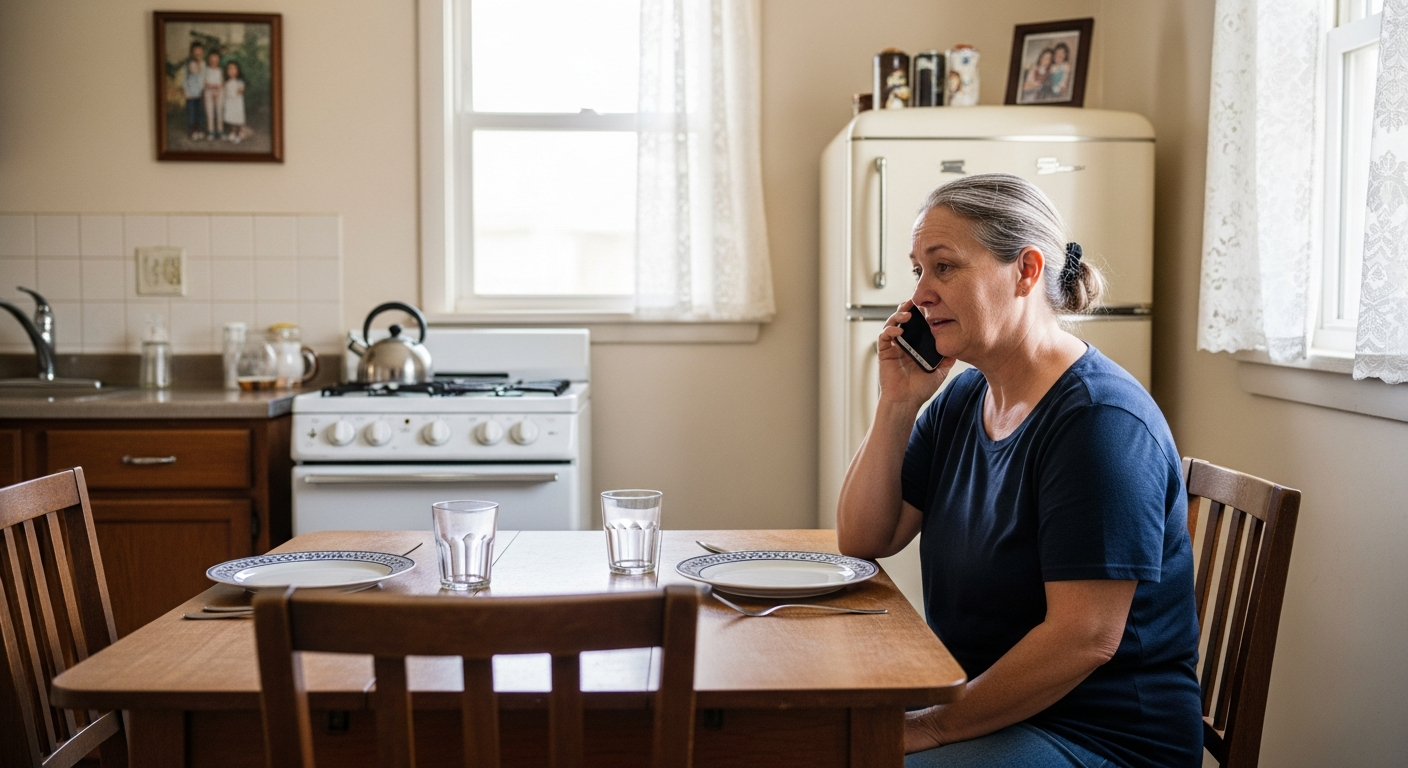
The first time my phone rang at exactly 7:00 p.m. on a Sunday, I was washing a single plate in a very quiet kitchen. I almost didn’t pick up. My life had shrunk to small sounds like running water and the ticking clock since my daughter Emily died.
“Hello?”
A thin, careful voice answered, “Is this Mom?”
For a second my heart stopped. “No… you must have the wrong number, sweetheart.”
Silence. Then a quick, panicked breath and the line clicked. I stood with the phone still pressed to my ear, staring at the empty chair where Emily used to toss her backpack.
Next Sunday, 7:00 p.m. sharp, the same ring.
“Hello?”
“Is this Mom?” The same boy, the same held‑back hope.
My throat tightened. “No. But… who are you trying to reach?”
“My mom,” he said, as if there could be no other answer. “She said I can call every Sunday. Maybe she changed her number.”
He sounded around eight, maybe nine. I forced myself to sound calm. “You might be dialing it wrong.”
A small, embarrassed laugh. “I’m not good with numbers. Sorry, ma’am.” Click.
After the third Sunday, I started watching the clock from 6:55. I told myself I should block the number, that this was none of my business. But every time, at 7:00 p.m., I was standing there, phone in hand, pretending I just happened to be nearby.
This time, when he asked, “Is this Mom?” I said, “No… it’s Anna. What’s your name?”
A pause. “Liam.”
“Hi, Liam.” The name felt fragile in my mouth. “Where’s your mom now?”
“In another city. Working. She says when she finishes saving money, she’ll come get me.” He lowered his voice. “It’s taking a long time.”
“Who do you live with?”
“My aunt. She’s busy. She says I shouldn’t bother her on Sundays.”
I swallowed the anger that rose. “You’re not bothering me.”
He let out a breath that sounded almost like a sob, quickly swallowed. “Okay. I’ll try to get the number right next time. Sorry.”
“Liam, wait—” But he was gone.
The fourth Sunday, his greeting changed.
“Hi… um… Anna?”
My chest warmed painfully. “Hi, Liam. How was your week?”
He told me about a spelling test, a soccer game he watched from the bench, how his aunt forgot to sign a permission slip. Nothing dramatic. Just the small hurts of a child whose existence is an afterthought.
I listened. I asked questions. I told him about the weather, about the neighbor’s cat, about how I once burned an entire batch of cookies and my daughter laughed for an hour.
“You have a daughter?” he asked softly.
“I had,” I corrected, before I could stop myself. The word fell heavy between us.
“What happened?”
I almost said, “It’s a long story,” to escape. Instead, I took a breath. “She got very sick. The doctors couldn’t help. She was ten.”
“My age,” he whispered.
“Yes.”
“I’m sorry,” he said, and somehow it didn’t sound like a child repeating something he’d been taught. It sounded like someone who understood what it meant when someone didn’t come back.
After that, 7 p.m. Sundays became our ritual. I stopped thinking of them as wrong numbers. He never talked badly about his aunt, but I could hear the TV blaring in the background, doors closing, the clatter of dishes. No one ever asked who he was talking to.
One evening he said, almost shyly, “I drew a picture of my mom today. I couldn’t remember her nose. Is that bad?”
“No,” I answered, blinking back tears. “That just means it’s been a long time. Maybe you remember how her hand felt?”
He was quiet, then: “Warm. And she hummed when she made my breakfast.”
I pressed the phone harder to my ear, as if I could hold him through the line.
Weeks turned into months. I bought a second plate. I started cooking enough food for two, even though I still ate alone. On Sundays, I set the table at 6:50, phone beside my fork, as if I were waiting for a guest who might actually walk through the door.
One Sunday, the call didn’t come.
By 7:05 my hands were shaking. By 7:10 I was pacing the kitchen. I told myself maybe his aunt had taken him somewhere, maybe he was just late. By 7:30 I was staring at the silent phone, the house suddenly smaller and colder than it had been in years.
I barely slept that night.

On Monday afternoon, I called my service provider, claiming I needed to confirm a number that had kept calling me. I wrote down his full number with trembling fingers, then stared at it, heart pounding. I had no right. I knew nothing except his first name and his loneliness.
On Tuesday, I dialed.
A woman answered, her voice brisk, tired. “Yes?”
“Hello, I’m… I’m looking for Liam,” I said.
“Who is this?” Her tone sharpened.
“Just… someone he calls on Sundays. I was worried when he didn’t—”
“He’s fine,” she cut in. “He doesn’t need strangers. Don’t call here again.”
“Please,” I blurted. “I’m not— I just listen. He thinks he’s calling his mother.”
Silence. Then a bitter laugh. “His mother? She left four years ago. No calls. No letters. Nothing. If he found you, that’s his problem, not mine.”
I felt sick. “He’s a child.”
“And I’m the one feeding him,” she snapped. “Goodbye.”
The line went dead.
Sunday came. I sat at the table anyway, staring at the clock. 6:58. 6:59. 7:00.
Nothing.
I told myself this was for the best. A boy shouldn’t rely on a stranger. A grieving woman shouldn’t build her week around a voice on the phone. I washed the single plate slowly, letting the water run too long.
At 7:12, my phone rang.
“Hello?” My voice cracked.
“Anna?” He sounded out of breath, like he’d run a long way. “I’m sorry I’m late. My aunt took my phone away. I had to borrow the neighbor’s.”
Relief washed over me so sharply I had to sit down. “I’m just glad you’re okay.”
“My aunt is mad,” he said quietly. “She says you’re not real family. She says I should stop calling. Am I bothering you?”
“No,” I said, too quickly. I forced myself to slow. “Liam, you’re never a bother to me.”
He was silent for a long time. I could hear street noises, a dog barking, someone calling in the distance.
Then he asked the question that lodged itself in my chest.
“Anna… if my mom comes back… can I still call you?”
I pressed my hand over my mouth. The kitchen blurred.
“Liam,” I said finally, “if your mom comes back, that will be the happiest day of your life. You should call her first.”
“I know,” he hurried. “But can I still call you too? Just sometimes. Because…” His voice shrank to a whisper. “Because sometimes I’m scared she’ll forget again.”
The twist of it — the boy still hoping for a mother who had vanished, and the mother who had lost her child but could never have her back — tore something open in me.
“Yes,” I said, the word breaking. “You can call me. Even if your mom comes back. Even if you’re thirty. You can always call me on Sundays.”
He exhaled a shaky little laugh. “Okay.”
We fell into our old rhythm, but something had changed. He stopped asking whether I thought his mom would come. Instead, he asked what high school was like, if math ever got easier, if adults were always tired.
Months later, he announced, proud and breathless, “I made the soccer team. I scored a goal. My aunt didn’t come, but the coach said I did good.”
“You did great,” I corrected. “I’m proud of you, Liam.”
No one had told him that in a long time; I could hear it in the way he went quiet, then whispered, “Thank you.”
Years passed. The voice on the phone deepened. Homework turned into exams, then job interviews. Sometimes he skipped a Sunday, then called on Monday, apologizing, laughing about overtime at work.
He never once said his mother had called.
The last time he asked me the question, he was twenty and standing, I later learned, outside a small apartment he could finally afford.
“Anna,” he said, “if I ever have kids… can they call you too?”
This time I didn’t cry. I smiled into the receiver, surrounded by photos of a girl with bright eyes and a boy I had never met but somehow watched grow up.
“Yes, Liam,” I said. “They can call me. On Sundays. I’ll be here.”
I still don’t know if his real mother will ever come back.
But every Sunday at 7 p.m., I set two plates on the table and wait for the phone to ring, for the boy who dialed the wrong number and somehow found the one person who needed him just as much as he needed her.