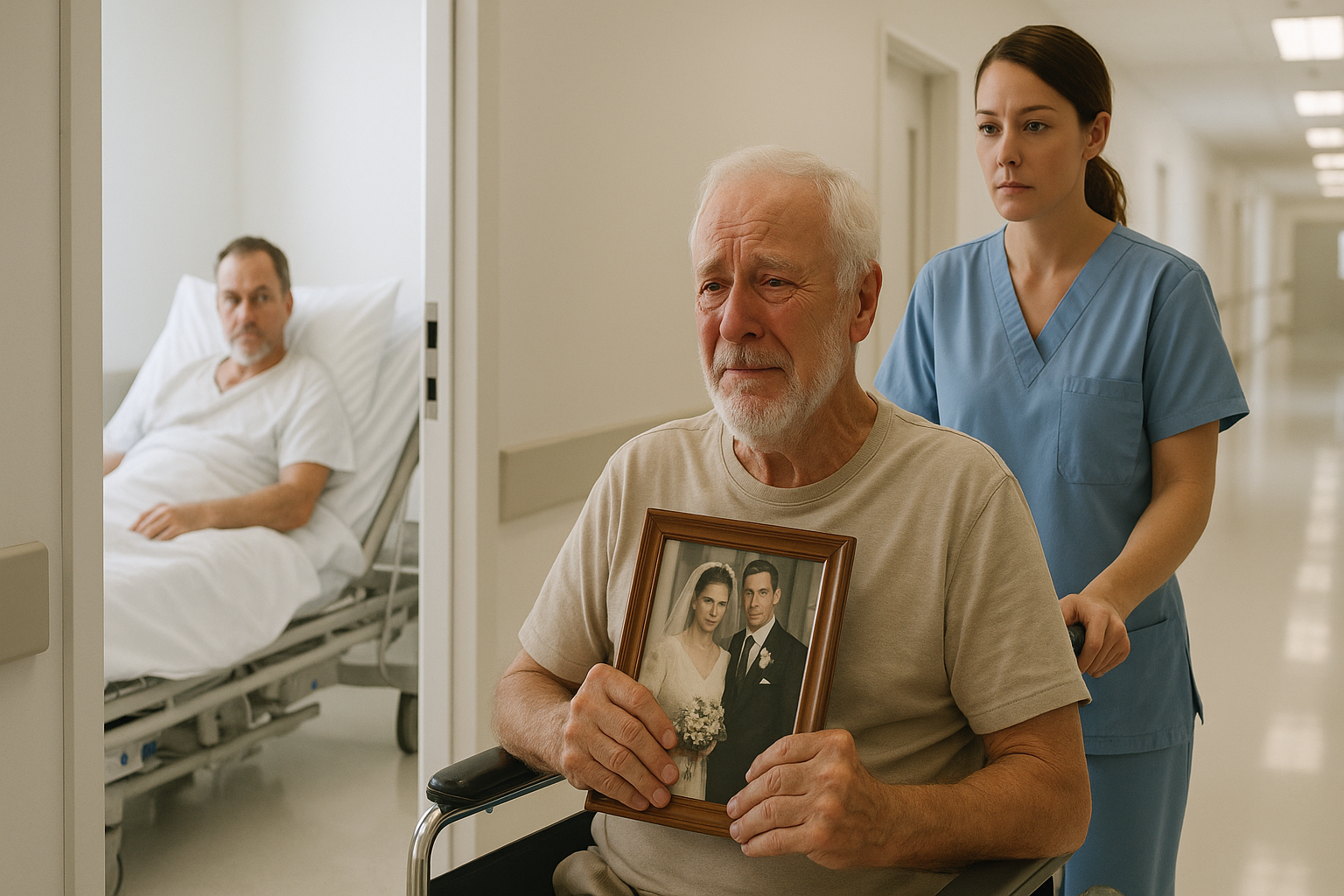
The nurse pushed the old man’s wheelchair past my door every morning, and only on the seventh day did I realize he was holding my lost wedding photo.

At first I barely noticed him. Hospitals blur people together into white walls and beeping sounds. I was too busy counting the cracks in the ceiling above my bed and wondering how long my heart could keep losing. The doctors called it “complications after surgery.” I called it being forty-three and suddenly useless.
Every morning at nine, the same scene: a thin nurse with tired eyes, a wheelchair, and an old man with snow-white hair and a sweater that looked one size too big. He always stared straight ahead, lips moving silently, a small picture frame clutched in his shaking hands. I thought he was praying.
On the seventh day, my IV alarm started beeping just as they passed. The nurse paused to silence it, and the old man turned his head slightly. That’s when I saw the photo. My breath caught.
It was my wedding picture. The one I’d lost three months ago when my house was taken apart for renovations. Me and Emma, August sun in our faces, her head thrown back in laughter, my arm around her shoulders. I remembered searching every box, every drawer, and crying alone in the garage when I realized it was gone.
“Where did you get that?” The words tore out of me, raw and too loud.
The nurse jumped. The old man flinched, his fingers tightening around the frame.
“I’m sorry,” the nurse said quickly. “Did we disturb you?”
“The photo,” I insisted, pointing with the hand that wasn’t full of needles. “That’s mine.”
The old man blinked, eyes clouded with confusion. “It’s my Anna,” he whispered. “My wife.”
The nurse looked from him to me, clearly uncomfortable. “Mr. Miller, your wife’s name is Laura,” she said gently.
He frowned. “No. No, this is Anna. She was laughing. I took this… I took this…” The rest of the sentence dissolved into air.
I stared at the photo. It was definitely mine. The chipped corner, the faint coffee stain on the edge from that first winter together. Even the little scratch across my tie where my nephew had bent it years ago.
“How does he have it?” I asked, my voice dropping. “I thought it was lost.”
The nurse sighed. “We found it in the hospital garden last week. He… he sort of claimed it. We didn’t know whose it was.”
“But that’s my wife,” I said. “Her name is Emma.” I felt absurd, arguing names in a hospital hallway.
The old man’s foggy eyes suddenly sharpened. He looked at the photo, then at me, squinting as if focusing hurt.
“Emma,” he repeated slowly. His lips trembled. “Emma… Green?”
My heart skipped. “Yes. Emma Green. Do you know her?”
His hand shook so violently the nurse reached out to steady the frame. He didn’t let go.
“I had… a daughter,” he said, each word like he was pulling it up from a deep well. “Emma. She married a man I never met.”
The corridor went silent. Even the machines seemed to hold their breath.
“My Emma’s father died ten years ago,” I said automatically. “Car accident. She never got to say goodbye.”
The old man closed his eyes. Two thin tears escaped and slid down his cheeks. “They told her I was dead,” he whispered.
The nurse shifted uncomfortably. “Mr. Miller, your file says—”
He cut her off with a shaky laugh that was half-sob. “My name is Daniel Green,” he said, more firmly now. “I… I changed it long ago. After the accident. After the shame.”
I felt the bed spin under me. Daniel Green. The name Emma never said without her voice going flat.
“You left them,” I said, the old anger flaring up from where I’d stored it for years on my wife’s behalf. “You drove drunk. You killed her mother.”
His shoulders crumpled. His hands slid from the armrests as if they were too heavy to hold.
“I know,” he whispered. “And then they said my Emma would be better off if she thought I died too. So I let them. I thought… I thought I was doing the only good thing left I could do.”
The nurse looked at me, eyes wide. “Is this… Could this be true?”
I couldn’t speak. Scenes crashed through my mind: Emma on our third date, telling me about the sirens and the police officer kneeling in front of her eight-year-old self; Emma on the floor of our first apartment, sorting through a box of old letters she never mailed; Emma pressing the lost wedding photo to her chest the day we framed it, saying softly, “This is the family I chose.”
Now her supposed-dead father was in front of me, in a hospital gown, clutching our photo like a life raft.
“Why do you have this?” I asked, throat tight.
He looked at the picture with a tenderness that hurt to see. “The nurse found it,” he said. “She asked if I remembered who they were. I… I told her it was my wife, to keep it near. But I knew.” His voice broke. “I knew it was my Emma. Happy. Safe. With a man who holds her like I never held anyone.”
Silence stretched between us, heavy and fragile.
“Does she… know I’m here?” he asked finally. “Does she hate me that much?”

I opened my mouth, then closed it. Emma had left yesterday to check on our son, promising she’d be back this evening. She had no idea.
“She thinks you’re dead,” I said quietly. “They showed her a burned car and told her there were no survivors. She… she never questioned it.”
Daniel’s face folded in on itself. He pressed the photo to his chest. “I tried to find her,” he said. “Years later, when I was… sober. But she had a new last name. New town. New life. I saw her once, across a street. She was laughing, pushing a stroller.” His voice dropped to a whisper. “She looked so free. I turned away. I didn’t deserve to step into that picture.”
My anger drained, leaving only a hollow ache. In my mind, I saw Emma as she was now: tired from caring for me, from juggling work and our teenage son’s moods and the fear of losing me. I imagined adding this to her shoulders.
The nurse cleared her throat. “Visiting hours will start in an hour,” she said softly. “I… I can bring him back then, if you want.”
I swallowed hard. “Keep the photo with him,” I said.
Daniel’s head jerked up. “No,” he protested weakly. “It’s yours. It’s her life with you. I have no right.”
“Keep it,” I repeated. “Please.”
He stared at me, confused.
“You’re not in any of her other photos,” I said. “Maybe… maybe you can have this one. For the years you didn’t see.”
His lips quivered. “I don’t deserve your kindness.”
“It’s not for you,” I answered, surprising myself with the harshness in my own voice. Then it softened. “It’s for her. For the little girl who lost everything in one night. Maybe some part of her would want you to see that she survived.”
His hands closed around the frame as if it were made of glass. He nodded slowly.
“When she was seven,” he said, looking at the photo, not at me, “she always wanted to feed the birds in the park. Even when we had no money. She’d save crumbs.” His mouth twisted. “I still remember her laugh. It’s the only piece of heaven I ever had.”
I looked away, blinking fast.
That evening, when Emma walked into my room with a paper cup of coffee and our son Leo behind her, I watched her face carefully. She kissed my forehead, too distracted to notice my trembling.
“There was an old man in a wheelchair in the hall,” Leo said casually. “He was crying over some picture.”
Emma froze. “What picture?”
Leo shrugged. “You and Dad. Wedding day.”
Her fingers tightened around the coffee cup. “Where is he?”
My heart pounded. “Emma,” I began, “before you go out there, you should know—”
But she was already at the door, shoulders squared, moving with the same determination she’d had the day she signed the papers for our mortgage, the day she insisted we could survive anything as long as we were together.
I never found out what she saw first: the curve of his jaw that matched hers, the familiar shape of his hands, or the way he said her name.
All I know is that, half an hour later, a nurse pushed the old man’s wheelchair past my door again. This time, Emma was walking beside him, not touching, eyes red but strangely calm. Leo trailed behind, confused.
The wedding photo rested on Daniel’s knees, but now there was another picture tucked behind the glass—the only surviving childhood photo of Emma and her parents, the one she kept hidden in the back of our closet.
Our eyes met as they passed. Daniel nodded at me, a small, broken gesture of gratitude I didn’t know how to return.
Emma paused in my doorway.
“I’m mad at you,” she said, voice shaking. I didn’t know if she meant me or him or the entire cruel universe.
“I know,” I answered. “But you’re not alone.”
She looked back at the old man in the wheelchair, at the photo on his lap, at our son watching all of it with wide eyes.
“For twenty years,” she whispered, more to herself than to me, “I thought my family was just gone.” Her gaze lifted, meeting mine. “Turns out it was sitting in the same hospital corridor, holding on to the same picture.”
She turned away then, walking beside the wheelchair down the bright, sterile hall, three generations bound together by a single, worn photograph and more regret than any of us knew how to carry.
Outside, through the window, I could see the hospital garden. Tomorrow morning, when the nurse pushed Daniel past my door again, I knew the scene would be different.
He wouldn’t be whispering to a stranger named Anna.
He would be holding the same photo—but this time, he would know exactly whose daughter was smiling back at him.