The old man kept standing every morning at the school gate, until one day a boy ran up to him and asked a question that made the whole town ashamed.

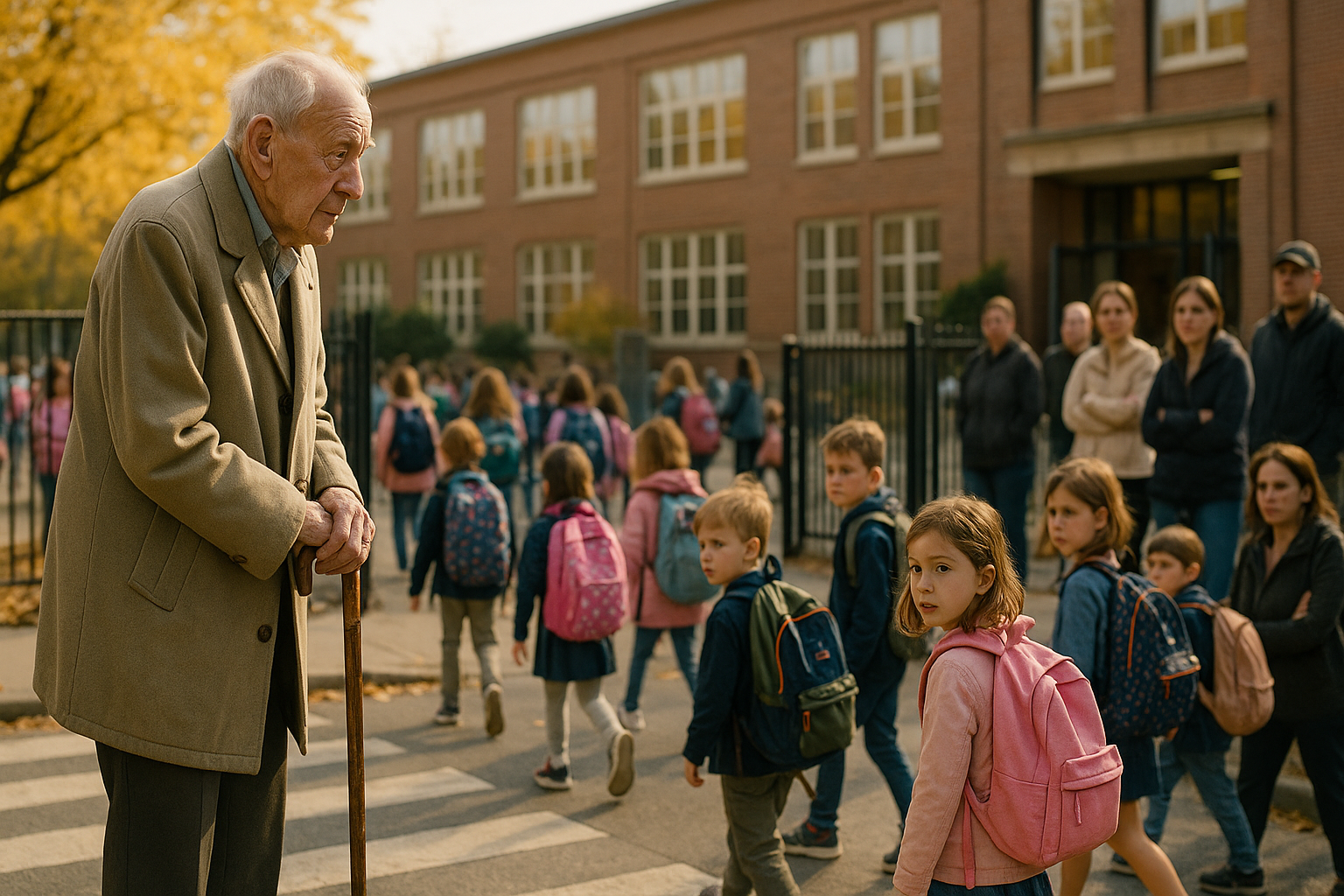
For three months, every weekday at 7:45 sharp, Daniel was there. Same place, same posture: back slightly bent, hands folded over the handle of an old cane, eyes fixed on the stream of children pouring into the small town school.
At first the kids just ignored him. Then the whispers started.
“Is he homeless?”
“My mom says not to talk to him.”
“He creeps me out, just staring like that.”
Parents pulled their children closer when they passed. Some crossed the street to avoid him. The principal, Mrs. Lewis, watched from the window, biting her lip.
He didn’t beg. He didn’t speak. He just stood there, every day, in his clean but worn coat, shoes carefully polished, as if he was waiting for someone who never came.
On the fourth week the gossip reached the teachers’ room. Someone said he’d been seen at the cemetery, standing by a small grave with a teddy bear on it. Someone else remembered that a year ago there had been a car accident near the school.
Only Mrs. Lewis knew the full story. She had been there that day.
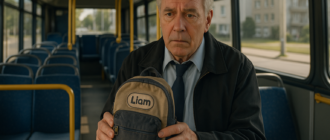
A rainy morning, a late bell, a car that didn’t slow down at the crosswalk. A little boy named Liam, seven years old, backpack with dinosaurs, running across the street because he didn’t want to miss the bell again.
Daniel was Liam’s grandfather.
After the funeral, he had come to the school with flowers and a question that never left his eyes: “Why was no one there at the road? Why was my boy alone?” The school promised a crossing guard, warning signs, something. Meetings were held, emails were sent. Then life went on. Funds were “not available”. People got busy. The road stayed the same.
And then, three months ago, Daniel had appeared at the gate.
He didn’t shout, didn’t demand. He simply placed himself where the crossing guard should have been, just a few steps from the very spot where Liam had fallen. But he didn’t step onto the road. His legs weren’t steady enough. He just watched, eyes following every child as if counting them, making sure each one reached the other side.
One Tuesday morning in October, it was colder than usual. Daniel’s fingers were red with the chill, but he still stood there, jaw clenched against the wind.
A little boy named Noah, eight years old, stopped on the sidewalk. Unlike the others, he didn’t walk faster when his mother tugged his sleeve.
“Mom, wait,” he said, pulling free. His mother sighed, already late for work, but he wriggled out of her hand and ran back to the gate.
He stopped right in front of Daniel, chest heaving from the short sprint. For a second they just looked at each other — old, tired eyes and young, curious ones.
“Mister,” Noah blurted out, cheeks flushed, “are you waiting for someone… or are you waiting for us?”
The question hung in the cold air.
A few kids slowed down to listen. Parents glanced over, annoyed, then stopped when they saw the scene. The street noise seemed to dim.
Daniel swallowed. His voice, when it came, was rough from disuse.
“I’m…” He looked past Noah, at the road, at the white lines of the crosswalk already fading. “I’m waiting to see if anyone will care enough to stand here so you don’t have to run for your lives to school.”
Noah frowned, not fully understanding, but he heard the word “lives” and looked at the cars rushing by, closer than they should.
“But… you’re here,” he said. “You care.”
Something in Daniel’s face crumpled, then steadied.
“I wasn’t here when my grandson crossed,” he whispered. “His name was Liam. He was about your age. He ran because the bell was ringing. The car didn’t stop.” He paused, his eyes filling. “I thought if I stood here long enough, someone would remember they promised this place would be safe.”
Silence.
The mother who had been tugging at Noah’s sleeve slowly let go. A father who always parked illegally right on the corner straightened, guilt flashing across his face. Mrs. Lewis stood frozen at the entrance, one hand over her mouth.
Across the street, an elderly woman who walked her dog every morning wiped her eyes with the back of her glove.

“You mean… no one did anything?” Noah asked, his voice small.
“They were sad,” Daniel said gently. “They cried at the funeral. They brought flowers. They said ‘never again’. And then… they went back to their lives.”
Noah looked at the crossing, then at the crowd of adults who suddenly couldn’t meet his gaze.
“But we cross here every day,” he said, louder now. “We could be Liam.”
The words cut through the murmurs like a knife. A car sped by, horn blaring at a child who had stepped too close to the curb.
Noah flinched — then did something no one expected. He grabbed Daniel’s hand.
“I’m scared to cross now,” he said, voice shaking. “Will you stand on the road with me? So the cars see us?”
Daniel hesitated, instinctively tightening his grip on the cane. His knees ached, his heart hammered. He had been afraid too — afraid that if he stepped back onto that road, he would see Liam lying there again.
But a small, warm hand was in his, trusting him.
He took one step forward.
A murmur rippled through the adults. Something like shame, something like courage.
“Wait,” Noah’s mother said, suddenly moving. “I’ll stand with you.” She walked to Daniel’s other side, planting herself at the edge of the crosswalk. Her voice was unsteady but firm. “Cars will stop if they see us together.”
Another parent joined. Then a teacher. Then the elderly woman with the dog. Within thirty seconds, there was a human wall at the crosswalk: ordinary people, standing where no one had had time or money to put a simple guard.
The next car slowed, then stopped.
Children crossed, wide-eyed, between the lines of adults. Some smiled at Daniel, some whispered Liam’s name under their breath, though they had never met him.
From that day on, Daniel didn’t stand alone.
Parents started taking turns being at the crossing before school. A sign appeared, handmade at first: “For Liam and for every child — slow down.” A week later, the town council, stung by photos circulating online and a petition started by Noah’s class, found the “unavailable” funds.
By winter, there was an official crossing guard in a bright vest. On the first morning of his duty, he found Daniel already there, leaning on his cane.
“You don’t have to come anymore,” the guard said kindly. “We’ve got it now.”
Daniel smiled, lines deepening around his eyes.
“I know,” he answered. “But some part of me still hopes that one morning, in that crowd of children… I’ll see a boy with a dinosaur backpack waving at me.”
He paused, then added quietly, “Until then, I’ll stand here. Not to wait for him. To make sure no one else becomes a picture on a grave.”
The guard nodded and stepped onto the road, raising his hand to stop the cars.
Behind them, Noah ran up, older now, but still with the same wide eyes.
“Morning, Daniel!” he called. “My mom says they want to name the new safety program after Liam. ‘Liam’s Crossing’.” He grinned. “So we don’t forget.”
Daniel blinked away sudden tears and looked at the line of children waiting to cross, alive, noisy, impatient.
“Good,” he said. “Forgetting is how we lost him. Remembering is how we keep the rest of you.”