The day Daniel carried his silent mother into the school auditorium, everyone thought he was ruining the graduation ceremony, but they had no idea what promise he was about to keep.

He pushed the old wheelchair as far as the steps would allow, then stopped. The narrow metal ramp was clearly marked “Staff Only”. A teacher in a neat gray suit hurried over, already shaking her head.
“Daniel, we can find a better place for your mother in the back,” she whispered. “Parents with special needs sit near the exit, it’s easier.”
Easier. He looked at his mother’s face, tilted slightly to one side, eyes unfocused but open. The stroke had stolen her speech, her right arm, and most of her memory. But when the letter about graduation arrived, she had pressed it to her chest with her good hand and begun to cry soundlessly.
“No,” Daniel said, his voice low but steady. “She’s sitting in the front row. She promised.”
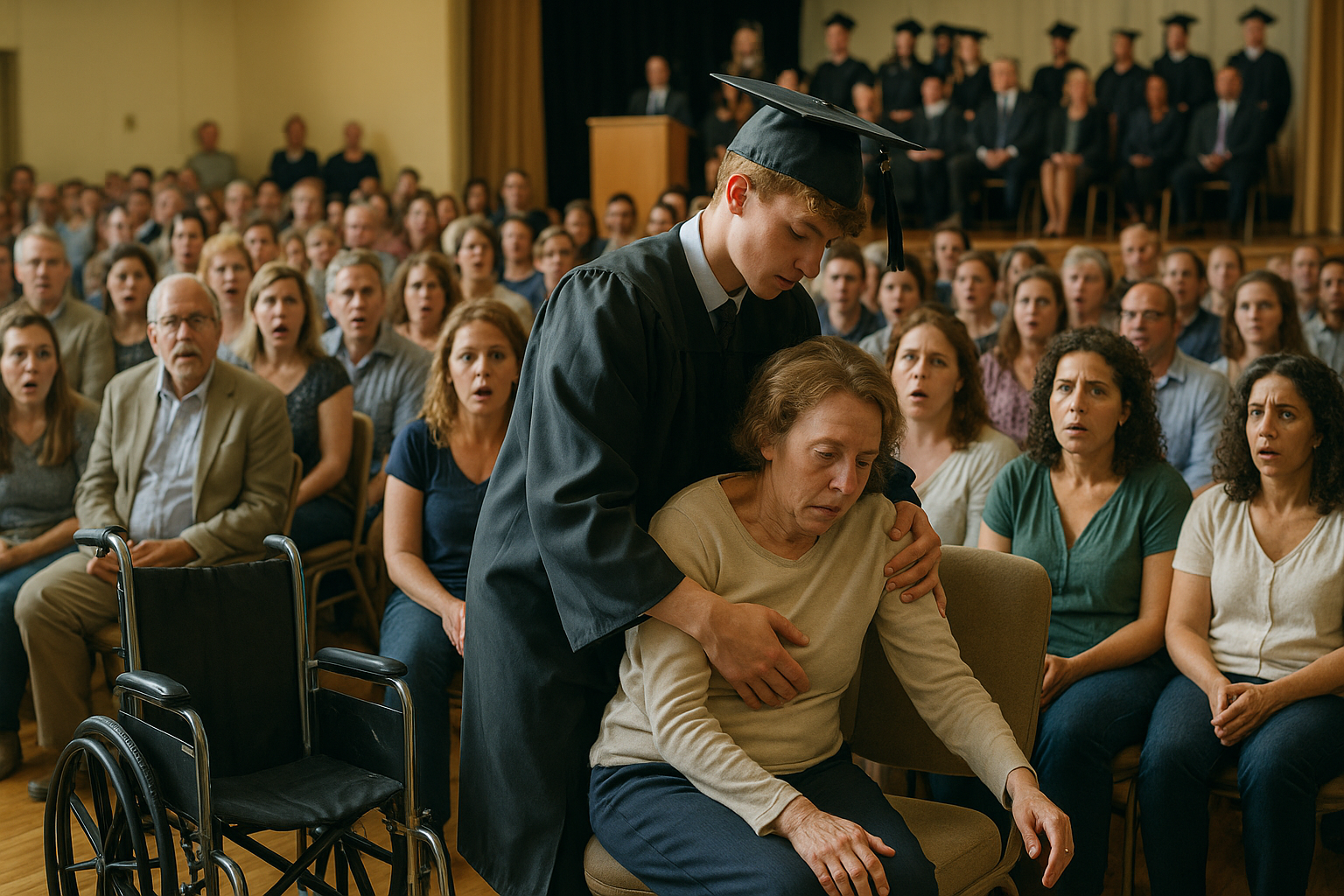
He bent down, hooked one arm under her knees and the other behind her back. She was lighter than he remembered, frighteningly light, like a bundle of clothes. Someone in the crowd gasped. A phone lifted to record.
“Son, you can’t just—” the teacher began.
But he was already climbing the steps, jaw clenched, his mother’s thin body pressed against his graduation gown.
Twelve years earlier, the same auditorium had been a different planet.
Back then, his mother, Elena, had sat in the last row, squeezing his small hand so tightly he could feel her pulse. He was six and terrified. His father had left the night before, slamming the door so hard the pictures rattled. First grade orientation was the next morning.
“Look at me, Daniel,” she had said, kneeling in front of him on the school steps. Her eyes were red, but her smile was fierce. “I will sit in the front row when you graduate. I don’t care if I have to crawl in here. I will be the first one to stand up and clap for you. Promise.”
He had laughed through his tears. “But what if you’re old?”
“Then I’ll be the loud old lady embarrassing you,” she replied. “But I will be there. Front row.”
After his father left, the promise became their private shield. When the electricity was cut off, when his shoes had holes, when she came home from cleaning offices with her hands swollen and cracked, she’d ruffle his hair and say, “Remember? Front row. We’re walking toward it.”
He remembered studying by candlelight while she fell asleep at the table. He remembered the day she sold the gold earrings her mother had given her, just so he could go on the school trip he’d been dreaming about.
He also remembered the ambulance lights two years before graduation, flashing blue against the kitchen walls.
They called it a massive stroke. “She may not speak again,” the doctor said. “She may not understand everything. You should prepare yourself.”
In the rehab ward, she stared at him with one eye more alert than the other, trapped in a body that refused to obey. He brought his textbooks, reading aloud while she blinked slowly.
The day the letter about his graduation came, he unfolded it by her bed. “Mom, they’re giving me an award too. For academic excellence.” His voice broke on the last word.
Her left hand trembled, reaching for the paper. Her mouth twisted, trying to form a sound. Nothing came, just a wet cough. But tears rolled down her cheeks. She tapped the corner of the letter with one finger, again and again, then touched her own chest.
“You want to go?” he whispered.
She blinked once, hard, like a nod.
Everyone told him it was impossible. The rehab nurse said the trip would exhaust her. His uncle said, “She won’t even know what’s happening, Daniel. She won’t remember the front row. Don’t torture her.”
But he remembered. That was enough.
Now, in the auditorium, he gently lowered her into the first seat of the front row. Her head wobbled; he adjusted the small pillow behind her neck. A few parents shifted uncomfortably. The teacher opened her mouth as if to protest, then closed it when she saw his face.
“I’ll move her back if she’s not okay,” Daniel said quietly. “Just give us this chance.”
He knelt in front of his mother for a moment, blocking the stage from her view so all she could see was him.
“Mom,” he said, taking her good hand. “We made it. Front row.”
For a heartbeat, her unfocused gaze seemed to sharpen. Her fingers tightened around his as much as they could. Then the principal’s voice boomed through the speakers, announcing that the ceremony would begin.
When they called his name, he walked onto the stage to polite applause. His gown swished around his sneakers; the spotlights were hot and blinding. He took the diploma with his left hand, because his right hand was shaking.
“Daniel,” the principal said quietly, leaning closer, “we also have a special recognition for you today. Would you mind sharing a few words?”
He hadn’t prepared a speech. He hadn’t expected anything except his mother in the front row. But when they pushed the microphone toward him, the words came out on their own.
“I wasn’t supposed to be here,” he began, his voice echoing slightly. “At least, that’s what life tried to tell us.”
He scanned the crowd until he found her. A frail woman in a faded blue dress, head tilted, eyes damp. Some students were staring, some parents looking away, embarrassed.

“My mom made me a promise when I was six,” he continued. “She said she would sit in the front row when I graduate. Back then, we didn’t know my dad would leave. We didn’t know about nights without heat, or about her working three jobs, or about hospitals and wheelchairs.”
A murmur rippled through the hall. A teacher in the second row wiped her eye.
“She doesn’t talk anymore,” he said, swallowing hard. “Most days, I don’t know how much she remembers. But I remember. And I know she doesn’t need words to keep a promise.”
He took a breath that felt too big for his chest.
“So if anyone thinks she’s in the wrong seat today… that seat has been waiting for her for twelve years.”
Silence fell, heavy and absolute. Then, softly at first, someone began to clap. Another person joined. The sound grew, rolling through the room like a wave.
Down in the front row, his mother’s shoulders shook. Her left hand lifted clumsily into the air, half a centimeter, then dropped. It was barely a gesture, but it was the closest thing to a proud wave she’d managed since the stroke.
And then, suddenly, the twist no one expected.
As the applause swelled, Elena’s lips moved. Not just the twisted grimace of effort he’d seen a hundred times, but a clear attempt at sound. Her throat worked. A broken, hoarse noise escaped, more breath than voice — but Daniel heard it, even from the stage.
“Da…”
It was not a full word. It didn’t need to be.
His legs nearly gave out. For two years, she had been locked behind glass, trapped in silence. Now, with the entire school watching, she tore a tiny crack in that glass just to reach him.
He stepped away from the microphone, ignoring the confused looks, and walked down the steps, diploma forgotten in his hand. The principal started to move toward him, then stopped when he saw where Daniel was going.
He knelt in front of his mother again. Up close, he could see the strain in her neck, the effort in every shallow breath.
“Say it if you can,” he whispered, tears spilling now. “Or just look at me. That’s enough.”
Her eyes locked onto his. For a moment, the years of cleaning offices at night, the empty chair at their kitchen table, the ambulance siren, the endless therapy — all of it stood between them, a mountain of hurt.
And then it was gone.
“Da…niel…”
The second syllable scraped out like it was made of glass. Some people in the audience covered their mouths. A boy in the third row began to cry openly.
He pressed his forehead gently against hers, careful of the wires and the fragile bones.
“I’m here, Mom,” he murmured. “Front row. You did it.”
The applause began again, louder this time, not for the grades or the awards, but for a woman in a faded blue dress who had crawled through twelve years of hardship to keep a promise no one else remembered.
Later, when the crowd had thinned and the balloons had deflated a little, a nurse from the rehab center came to help lift Elena back into her chair. Her strength was fading; the short burst of speech had cost her dearly.
“Was it worth it, Daniel?” the nurse asked softly as they adjusted the straps.
He looked at his mother, now dozing, her hand still curled as if holding onto an invisible diploma.
“She won’t remember this tomorrow,” the nurse added gently. “That’s how it goes.”
Daniel brushed a strand of gray hair from his mother’s forehead.
“Maybe she won’t,” he said. “But I will. And sometimes, remembering for someone is the best way to love them.”
He straightened up, clutching his diploma in one hand and the wheelchair handle in the other.
On the way out, he paused at the back of the auditorium and looked toward the stage one last time. The front row seat where his mother had sat was already empty, just a worn cushion and a program crumpled on the floor.
But in his mind, that chair would never be empty again.
Some promises, he thought as he pushed his mother gently into the sunlight, are stronger than sickness, stronger than time. Some promises are the only reason you make it to the stage at all.