The old man kept standing at the school fence every afternoon, until one day my son came home and whispered, “Mom, he thinks I’m his boy.”

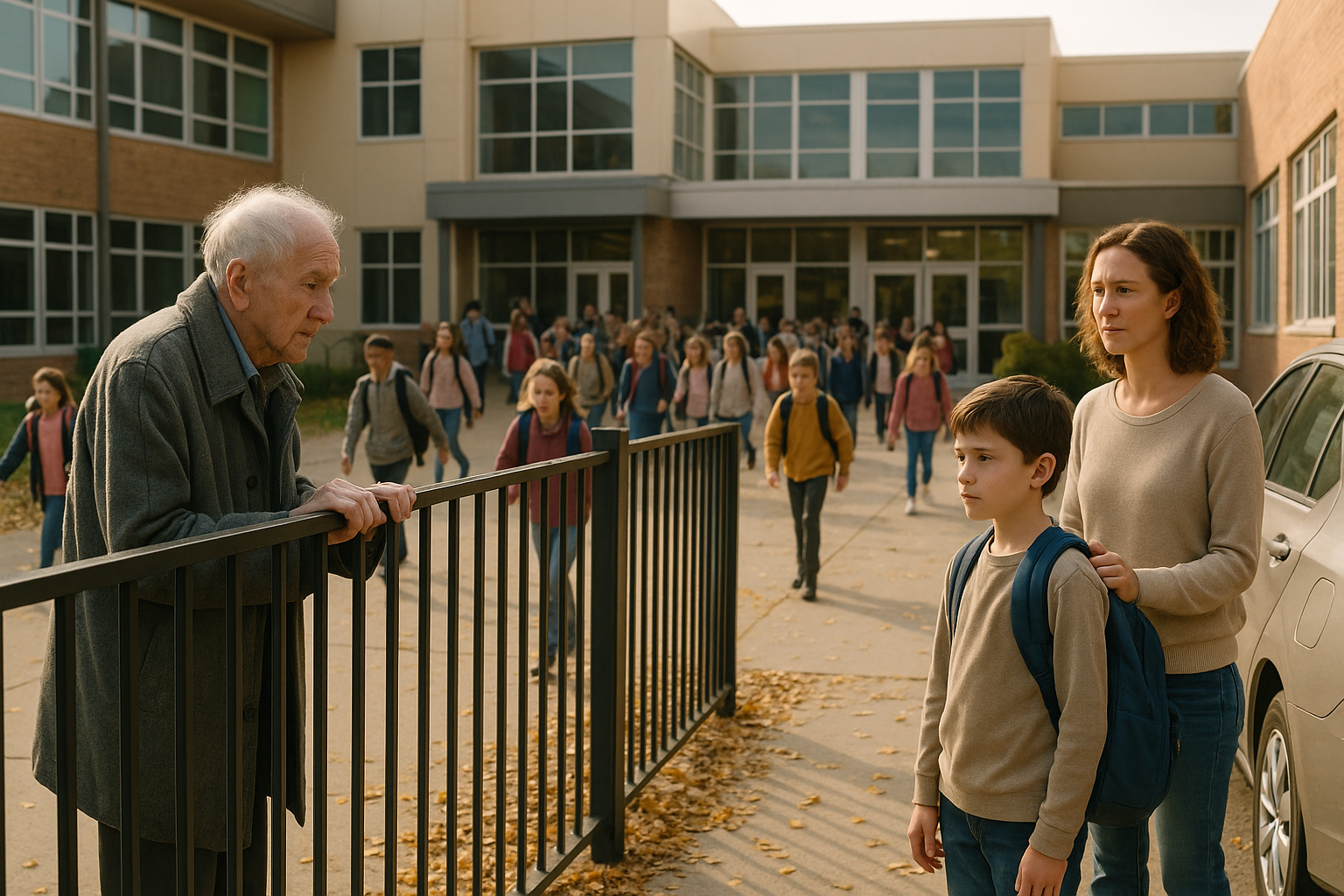
I first noticed him in September, when the leaves were just starting to turn yellow over the playground. A thin, stooped man in a worn gray coat, hands gripping the metal bars of the school fence, eyes following the children as they ran out, shouting and laughing.
At first I thought he was just another grandfather waiting a bit farther from the crowd. But he never called anyone’s name. He just watched, searching faces, as if looking for a specific child who never appeared.
Week after week he stood in the same spot. If it rained, he held a small umbrella, the cheap kind from the supermarket, water dripping from its torn edge. If it was cold, he had a brown wool scarf, carefully wrapped, as if someone had once tied it for him and he was afraid to move it.
I asked other parents. No one knew him. “Maybe he’s waiting for the school bus to go by,” someone shrugged. “Maybe he’s just lonely,” another said. But the way he watched the children made my chest tighten. It wasn’t creepy, it was… desperate.
One afternoon in October, my ten-year-old son Leo came out, waved at me, then glanced over at the fence. His face changed. On the way home he was unusually quiet.
“Mom,” he said finally, “the man at the fence… he smiled at me today.”
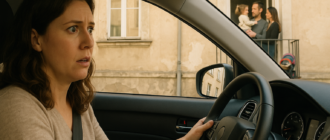
“That’s okay,” I said, checking his expression in the rearview mirror.
“He called me Daniel.”
I frowned. “Maybe he mixed you up with someone else.”
Leo shook his head. “He said, ‘Daniel, you’ve grown. I knew you’d come out last.’ And then he looked… confused. Like he realized something was wrong.”
A small, cold knot formed in my stomach. “Did he touch you?”
Leo’s eyes widened. “No, he just… looked sad. Really sad. I said, ‘I’m Leo, sir.’ And he whispered, ‘Of course. Of course you are.’ Then he stepped back.”
That night, when Leo was asleep, I stood at the kitchen sink, pretending to wash dishes while the scene replayed in my mind. An old man calling my son by another boy’s name. A boy named Daniel who, apparently, should have been walking out of that school long ago.
The next day, I left work early and parked a little farther from the gate. Leo ran to the car; I kissed the top of his head and told him to wait inside. Then I walked back toward the fence.
The old man was there. Up close, he looked even smaller. His coat was too big, sleeves worn at the cuffs. His eyes were a soft gray, watery but alert.
“Excuse me,” I said gently. “Sir?”
He startled, shoulders tightening. “I’m not bothering anyone,” he said quickly, in a trembling voice.
“You’re not,” I assured him. “I just… my son said you spoke to him yesterday.”
He swallowed, his gaze flicking to the car where Leo sat, watching us through the windshield. A soft, painful warmth entered his eyes.
“He looks like my Daniel,” the man whispered. “From far away. The way he runs with his backpack sliding down his arm.”
I followed his eyes. Leo was adjusting his backpack strap, exactly as he always did.
“Where is Daniel?” I asked quietly.
The man’s fingers tightened around the fence. For a moment I thought he would refuse to answer. Then he exhaled.
“Gone,” he said simply. “Ten years now. He was seven. The last time I saw him, he turned around at that gate and waved at me. Just there.” He pointed to a cracked patch of pavement. “I was late for work. I didn’t walk him across the street. I just waved back.”
His voice broke on the last word.
A car slowed nearby. A horn sounded, kids laughed. The world went on, indifferent.
“He ran,” the old man continued, staring past me, into some stubborn, unhealed memory. “He always ran. A truck came too fast. The driver said he didn’t see him.” His lips trembled. “I should have been there. I should have been holding his hand.”
I felt my throat closing. “I’m… I’m so sorry.”
He nodded, like he’d heard those words a thousand times and they never reached the place that hurt.
“My name is Arthur,” he said after a pause. “I come here because it’s the last place I remember him alive. The doctors say I’m forgetting things. Sometimes I forget what I had for breakfast. But I remember this gate. I remember his backpack. Blue with rockets.”
Leo’s backpack was blue. With planets.
“And when I saw your boy,” Arthur whispered, “I thought, just for a second, that time had gone wrong. That I’d been given another chance to walk him home.”
Something inside me cracked. All the warnings, all the fears about strange men near schools battled with the sight of this fragile figure, chained to a moment from ten years ago.
“Arthur,” I said, choosing my words carefully, “would you like to sit on the bench instead of standing? It’s getting cold.”
He looked at me as if I’d offered him something rare. “I don’t want to be in the way.”
“You’re not in the way.” I hesitated, then added, “Maybe… maybe you could just say hello to Leo. Properly. So he isn’t scared.”
He flinched. “I scared him?”
“A little,” I admitted. “But he also… he felt sorry. He told me, ‘Mom, he looks like he lost something important.’”
Arthur’s eyes filled with tears he fought back with an old man’s stubborn dignity. “He’s a kind boy.”
I called Leo over. He trotted up, backpack bouncing.
“Leo,” I said, “this is Arthur. He used to have a son who went to this school too.”
Arthur cleared his throat. “Hello, Leo. I’m sorry I called you the wrong name.”
“It’s okay,” Leo said quickly. “Mom mixes up my name with the dog’s all the time.”
I choked on an inappropriate laugh. Arthur’s mouth twitched.
“Would you like to sit with me a minute?” Arthur asked, voice tentative, as if expecting rejection.
Leo looked at me. I nodded. “Just for a minute.”
They sat on the low concrete ledge by the fence. I stood a few steps away, close enough to hear but far enough to give them the illusion of privacy.
“My son liked space,” Arthur said. “He wanted to be an astronaut. Does your backpack mean you like space too?”

Leo brightened. “I love space! I want to build rockets. Real ones. Not the cardboard kind.”
Arthur listened, his face softening. For a few minutes, he wasn’t a man counting the years since a truck stopped his world; he was just an old man talking about stars with a boy.
When we left, Arthur stayed at the fence, but he looked calmer.
That evening, Leo was quiet again. “Mom?” he asked while we set the table. “Why doesn’t anyone come pick Arthur up?”
“Because he lives alone, I think.”
Leo bit his lip. “That’s sad.”
The next day, Leo insisted on bringing an extra sandwich. “In case he forgot his lunch,” he explained. I hesitated, then nodded.
We found Arthur at the same spot. Leo marched up to him, pushing the wrapped sandwich through the bars.
“This is turkey and cheese,” he announced. “No mustard. Mustard is evil.”
Arthur took it with trembling hands. “Thank you, Leo.” His eyes shone. “You didn’t have to.”
Leo shrugged. “My friend Ben says we should be kind to old people, because they know all the secrets.”
Arthur smiled. “We mostly just know where the good benches are.”
Days turned into weeks. Sometimes Arthur was there, sometimes he wasn’t. On the days he appeared, Leo would wave, or stop for a minute to tell him about a test, a project, or something funny his teacher had said. Their conversations were small, ordinary. But I watched the way Arthur’s back straightened when he saw us, the way Leo checked the fence first thing as he came out of school.
One Monday in November, Arthur wasn’t there. Or Tuesday. Or Wednesday.
By Thursday, Leo’s shoulders were tight. “Maybe he’s sick,” he whispered. “Or maybe he forgot the way.”
I called the school office and described him, feeling strange and intrusive. The secretary sighed softly. “Oh. You must mean Mr. Harris. He used to come here a lot. He lives three streets away, in the yellow house with the cracked steps. I can’t give you his full information, but… maybe you could check on him?”
That afternoon, instead of going straight home, we walked. The yellow house was easy to find. The curtains were half drawn. A dry plant drooped on the windowsill.
Leo squeezed my hand. “What if he’s… gone?”
I rang the bell. After a long minute, the door creaked open a few centimeters. One gray eye appeared.
“Arthur?” I asked. “It’s us. From the school gate.”
The door opened wider. Arthur looked smaller without his coat, wrapped instead in an old cardigan.
“I’ve been… tired,” he said. “The doctor says I must rest.”
Leo stepped forward. “We brought you soup. Mom made too much. Like, a lot too much.”
I blinked at him. We hadn’t, but in that moment I understood and nodded. “Yes. Way too much.”
Arthur stared at us as if he couldn’t quite believe we were real. Then he moved aside.
Inside, the house smelled of dust and something faintly medicinal. Family photos lined the walls: a younger Arthur, a smiling woman, a little boy with a blue backpack covered in rockets.
Leo stopped in front of one frame. “Is that Daniel?”
Arthur’s face softened. “Yes. That’s my boy.”
Leo studied the photo. “He does look like me,” he said quietly.
Arthur’s hand hovered in the air, as if he wanted to touch Leo’s shoulder but didn’t dare. “Sometimes my mind goes places it shouldn’t,” he confessed. “But I know you’re not him. I do know.”
“I know,” Leo said. “But maybe… I can listen about him. If you want.”
The strongest twist came not from tragedy, but from what my son said next.
“Because I think,” Leo added, “Daniel would be happy if you weren’t alone at the fence anymore.”
Arthur’s face crumpled. The grief that had been frozen in him for ten years finally moved, like ice breaking on a river.
We stayed for an hour. Arthur told us how Daniel loved dinosaurs, how he once painted the kitchen wall green and pretended it was a jungle. Leo laughed in the right places, asked questions, compared Daniel’s stories with his own.
When we left, Arthur walked us to the gate.
“Will you… come again?” he asked, his voice small.
“Yes,” Leo said firmly. “And when you feel better, you can come back to the fence. Not to wait for anyone. Just to say hi.”
In the weeks that followed, our routine changed. Some days, Arthur would be at the fence, not clutching it like a lifeline anymore, just standing a little to the side, watching Leo emerge. Other days, we’d stop by his house with soup that we actually had too much of, or cookies Leo insisted on burning at least once before we got them right.
One afternoon, as we walked home, Leo said, “Mom, you know how I always wanted a grandpa who lived nearby?”
“Yes?”
“I think maybe Arthur wanted a boy who still waved at him at the school gate.” He looked up at me, eyes serious. “We can’t be exactly that. But we can be… almost.”
I swallowed hard. “Almost can be a lot,” I said.
Sometimes, when I see Arthur’s fragile figure sitting on the bench by the school now, I still feel that old stab of pity. But it’s softer, wrapped in something warmer. He no longer searches every face with that desperate, breaking gaze.
He just waits for one boy with a blue backpack covered in planets, who runs toward him and shouts, “Arthur! Did you know there might be water on Mars?”
And for a few minutes every afternoon, an old wound is not healed, but held. Not replaced, but gently surrounded by new, smaller, living things: a sandwich without mustard. A shared joke. A boy who listens.
He never called Leo “Daniel” again. He didn’t need to.
Because somehow, between the cracked pavement of the school gate and the yellow house with the dry plant on the windowsill, they had found a way to stand together in the space between what was lost and what could still be saved.