The note the old man slid into my shopping cart said only three words: “Help my dog”. It was written in shaky, uneven letters on the back of a faded pharmacy receipt, the ink smudged as if someone had held it too long with trembling fingers.

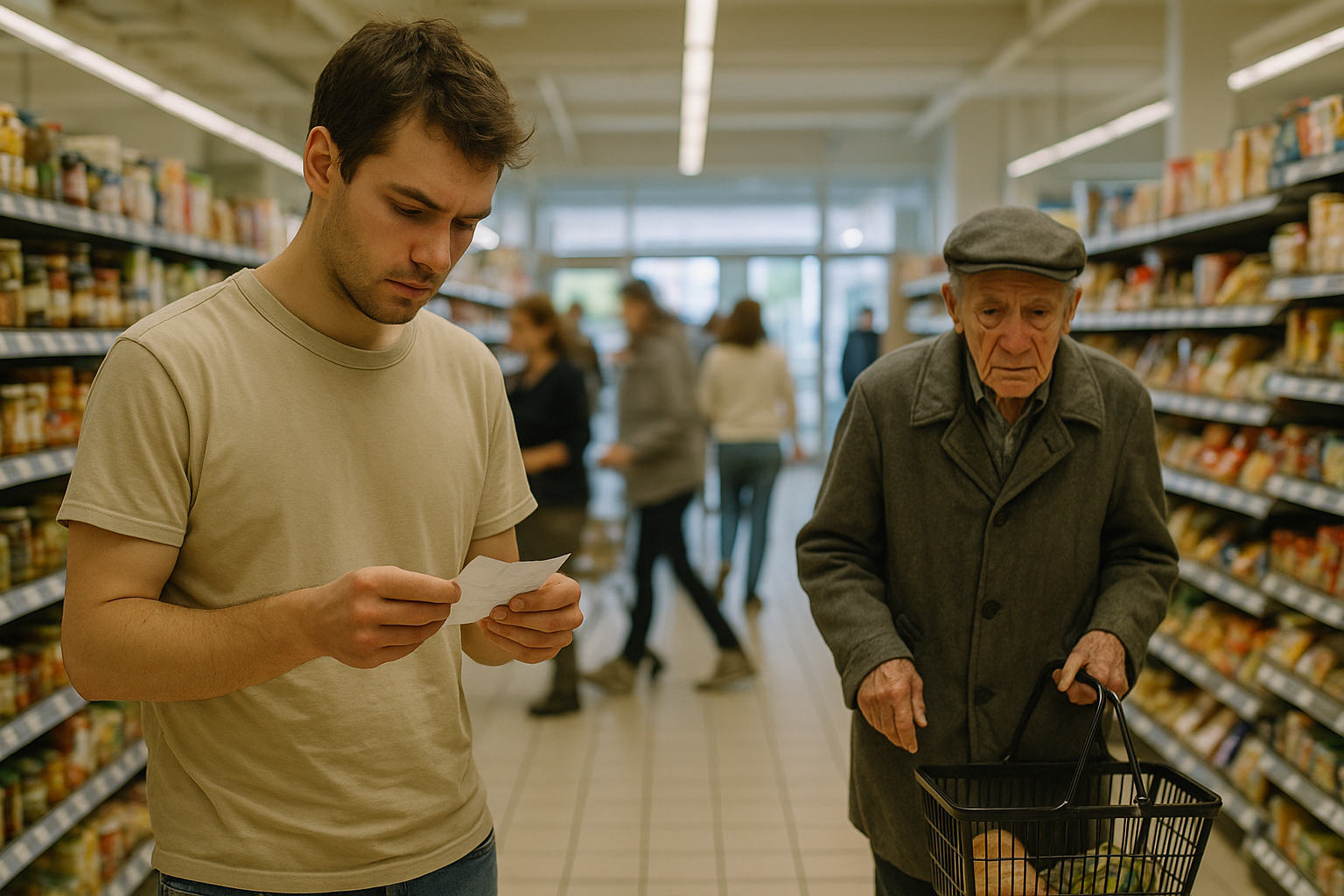
I almost didn’t notice it. I was busy comparing prices on pasta, thinking about deadlines and unanswered emails, when the cart bumped into something soft. I looked up, annoyed, ready to apologize on autopilot.
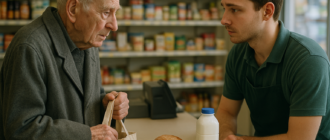
He stood there, small and slightly bent, in an old grey coat that looked a size too big. His eyes were the only bright thing about him: washed-out blue but painfully clear. He didn’t say a word, just gave a quick nod toward the cart and stepped back, as if already expecting to be ignored.
I frowned, picked up the note, read it, and looked around. The old man had already turned toward the exit, walking with that careful, slow shuffle that always makes you think the floor is icy. I could’ve just left it there, told myself it was some kind of prank, but something about those three words glued my fingers to the paper.
“Sir?” I called out.
He stopped but didn’t turn immediately, like he was bracing himself. When he finally looked back, his eyes went straight to the note in my hand, then to my face.
“Please,” he said softly, and that was all.
We stood in the middle of the supermarket aisle, people moving around us with carts and phones and busy faces. I felt ridiculous and, at the same time, like this moment was heavier than it should’ve been.
“Help your dog how?” I asked.
He swallowed, his Adam’s apple jumping. “She’s alone. I… I can’t walk well anymore. They…” He waved vaguely toward the ceiling, meaning doctors, fate, someone. “They said I should think about… a home.” The last word came out bitter. “But they won’t take her. Nobody wants an old man with an old dog.”
He took a breath and his voice grew smaller. “I just need someone to bring her food. Maybe take her outside sometimes. I live nearby. I saw you here last week. You smiled at the cashier. People who smile like that usually… help.”
I had no memory of seeing him before. But there he was, clutching a half-empty basket with only bread and the cheapest canned soup.
“What’s your name?” I asked.
“Mark,” he said. “And she’s Daisy.”
I hesitated. I lived alone, worked a lot, barely managed my own laundry, let alone someone else’s dog. But those three words on the note wouldn’t let go.
“I can come today,” I said finally. “Just to see.”
The relief that flooded his face was almost painful to watch. He nodded several times, as if afraid I’d change my mind if he stopped.
Mark lived in a crumbling building just two streets away. The elevator door had a dent in it like someone had tried to kick their way out. He walked slightly behind me, breathing quietly, one hand pressed to his side.
His apartment smelled like dust and something faintly sweet. It was tidy in the way of people who own very few things. And in the middle of the small living room, on a thin blanket, lay Daisy.
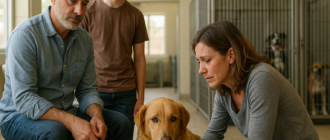
She was a golden retriever, but the gold had faded into grey around her muzzle. Her eyes were cloudy, her movements slow. When she saw Mark, though, her tail tried its best to wag. When she saw me, she paused, suspicious, then sniffed the air.
“She doesn’t bite,” Mark said quickly, with a flash of pride. “She never did. She used to sleep next to my wife when…” He broke off, staring at the wall over my shoulder.
I knelt, letting Daisy sniff my hand. Her nose was warm and a little dry. She licked my fingers once, cautiously, like someone testing if a bridge would hold.
“See?” Mark whispered, and for a moment he sounded almost like a child. “She likes you.”
We made a plan: I’d bring dog food and help take Daisy out every other day. It didn’t sound like much. It sounded like something any decent person should do without turning it into a moral victory.
For a few weeks, that’s how it went. I’d leave work a bit earlier, buy food, climb the stairs when the elevator inevitably broke. Daisy would greet me with slow tail thumps, Mark would ask about my day with genuine interest that I wasn’t used to. He showed me old photos: a young Mark with darker hair, his wife Anna laughing while a puppy version of Daisy chewed on a shoe. They had no children, he said. “We thought we had time.”
Slowly, the routine began to feel less like an obligation and more like a strange, gentle anchor in my rushed life.
The twist came on a Tuesday.
I arrived with a bag of food, rehearsing in my head how I’d apologize for being late. The door to Mark’s apartment was slightly open.
My heart dropped.
“Mark?” I called, pushing it wider.
Daisy was lying by the door, not on her blanket. She lifted her head with effort when she heard my voice. Her water bowl was almost dry. The clock on the wall ticked too loudly in the silence.
“Mark?” I repeated, louder.
Nobody answered.
I checked the kitchen, the tiny bedroom, the bathroom. The bed was made. His glasses lay neatly on the bedside table, next to a pill bottle and a folded handkerchief.

On the kitchen table, under a mug with a coffee ring, there was another note. My name was on it.
My hands shook as I unfolded it.
“They took me to the hospital. Don’t worry. Please don’t forget Daisy. She waited for you before I met you. She will wait after. — Mark”
The words blurred as my eyes filled. Daisy whined quietly, trying to stand up. I sank to the floor beside her.
He had gone, alone, with only this hope that a stranger from a supermarket would keep their promise.
I called the number on the ambulance card pinned to his door. The nurse sounded tired. Yes, he was there. Yes, he was weak. No, visits were not allowed today. “He keeps asking about a dog,” she added. “We told him pets aren’t allowed. He cried.”
Something inside me hardened.
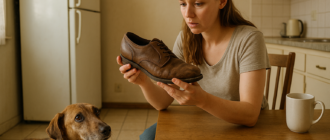
I looked at Daisy, at her old, patient eyes. At the almost empty food bowl. At the worn collar with a metal tag that simply said “Daisy” and an old phone number that probably no longer worked.
I heard my own voice, steady and clear in the quiet apartment: “You’re coming home with me.”
Daisy blinked slowly, as if trying to understand, then pushed her nose into my hand.
The next days were a blur of logistics. I spoke with the landlord, who shrugged and said, “As long as someone pays.” I gathered Mark’s clothes, his photos, his old radio. I set up a corner in my small living room with Daisy’s blanket and bowls. She paced uncertainly at first, then lay down with a sigh, watching me move around as if memorizing every sound.
When I finally managed to visit Mark, he looked even smaller, swallowed by white sheets and the smell of disinfectant. His eyes found me immediately.
“Daisy?” was his first word.
“She’s safe,” I said, pulling out my phone. I had taken a picture that morning: Daisy asleep on my rug, one paw thrown over a squeaky toy I’d bought on a whim.
His hands shook as he held the phone. He stared for a long time, then pressed it to his chest.
“I thought…” His voice broke. “I thought she would die alone. Like Anna.”
I sat on the edge of the chair. “She won’t. I promise. And neither will you.”
He smiled then, a small, fragile curve of his lips. “You already kept the hardest promise,” he whispered.
Mark never came back to the apartment. A few weeks later, the nurse called. Her voice was gentle this time. He had gone quietly in his sleep, they said, with a picture of Daisy on the bedside table.
I went back to his empty apartment one last time, closing drawers that no one would open again. On the kitchen table, under a sheet of old newspaper, I found something I hadn’t seen before: a neatly folded piece of paper.
“If I am gone,” it read in that same shaky handwriting, “and you are reading this, it means you did not forget us. Thank you for proving I was not wrong about people. — Mark”
I stood there in the silent kitchen, the afternoon sun making dust dance in the air, the weight of the paper almost unbearable in my hand.
At home, Daisy struggled more with each step, but she followed me from room to room, always wanting to be where I was. Sometimes she’d stop by the door, stare at it for a long time, her ears twitching, as if expecting a familiar knock.
On the day she finally couldn’t get up, I lay on the floor beside her, my hand on her head. Her breathing was shallow but calm.
“He’s waiting for you,” I whispered. “You’re not going alone.”
The vet was kind. It was peaceful. Still, when it was over, the apartment felt too quiet, too big. I sat on the floor beside the empty blanket and cried in a way I hadn’t cried even for people I had known for years.
Two strangers. One old man, one old dog. They had entered my life through a crumpled note in a supermarket and left it with more silence than I knew what to do with.
But in that silence, something else slowly appeared: a stubborn, steady warmth.
I started noticing other old people in the store, in the street, in my building. The ones walking too slowly, counting coins at the cash register, reading labels with the careful attention of someone who doesn’t have room for mistakes. I started smiling at them more. Not the small, polite smile I gave before, but the kind that says: I see you.
Sometimes I still find one of Daisy’s hairs on my couch, or I catch myself reaching for my keys at the exact time I used to visit Mark. The ache is still there, but it no longer feels empty.
Because now I know: sometimes the biggest turn in your life fits into three shaky words on a crumpled piece of paper.
Help my dog.