The day Daniel carried a stranger’s grandfather into our house, my first thought was that he had finally lost his mind.

It was a gray November afternoon, the kind when the cold seems to seep through the windows no matter how high you turn up the heating. I was in the kitchen, stirring soup and scrolling through the news, trying to ignore the silence of our too-empty home. Since our son Noah had left for university, the three-bedroom house felt enormous and useless, like we were rattling around inside someone else’s life.
The front door burst open with a gust of wind. I heard Daniel’s heavy footsteps, a muffled groan, and then his voice:
“Emma, I need a blanket. Quickly.”
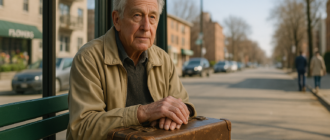
I stepped into the hallway and froze. My husband stood there, cheeks flushed from the cold, holding up an old man under the arms. The stranger’s legs dragged limply, his thin body wrapped in a threadbare coat several sizes too big. His eyes were wide and confused, his lips trembling from the cold.
“What are you doing?” I gasped.
“He was sitting on the bench by the bus stop,” Daniel panted. “No hat, no gloves. People were just walking past him. He couldn’t even tell me his name properly. Help me get him to the couch, please.”
Everything in me wanted to say no. This was not normal. We didn’t know who he was, if he was dangerous, if he was sick. But the old man’s hands made me swallow my words. They were shaking so violently he couldn’t even hold his coat closed.
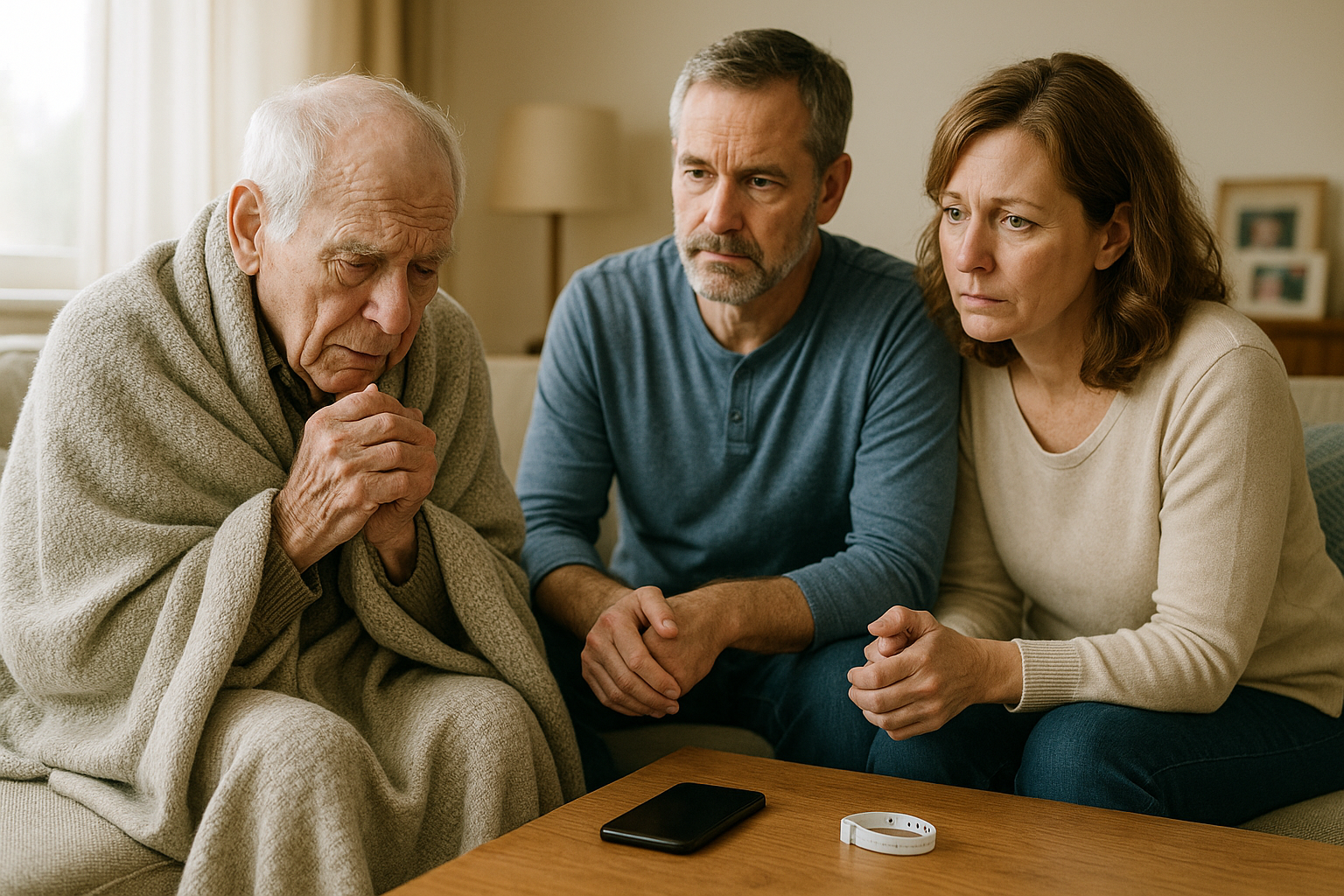
We got him to the living room. Daniel lowered him onto the couch as gently as if he were made of glass. I ran for a blanket and wrapped it around the stranger’s shoulders. Up close, he looked even smaller, like a child dressed in an adult’s clothes. Deep wrinkles cut across his face, and a faded hospital bracelet clung to his wrist.
“Sir,” Daniel said softly, kneeling. “Can you tell us your name?”
The old man blinked at us as if trying to remember how to speak.
“Michael,” he finally whispered. “My name is Michael.”
“Where do you live?” I asked.
He looked at his hands, then at the window, then back at us. His eyes filled with pure, helpless panic.
“I… I was going home,” he said. “To Sarah. My wife. She made soup. She’s waiting.”
Daniel and I exchanged a glance. We both knew that look. My grandmother had had it too, at the end. The world slipping away, piece by piece.
“We’re going to help you, Michael,” I said, forcing my voice to sound calm. “We’ll call someone. Do you have any family?”
He nodded eagerly. “Yes, yes. My grandson. David. He works a lot. Very busy. But he loves me. He’ll come.”
Daniel pointed to the bracelet. “Emma, look. There’s a phone number.”
My fingers shook as I dialed. It rang for a long time. I glanced at Michael, who was staring at the doorway like he expected his wife to appear any second with a steaming bowl of soup.
Finally, a man’s voice answered, impatient and distracted.
“Yeah?”
“Hello,” I said. “Is this David? I think your grandfather is with us. We found him sitting at a bus stop. He looks very cold and confused. We—”
A sigh on the other end. Annoyed, not relieved.
“Again?” the man muttered. “Look, I already told the hospital. I can’t keep leaving work for this. They’re supposed to handle him.”
I felt my throat tighten. “He’s not at the hospital. He’s in our living room. He thinks he’s going home to his wife. He’s freezing.”
“Yeah, he always says that,” the man replied, almost bored. “My grandma’s been dead for ten years. He doesn’t remember. Listen, I’m in the middle of something. Can you just call an ambulance or something? I can’t come.”
I stared at the phone, speechless. “He’s your grandfather.”
“And I’ve been dealing with this for years,” he snapped. “You have no idea what it’s like. I’m done. I can’t do it anymore. Just… let the system take care of him.”
The line went dead.
For a moment, all I could hear was my own breathing. Then Daniel’s hand touched my arm.
“What did he say?”
I looked at Michael. He had dozed off, his fingers still twitching against the blanket, lips moving silently like he was talking to someone in a dream.
“He’s not coming,” I said.
Something broke in Daniel’s face. A quiet, controlled anger I wasn’t used to seeing in him settled in his eyes.
“We’re not calling an ambulance yet,” he said. “Not like this. He’s not a package to be returned.”
We let Michael sleep. I made tea and thick sandwiches he probably wouldn’t eat. As the soup simmered on the stove, the house smelled like the evenings when Noah was small and came running in from the snow, cheeks red, talking non-stop about school. Back then, I used to complain that I had no time for myself.
Now, there was nothing but time.
When Michael woke up, he looked around, startled.
“Is this… my house?” he asked.
“No,” I said gently. “You’re safe with us, Michael. My name is Emma. This is my husband, Daniel.”
He studied our faces like he was trying to place us in some half-remembered album.
“Did I… get lost again?” he whispered.
“It happens,” Daniel said. “You were cold. We brought you in. Would you like some soup?”
At the word “soup,” his eyes brightened with a childlike joy.
“Yes. Sarah makes the best soup.”
I swallowed hard. “Ours isn’t bad either,” I managed to say.
We sat at the table, the three of us. Michael’s hands shook so much that Daniel quietly steadied his bowl with one hand without making a fuss. Michael talked between spoonfuls—about a garden with roses, about a dog named Lucky, about a little boy who used to run into his arms shouting “Grandpa, Grandpa!”
“Is that David?” I asked.
He hesitated, then frowned.
“David?” he repeated. “No… Noah. My boy is Noah.”
My spoon clinked against the bowl. Daniel’s hand froze in mid-air.
“What did you say?” I whispered.
Michael looked at us, startled by my reaction, then smiled slowly, as if he’d finally found the right memory.
“Noah,” he said again, nodding. “He used to draw me little cars. He would cry when he had to go home. Always saying, ‘I don’t want to leave you, Grandpa.’”
The words hit something raw in me. I pushed back my chair and went to the hallway, pretending I needed more bread. In reality, I leaned against the wall and let out a shaky breath.
Daniel followed me.
“It’s just a coincidence,” he murmured, though his voice sounded unconvinced.
“It’s not the name,” I said. “It’s… everything. The way he talks about that boy. Like he was his whole world. And now…” My voice broke. “Now his real grandson won’t even pick up the phone.”
We stood there in silence, listening to the faint clatter of Michael’s spoon in the kitchen.

“You know,” Daniel said quietly, “when Noah left, I told myself it was good. Means we did our job. Gave him wings. But the house feels like… like someone turned the volume of our life down to almost zero.”
I nodded. We had both been pretending it was fine.
Daniel took a deep breath. “What if, just for tonight, we turn it up again—for him?”
We didn’t make any big decisions out loud. We just moved, both of us, as if some invisible script had been handed to us.
I found one of Noah’s old sweaters that I hadn’t been able to give away. It was soft and warm and still smelled faintly of the detergent we always used when he was little. I helped Michael into it. It hung on his frail frame, but he smiled and patted the front.
“Nice,” he said. “Did Sarah buy this?”
“Someone who loved a boy very much did,” I replied.
We called social services. They told us an officer could come in the morning, that if he wasn’t in immediate danger we could let him stay for the night. I almost laughed at the phrase. Immediate danger. As if a cold bench and a forgotten old man were not dangerous in their own way.
That evening, Daniel brought down the dusty photo albums. We hadn’t opened them in years. Michael leaned forward, eyes wide, as we showed him pictures of our young, exhausted faces holding a red-faced baby; of Noah with missing teeth; of snowmen in the yard.
“Is that… my boy?” Michael asked at one point, pointing at a photo of five-year-old Noah holding a toy truck.
“No,” Daniel said softly. “That’s ours. But he loved his grandfather too.”
Michael looked from the photo to Daniel, then to me.
“Then you understand,” he whispered.
I didn’t realize I was crying until a tear fell onto the plastic page.
When it was time for bed, we made up the guest room. Michael stood in the doorway, looking unsure.
“Will… will someone be here?” he asked.
“I’ll be right across the hall,” I said. “If you need anything, just call.”
He nodded, then did something that made my heart clench. He reached out his hand—not to touch me, but to the empty air beside him, as if he was offering it to someone only he could see.
“Come on, Sarah,” he murmured. “They’re nice.”
After he fell asleep, I stood in the doorway for a long time, listening to his uneven breathing. Daniel slipped his arm around me—not romantically, just the steadying touch of someone who has walked beside you through too many winters.
“We can’t keep him,” I whispered. “We’re not his family.”
“Apparently,” Daniel said, his voice tight, “neither is the one he actually has.”
Morning came too quickly. Social services arrived—a tired woman with kind eyes and a folder already too thick.
“We’ve been trying to contact his grandson,” she said. “He signed some papers last month. He doesn’t want to be his legal guardian anymore.”
“So what happens now?” I asked.
She hesitated. “We’ll find a place. A facility. They’re full, but… we always find something. Eventually.”
Eventually. The word tasted like dust.
Michael shuffled into the hallway, rubbing his eyes.
“Oh,” he said, seeing the woman. “Are we going home?”
She forced a smile. “We’re going to take good care of you, Michael.”
He looked at me, panic rising again.
“Will you come?” he asked. “You and the boy?”
“The boy?” I echoed.
He frowned, frustrated with himself. “The one with the cars. The one who said he’d never leave.”
Daniel stepped closer. His voice was calm, but I could see his hands shaking.
“I can’t come with you,” he said. “But I promise you this—you are not forgotten, Michael. Not by everyone.”
Michael’s eyes filled with tears. He nodded slowly, though I wasn’t sure he truly understood.
When they led him to the car, he turned one last time.
“Tell Noah I kept his drawings,” he said. “In the drawer. By my bed.”
Then he was gone.
The house was quiet again. Too quiet. I walked into the guest room. The bed was still warm. On the nightstand lay the hospital bracelet we had forgotten to put back on him.
Without planning to, I picked up my phone and called our son.
He answered on the second ring, his voice sleepy.
“Mom? Is everything okay?”
There was a time I would have said yes, automatically. Today, I didn’t.
“No,” I said, my voice breaking. “And that’s why I’m calling. When was the last time you visited Grandpa’s grave, Noah?”
There was a long silence.
“I… I don’t know,” he admitted. “I’ve been busy with exams and—”
“I know,” I cut in, more sharply than I meant. Then I softened. “Listen to me. One day, if you’re lucky, you’ll be old too. You’ll forget things. You’ll get lost. And you’ll hope that someone, somewhere, still cares enough to walk you home.”
I told him about Michael. About the bench, the useless bracelet, the grandson who had decided he was done.
On the other end, I heard Noah sniff quietly.
“Mom,” he said finally, “I’m coming home this weekend. Can we go to Grandpa’s grave together?”
I sat down on Michael’s still-rumpled bed.
“Yes,” I whispered. “We can.”
After I hung up, I folded the old man’s blanket and placed it carefully on the chair, as if he might still need it.
He had stayed only one night, but he left something behind that was heavier than the sweater, than the silence, than the empty chair at our table.
He left the question that still echoes in my head whenever I see an old person sitting alone on a bench:
If we can’t carry our elders for a few more steps, what, exactly, are we so busy doing?