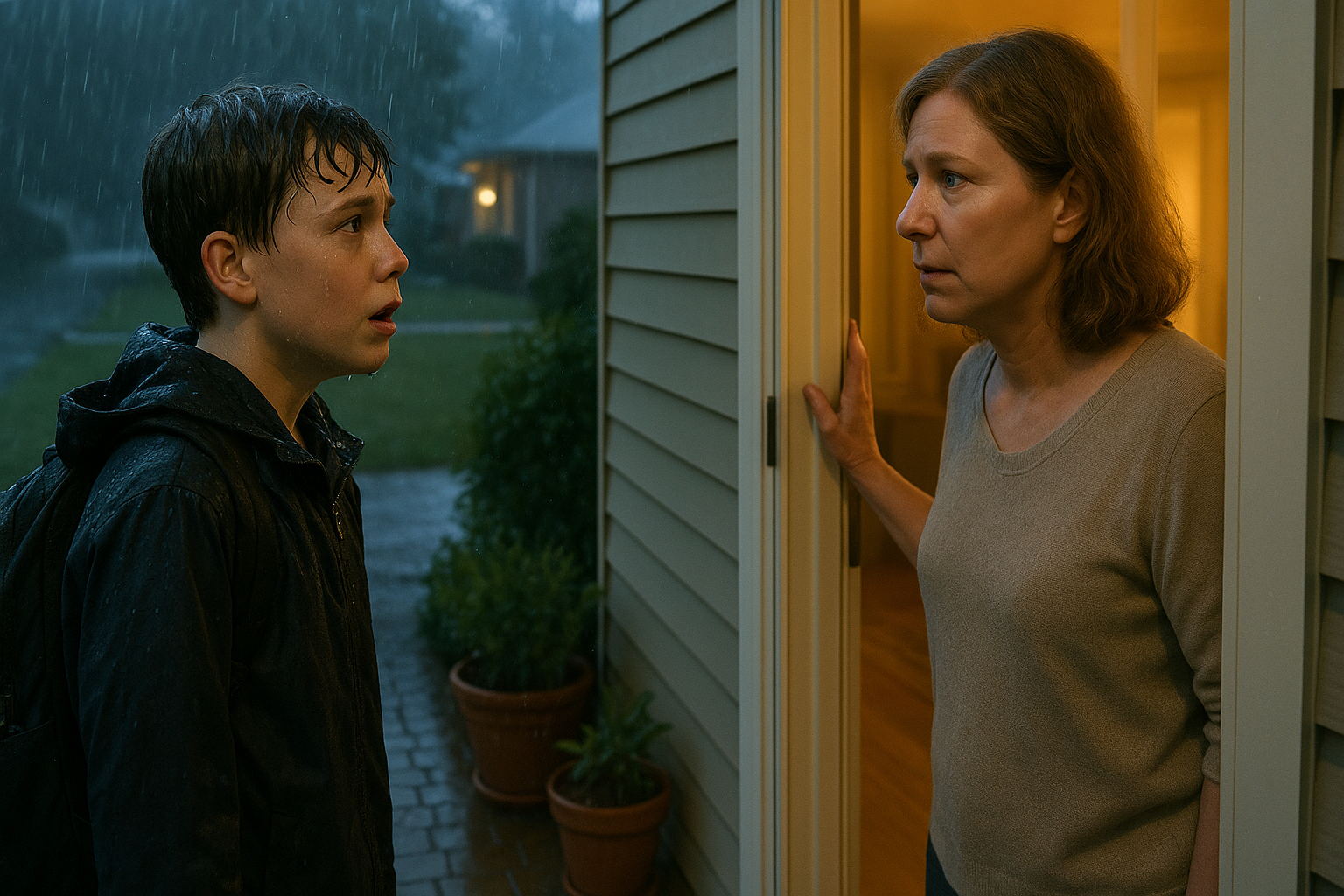
The boy at my door kept calling me “Mom”, but my only son had died three years ago. He stood there on the rainy porch, backpack soaked, hair plastered to his forehead, eyes the same impossible shade of gray that had followed me in my dreams for three long years. My hands started shaking so hard I had to grip the doorframe.

“Mom, I forgot my key again,” he said with a tired little smile, the kind I used to get when Daniel came home from school and tried to pretend everything was fine.
But Daniel was gone. I had identified his body myself after the car accident. I had chosen the coffin. I had watched them lower it into the ground.
“I think… you have the wrong house,” I whispered, my voice barely there. “Who are you?”
The boy’s smile faded. Confusion clouded his face, then hurt. “Mom, it’s me. Adam.”
That name stabbed straight into my chest. Adam had been the name we wanted to give a second child, back when we still believed in second chances. Back before the hospital doctor said the word “infertility” and shut that door forever.
“I’m not your mother,” I said, the words scraping their way out. “My son… my son is dead.”
He blinked rapidly, and his lower lip trembled in a way that was painfully, cruelly familiar. “Please, Mom, don’t do this again. If this is because I broke your vase— I’m sorry, okay? I didn’t mean to.”
I stared at him, at the mole near his left eyebrow, at the faint scar on his chin. Daniel had a scar there from when he fell off his bike at eight. My knees almost gave out.
“Wait here,” I managed. I shut the door before he could answer and pressed my back against it, sliding down to the floor. My heart hammered in my ears. On the other side of the wood, I heard a small, choked sob.
I grabbed my phone with numb fingers and dialed my neighbor, Laura.
“There’s a boy at my door,” I said. “He… he looks like Daniel.”
There was a pause. “Emma,” she said carefully, “do you need me to come over?”
“Yes. Please.”
By the time Laura arrived, the boy was sitting on the porch step, hugging his knees, backpack at his feet. He looked up at her, hopeful, then confused when he saw she wasn’t who he expected.
“Hi there,” Laura said gently. “What’s your name?”
He swallowed. “My name is Adam Turner. I live here. This is my house.” He pointed at my door with a small, shaking hand.
“That’s not possible,” Laura murmured, glancing at me. “Emma has lived here for fifteen years.”
“I’ve lived here for ten,” he insisted. “My room is upstairs on the left. My bed has blue sheets with stars. My desk is next to the window.”
I felt the air leave my lungs. Daniel’s room had blue star sheets. His desk was next to the window.
I fumbled with my keys, opened the door, and stepped aside. “Come in,” I said to him, my voice thin. “Show us.”
He went straight up the stairs as if he had walked them a thousand times. I followed, each step heavier than the last. He turned left at the top without hesitation and stopped at Daniel’s door. My hand flew to my mouth.
He reached for the handle, then froze. “Did you change the lock again?”
The door was closed, but not locked. I pushed it open.
The room was exactly as I had left it after the funeral. The star sheets were on the bed. The desk sat by the window, a thin layer of dust covering abandoned notebooks and a photo frame turned face down.
Adam stepped inside, staring around with growing panic. He ran his fingers over the desk, leaving streaks in the dust. “Why is it like this?” he whispered. “Where are my things? Where are my posters?”
I couldn’t breathe. Laura put a hand on my arm.
“Emma,” she said quietly, “we need to call someone. Maybe the police, or… or child services.”
“I’m not crazy,” Adam blurted, tears spilling now. “I live here. Mom, you help me with my math homework at this desk. You make pancakes every Sunday. Dad used to fix the car in the driveway before…” He stopped, eyes wide with sudden fear. “Where is Dad?”
“I don’t have a husband,” I said, the words automatic, practiced. “My husband left when Daniel was a baby. It’s just me.”
For a moment, the room was a vacuum, all sound sucked out. Adam stared at me like the ground had given way beneath him.
Then he whispered, “They said this might happen.”
I exchanged a look with Laura. “Who said that?” I asked.
“The doctors,” he said, wiping his face with the back of his hand. “At the hospital. After the fire. They said my memory might be… confused. That sometimes the brain tries to protect us from things we can’t handle.”
Fire.
That word slammed into me harder than any car ever could. Something old and buried flared back to life in my chest: an article I had skimmed months ago about a house fire across town, one child surviving, parents gone.
“Adam,” I said carefully, “where do you remember living? Before you came here, I mean.”
He closed his eyes, brow furrowing. “A small white house with green shutters. There was a cherry tree in the yard. My bike was always leaning on the fence because Dad said I never put it away properly.” His voice broke. “The firefighters pulled me out. They said Mom and Dad… didn’t make it.”
He opened his eyes and looked straight at me, desperation naked on his face. “But I woke up and I remembered this house. This room. Your face. I remembered pancakes and math homework and the way you sing when you clean the kitchen. I remembered you, Mom. Not her. Not the woman in the photos they showed me. I remembered you.”
The twist of it all knocked the air from my lungs. He had lost his parents in a fire. His brain had gone searching for a mother it knew how to love— and latched onto me, a stranger who had lost a son.
“I’m so sorry,” I whispered, feeling my own tears start to fall. “I’m not your mom. I wish I were, but I’m not.”
He flinched like I’d slapped him.
Laura gently pulled out her phone. “I’ll call social services,” she murmured. “He needs help, Emma.”
“Wait,” I said, too quickly. “Just… wait a minute.”

Adam stood in the middle of Daniel’s room, small and shaking, surrounded by the ghost of a boy who would never come home again. His backpack slid off his shoulder and thudded softly to the floor.
“Where am I supposed to go?” he asked no one in particular. “They said there might be a foster family, but they smelled like cigarettes and the lady kept calling me ‘boy’ instead of my name. I thought… I thought if I could just find you, everything would make sense.”
His words cracked something final and fragile inside me. For three years I had walked through my life like a shadow, talking to Daniel’s empty bed, cooking too much food, setting two plates at dinner by mistake. My therapist called it complicated grief. I called it punishment.
Now, in my dead son’s room, stood a living, breathing boy with his eyes, his scar, his stubborn tilt of the chin. A boy who had lost everything and chosen, in his broken mind, to remember me.
Laura touched my shoulder. “Emma, be careful,” she whispered. “You’re vulnerable. He is too. This is messy.”
“I know,” I said, and I did. This wasn’t a miracle. It wasn’t Daniel come back. It was trauma and coincidence and a mind trying to survive.
Still.
“Adam,” I said softly, stepping closer. “I am not your mother. Your mother loved you. She was real, and she deserves to be remembered. But… I did have a son. His name was Daniel. He died in an accident.” My voice shook. “When I look at you, it hurts. A lot. But it also… reminds me that there is still a boy who needs someone.”
He looked up, hope and fear warring in his eyes. “Are you… sending me away?”
“I’m not allowed to just keep you,” I said with a sad smile. “There are laws, and social workers, and paperwork. Adults who have to make sure you’re safe. We have to call them.”
His face crumpled.
“But,” I added quickly, “I can ask them something. I can ask if… if I can be one of the people they consider. To be your foster mom. Maybe, one day, your real mom on paper too. If that’s something you’d want.”
Laura sucked in a breath. Adam stared at me like he didn’t dare believe.
“You’d… want me?” he whispered.
I thought of the empty chair at my table. The silent mornings. The untouched toys in the closet I couldn’t bear to throw away.
“I can’t be your mother the way you remember,” I said honestly. “And you can’t be Daniel. But maybe… maybe we can be something new. Two broken people trying to be less broken together.”
He hesitated, then nodded, tears sliding down his cheeks. “Can I… call you Emma for now?”
Relief and sorrow washed over me in the same wave. “Yes,” I said. “For now, Emma is perfect.”
Laura made the calls. The social worker arrived an hour later, a kind-eyed woman named Grace who listened to Adam’s story and mine with a furrowed brow and a clenched jaw. She asked questions, took notes, made more calls.
At the end, she looked at me. “If you’re serious about fostering him,” she said, “it’s a long process. Background checks, home visits, training. And there’s no guarantee.”
“I understand,” I said. “But I want to try.”
Adam sat on the edge of Daniel’s bed, clutching the star-patterned pillow. He looked so small.
Grace softened. “For tonight, he’ll need to come with me to the emergency shelter,” she said gently. “Just until we can sort things out.”
The thought of him sleeping in a strange bed, surrounded by strangers, twisted my stomach. But rules were rules.
I walked him to the door. The rain had stopped, leaving the world washed and sharp.
He turned to me on the porch. “If… if they don’t let you be my foster mom,” he said, voice barely above a whisper, “will you still… visit me? Or will you forget me too?”
I knelt, so we were eye to eye. Up close, I could see the fine freckles across his nose, the redness around his eyes from too many nights of crying.
“I will not forget you,” I said, each word an oath. “Even if they don’t let me be your mom, I will find a way to be in your life. You knocked on my door, Adam. That means something. To me, it does.”
He studied my face, then gave a tiny, trembling nod. Grace led him down the path. He looked back twice before the car door closed.
When they drove away, I stood alone in the doorway, the echo of “Mom” still ringing in my ears.
That night, I went into Daniel’s room for the first time in months and turned on the light. Dust motes danced in the air. I opened the window and let the cool air in. Slowly, carefully, I took the photo of Daniel from the drawer and set it on the desk, next to the spot where Adam’s fingers had drawn lines in the dust.
“Daniel,” I whispered into the empty room, “I will never replace you. No one could. But there is a boy out there who needs someone to stand up for him the way I used to stand up for you. I think… I think you would have wanted me to open the door.”
The house felt less hollow as I spoke. Not full, not healed, but different. Like the first stitch pulled through a torn seam.
Three weeks later, after forms and interviews and tears and waiting, my phone rang. Grace’s voice was bright.
“Emma,” she said, “if you’re still willing… we’d like to place Adam with you as a foster parent. He asked for you by name.”
When Adam walked back through my door, his backpack a little less full and his eyes a little more guarded, he didn’t call me “Mom”. He just said, “Hi, Emma,” and looked around like he was afraid it had all been a dream.
“Welcome home,” I said, my voice thick. “Would you like pancakes for dinner?”
His mouth twitched. “You know it’s not Sunday, right?”
“I know,” I said. “But I think we can make an exception.”
As I pulled out the mixing bowl, he hovered in the doorway of the kitchen, watching me with that same impossible gray gaze. It hurt. It always would. But alongside the hurt, something else began to grow, fragile and real.
He wasn’t my son. And yet, somehow, he was the boy who had chosen my door on the night the rain wouldn’t stop.
Maybe grief had led him here. Maybe love would be the thing that finally let us both stay.