The boy kept leaving food on our doorstep, and my husband wanted to call the police—until we finally opened the door and saw who was standing there.

At first it was just an apple. Early October, chilly morning, I opened the door to take out the trash and nearly stepped on it: a small red apple, still wet with dew, placed right on the mat. I looked up and down the quiet suburban street. No one. Just the mailman two houses away and the neighbor’s dog.
“Probably kids messing around,” my husband Mark said, shrugging. He washed the apple and ate it on his way to work.
The next day there was half a sandwich, carefully wrapped in plastic. The day after—a neatly folded paper napkin with three cookies. Always early, always on the mat, always when we weren’t looking.
By the end of the week, it stopped feeling funny.
“What if it’s poisoned?” Mark snapped on Friday, holding a small container with pasta that had appeared overnight. “Or some freak recording us for a prank video? I’m calling the police if this happens again.”
I wanted to laugh, but there was something about the way the food was placed. Not thrown, not scattered. Arranged. Like a quiet, clumsy gift.
That night I couldn’t sleep. The house was too still, the tick of the hallway clock too loud. Maybe it was because we had just come back from the doctor, again, with the same answer: no, not this time, maybe try another treatment. The silent echo of the phrase “unexplained infertility” was louder than any clock.
I got up around six, wrapped myself in a cardigan, and sat on the stairs, watching the frosted glass of the front door. Outside, a pale dawn was leaking into the sky.
At 6:23, a small shadow moved past the glass.
My heart jumped. I held my breath and, as quietly as I could, turned the lock. The door creaked anyway, the sound huge in the stillness.
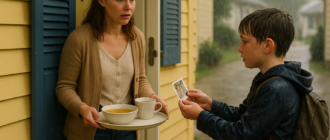
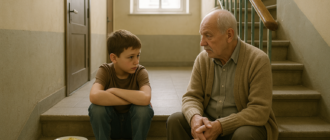
On the porch stood a boy—maybe ten, skinny, with a jacket too thin for the cold. In his hands he held a plastic container with rice and a boiled egg. He froze, eyes wide, as if he’d been caught stealing.
“Hey,” I said softly. “It’s you.”
He looked ready to run.
“I—I’m sorry,” he mumbled. “I didn’t mean to wake you.” His English had a slight accent, something Eastern European. “I just wanted to leave this and go.”
“Why?” I asked, stepping out barefoot into the cold. “Why are you leaving food here?”
He hesitated, then looked over my shoulder into the hallway, as if expecting someone else. His eyes were dark, tired, older than his face.
“You are the lady who cried,” he said finally.
The words hit me like a slap. “What?”
“Last month,” he went on quietly, clutching the container, “at the hospital. You were in the hallway. You were crying on the floor. I was sitting on the bench.”
The memory rose, sharp and humiliating. The fertility clinic, the doctor’s voice—“I’m afraid the last attempt failed”—the little waiting area with the peeling plant. I had sat down on the floor because my legs wouldn’t hold me, sobbing into my hands, not caring who saw.
I remembered a pair of sneakers across from me. Small ones. I hadn’t even looked up.
“My mom was in the room with the doctor,” the boy continued. “They said…” He swallowed hard. “They said she is very sick. They said she might not stay long. You were crying, and I… I wanted to give you my sandwich, but I was scared. I thought you would be angry.”
He glanced at the container. “I heard you say your street name to the nurse when you called someone. I remembered it. I wanted to help. My mom says when someone cries because their heart is broken, you must give them food, so they remember they are still alive.”
My throat closed. The cold bit into my bare feet; I barely felt it.
“Where is your mom now?” I whispered.
He looked down. “She is at home. She doesn’t get up much. We don’t have car. My uncle works nights. I cook sometimes. I thought… maybe you are still sad. So I bring food.”
Behind me, the floor creaked. Mark appeared, hair messy, eyes narrowed with sleep. “Emma, who are you talking to?”
He stopped when he saw the boy.
“This is the one leaving the food,” Mark said slowly. “Kid, you can’t just—”
“Mark,” I cut in, my voice sharper than I intended. “He saw me at the clinic. When I… lost it.”
Understanding flickered across his face, followed by guilt.
The boy shuffled his feet. “If it is bad, I stop,” he said quickly. “I just didn’t want the lady who cried to be hungry. You looked like my mom when she cries at night.”
Mark’s shoulders dropped. He ran a hand over his face and then did something I didn’t expect—his voice broke a little.
“Are you eating enough yourself, kid?” he asked. “You look like you’re the one who needs food.”
The boy shrugged. “We are okay. I just… share.”
“What’s your name?” I asked.

“Luka,” he said. “We moved here in summer. From Ukraine.”
I stepped back and opened the door wider. “Luka, would you like to come in? It’s freezing.”
He hesitated, glancing down the street as if someone might scold him. Then he nodded.
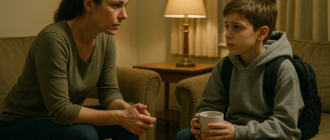
Inside, under the kitchen lights, Luka looked even smaller. His fingers were red from the cold. He sat at the table like someone sitting in a stranger’s church—back straight, hands folded, afraid to touch anything.
I made hot chocolate and toast, my hands shaking. Mark found an extra sweater and draped it over the back of his chair.
“Does your mom know you’re here?” I asked.
He nodded. “She sleeps now. I put a note on the table. I always come back before she wakes.”
As he ate, words slowly spilled out between cautious bites. His mother, Anna, cleaned offices at night until her body couldn’t handle it anymore. The diagnosis that came too late. The uncle who took an extra shift to pay for medicine. The quiet hours Luka spent alone, cooking simple meals, listening to his mother’s labored breathing from the next room.
He said it all matter-of-factly, like reading a weather report.
“And the food?” Mark asked softly.
Luka’s ears reddened. “Sometimes we get boxes from the church. Too much for us. Mom says we must share. She doesn’t know I give it to you. She would say we should give to someone older. But you… you looked like you needed it.”
I covered my face with my hands for a moment so he wouldn’t see my tears. This boy, with a sick mother and not enough of anything, had been leaving little offerings on our doorstep so a stranger wouldn’t feel alone.
The twist of shame and tenderness in my chest was almost unbearable.
“We’re the ones who should be helping you,” I said finally, wiping my eyes. “Not the other way around.”
He frowned, clearly puzzled. “But you are sad,” he said, as if that settled it.
Mark cleared his throat. “Luka, how about we walk you home later? Maybe meet your mom. We can bring some groceries. No strings attached. Just neighbors, okay?”
Luka’s eyes widened, fear flashing through them. “Please, no social workers,” he blurted. “Mom is scared they will take me.”
“No social workers,” I said quickly. “Just us. Just Emma and Mark from around the corner. I promise.”
He searched my face for a long second, then nodded slowly.
That afternoon we stood in a small, dim apartment three blocks away, bags of groceries at our feet. Anna was thinner than any adult should be, her cheeks hollow, a scarf tied around her head. But her eyes—when they moved from Luka to us and back—were fierce.
“I told him not to bother anyone,” she said, embarrassed, when Luka finally confessed about the food. “I am sorry. He just… he loves to help.”
“Please don’t be sorry,” I said, my own voice thick. “He’s been helping more than you know.”
I told her about the clinic, about the hallway, about the apple and the cookies. About how, on mornings when getting out of bed felt impossible, the sight of that small, clumsy gift had been enough to make me boil water for tea and keep going.
By the time I finished, all three of us adults had tears in our eyes. Luka stood between us like a bridge, his face pale with confusion and stubborn hope.
In the weeks that followed, our house changed. There were extra shoes by the door, schoolbooks on the coffee table, cheap cartoons playing on low volume in the evenings. Luka came by after school to do homework at our kitchen table while Mark pretended not to help with math and absolutely helped.
I found myself cooking too much on purpose. “Accidentally” making an extra lasagna. “Forgetting” that I’d already baked cookies. Groceries went back and forth between our houses so often that it stopped mattering who bought what.
One night, as I was tucking a blanket around Luka on our couch after he’d fallen asleep watching a nature documentary, Mark caught my eye.
“We’re not parents,” he whispered, almost apologetically.
I looked at Luka’s relaxed face, the way his hand still clutched the TV remote like a toy.
“Maybe not the way we planned,” I replied. “But we’re something.”
Months later, at another clinic appointment, the doctor said the words I had stopped believing I’d ever hear. Positive. Early, fragile, but real. A life.
I cried again in a hospital hallway. But this time, when I looked up through my tears, Luka was there, taller now, holding a sandwich in a napkin.
“For when your heart is too happy and you forget to eat,” he said, shy but proud.
And for the first time, I realized that somewhere between the apples and the pasta containers and the hot chocolate on cold mornings, the boy who had tried to feed my broken heart had quietly stitched it back together.
We never called the police.
We just opened the door.