I found a little boy sleeping on the bench in front of our house, and when I covered him with my late son’s jacket, he whispered a name that made my legs give way.

It was late afternoon, the kind of quiet Sunday when the whole street seems to breathe slowly. I had just finished dusting Daniel’s room again, rearranging the same books, folding the same shirts that would never be worn. Three years, and I still could not bring myself to pack anything away.
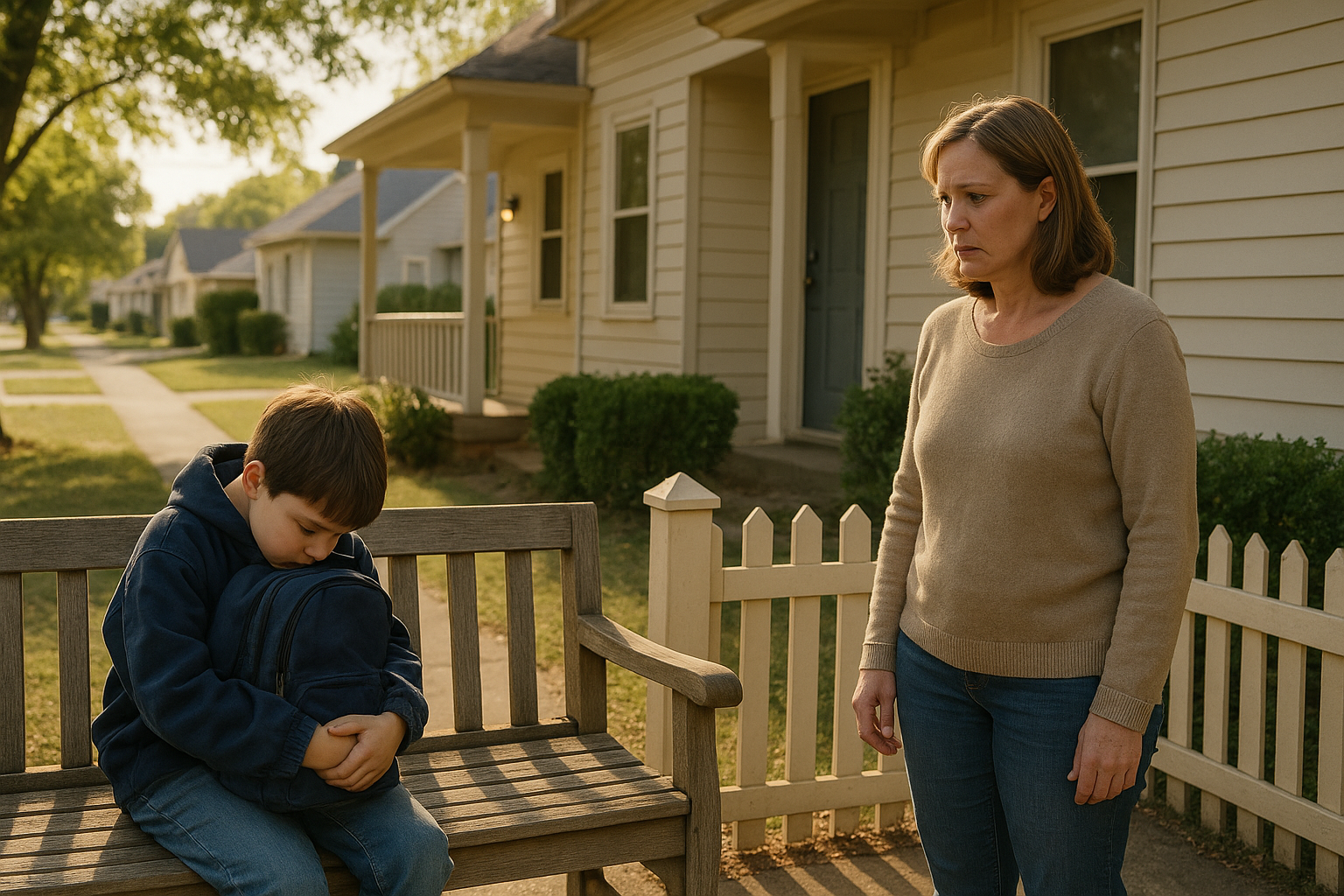
When I stepped outside to shake the doormat, I saw him. A small boy, maybe seven or eight, curled up on the wooden bench by our gate. His knees were pulled to his chest, sneakers caked with dried mud, a backpack clutched to his chest like a shield. His hair was messy, his cheeks pale, and there was that certain stiffness of someone who is too tired to even be properly afraid.
I looked up and down the street. No parents, no car, no one calling his name. Just the sound of a distant lawnmower and a barking dog.
“Hey, sweetheart,” I said softly, approaching. “Are you okay?”
He didn’t answer. I realized then that he wasn’t just resting his eyes—he was deeply asleep, his lashes trembling slightly like he had cried himself into it.
The autumn air had teeth. I was suddenly angry at whoever had left a child outside in this cold. Without thinking, I went back inside, straight to Daniel’s room, and took his favorite navy jacket from the back of the chair. It still smelled faintly of his shampoo, or maybe that was just my memory refusing to let go.
I walked back and gently draped the jacket over the boy. He stirred, fingers loosening on the backpack. For a second I thought he would wake, but his eyes stayed closed.
Then, in a voice raw with sleep and something like fear, he whispered, “Daniel… don’t go.”
The world tilted. My knees actually buckled; I grabbed the side of the bench to steady myself. I stared at him, at the too-thin wrists, the chapped lips, the way his small hand had slipped out from under the backpack and rested on my son’s jacket.
“How do you know that name?” I whispered, but he didn’t answer. A tear slid from the corner of his closed eye.
For a horrible, irrational moment, a thought flashed through me: maybe this is a sign, maybe Daniel sent him. Grief is cruel like that—it makes you believe in impossible things because the possible ones hurt too much.
I could not leave him there. Carefully, I shook his shoulder. “Sweetheart, wake up. You’re cold.”
He flinched awake with a small cry, scrambling back until his shoulders hit the armrest. His eyes—light hazel, ringed with red—darted everywhere, searching for exits.
“It’s okay,” I raised my hands, palms up. “You’re safe. My name is Laura. You were asleep on my bench.”
He blinked at the jacket around his shoulders, then at my face. “I– I’m sorry,” he stammered. “I didn’t mean to… I was just… tired.”
“You don’t have to be sorry for being tired,” I said. “Are you hungry?”
His Adam’s apple bobbed. That was answer enough.
Inside, at the kitchen table, he sat perched on the edge of the chair like a bird ready to fly away at any second. He kept the jacket around him, fingers pressed into the fabric.
“What’s your name?” I asked, placing a plate with a sandwich and an apple in front of him.
He hesitated. “Lucas.”
“It’s nice to meet you, Lucas.”
He devoured the sandwich so fast I had to remind him to chew. Only after the second glass of water did his shoulders drop a little.
“Where are your parents, Lucas?” I asked gently.
His eyes went to the window, to the bench outside. “My mom… she had to go. My stepdad said… he said I was old enough to figure things out. He left this morning.”
Something in my chest tore a little. “He left you? Just like that?”
Lucas shrugged, but the movement was too sharp, too bitter for such a small body. “He left some money on the table. Said it would last, if I didn’t eat too much.” He gave a small, humorless laugh. “The fridge was almost empty.”
“Where do you live?”
He pointed vaguely down the street. “Four blocks. But I don’t want to go back. It’s… loud.”
Loud. I pictured shouting, doors slamming, maybe fists on the table. Or worse.
“And Daniel?” I asked before I could stop myself. “You said his name outside. Who is Daniel?”
Lucas’s hand tightened on the jacket. “He… he was my friend. At the hospital.”
The kitchen clock ticked loudly, each second stretching.
“Which hospital?” I asked, though I already knew the answer in my bones.
“St. Mary’s,” he said. “The children’s ward. He was in the bed next to mine. He… he used to tell me stories when I couldn’t sleep. Space stories. He said when we got better, we’d build a rocket from cardboard.”
My fingers went numb. St. Mary’s Children’s Hospital. The same ward where my Daniel had spent his last months fighting the cancer we never managed to beat.

“What… what was your illness?” I forced the words out.
“Leukemia,” Lucas said quietly. “But I’m better now. They said I could go home.” He swallowed. “Only it wasn’t really home anymore.”
Suddenly the dining room seemed too small, the air too thick. I saw flashes: my son’s thin face, his laugh when he made ridiculous sound effects for rocket engines, the little boy in the next bed who always listened with wide eyes.
“Was Daniel… tall, with dark hair that never stayed down?” I asked, my voice trembling.
Lucas’s eyes widened. “You knew him?”
“I’m his mother,” I whispered.
For a second, we just stared at each other. Then Lucas’s chair scraped loudly as he stood up. “He… he talked about you all the time,” he blurted. “About how you’d sneak in extra jam on his toast when the nurses weren’t looking. He said you’d be mad if he didn’t wear a jacket outside, because you worried too much.”
A sound came out of me that was half laugh, half sob.
“He promised,” Lucas went on, his voice shaking, “he promised that when we both got out, I could come to his house and meet you. He said you make pancakes shaped like planets.”
I covered my mouth with my hand. I remembered that conversation now, in fragments—the two boys whispering when they thought I was asleep in the visitor’s chair, Daniel’s quiet excitement when he said, “Mom, maybe Lucas can visit one day.”
“Daniel didn’t get out,” Lucas said softly, more to himself than to me. “The night he… he went away, he held my hand and said if I ever felt really alone, I should go find you. That you’d know what to do, even if you were sad.”
Tears blurred my vision completely. I reached for the back of a chair to steady myself. “He told you that?”
Lucas nodded, and for the first time, his composure cracked. “I tried to be brave like him, but my stepdad hates hospitals, he hates talking about it, and my mom… she’s so tired all the time. They fight about money, about me. I remembered the street name he told me. I walked until my feet hurt. I didn’t know if you’d even still live here. I just… I didn’t know where else to go.”
A little boy, following directions given by a child who never made it home.
I moved around the table slowly, giving him space to pull away if he wanted. He didn’t. He just stood there, shaking, clutching my son’s jacket like a lifeline.
“I am sad,” I said, my voice rough. “Every day. But I also know what to do with a hungry boy who has nowhere safe to sleep.”
His chin wobbled. “He said you would.”
For the first time in three years, the house didn’t feel like a museum of things lost. It felt like a place where someone needed me again.
“I can’t promise everything will be easy,” I said carefully. “There will be calls to make, people to talk to. Maybe your mom, if it’s safe. Maybe someone who can help us figure all this out.” I took a deep breath. “But I can promise you won’t be alone tonight. Or hungry.”
Lucas nodded, a single, jerky movement. A tear slid down his cheek, catching the light.
“Do you want to see his room?” I asked softly.
He hesitated, then whispered, “Yes.”
We walked down the hallway together. I opened the door that had been closed more often than not these past years.
Sunlight spilled over the posters on the walls, the shelves of books, the model rockets frozen mid-flight. For once, the sight of it didn’t crush me. Instead, I saw it through Lucas’s eyes: a boy’s world, full of dreams that had not completely died, because they had been shared.
“He really loved space,” Lucas said, stepping inside slowly.
“He really loved you,” I answered before I could stop myself.
He turned to me, eyes wet. “Then… then maybe he wouldn’t mind if I stayed here for a little while.”
I thought of the jacket around his shoulders, of the whispered promise in a hospital room full of machines. And for the first time, the idea of packing Daniel’s things away didn’t feel like betrayal. It felt like making space.
“I think,” I said, my throat tight, “that he sent you here for a reason.”
Lucas looked at the photo of Daniel on the nightstand and gave a small, shy nod, as if agreeing with an old friend.
And in that quiet, sunlit room, with one boy gone and another standing in his place, I realized that grief doesn’t always end—sometimes it changes shape, making room for a new, fragile kind of love.
That evening, as I cooked planet-shaped pancakes for Lucas and listened to him talk about school, I caught myself smiling. Not the brittle smile I wore for other people, but something softer, almost unfamiliar.
Outside, the bench in front of our house stood empty, my late son’s jacket no longer hanging unused on a chair. Inside, a little boy finally slept in a warm bed, his backpack on the floor, his breathing even.
And for the first time since Daniel left, I did not feel completely alone.