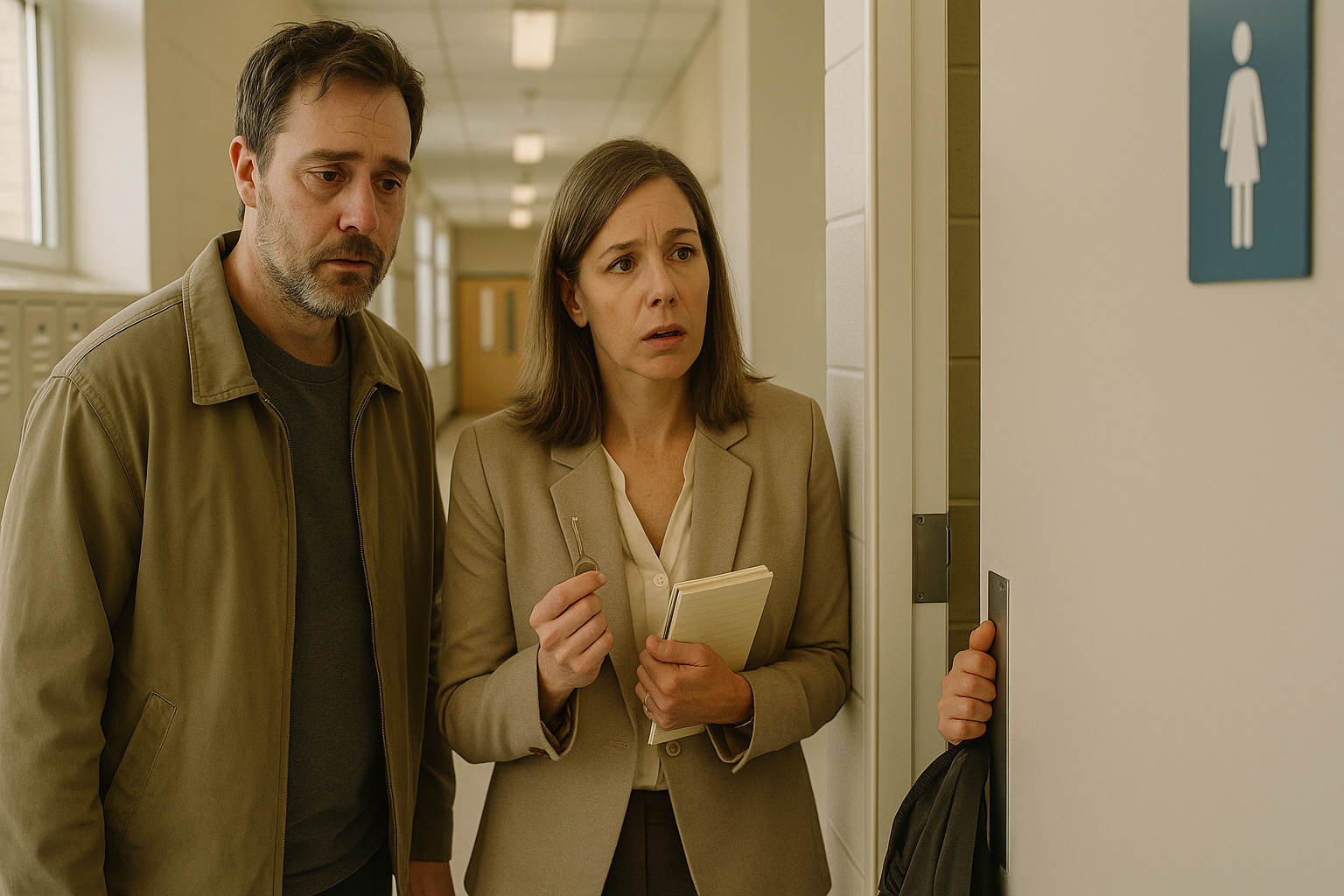
On a rainy Tuesday, Leo locked himself in the school bathroom and refused to come out until his mother answered the phone, but the number he kept dialing had been disconnected three months ago.

The school counselor, Emma, stood outside the stall, listening to the quiet, stubborn beeps of redial. The janitor had already tried the master key, but Leo had wedged his backpack under the door. Somewhere behind the thin wall, a twelve-year-old boy was breathing too fast.
“Leo,” Emma said softly, keeping her voice steady, “it’s me. Can you open the door so we can talk?”
Silence. Then the muffled sound of a sob being swallowed.
“She’s not picking up because you’re talking to me,” Leo said, his voice hoarse. “If you go away, she’ll answer.”
Emma closed her eyes for a second. Three months ago she had sat in the same office with a police officer and the principal, discussing how to tell Leo that his mother had died in a car crash on her way back from a night shift. They had tried the gentle words, the careful pauses. Leo had stared at them, then at the floor, and then had simply said, “No.”
Since that day, he had never said the word “died.” He said “busy,” “at work,” “phone off.” His father, Daniel, came to school when he could, always looking like he had slept in his car—eyes red, shirt wrinkled, a permanent apology in his shoulders.
“Leo, the principal is worried,” Emma tried again. “Your dad is on his way. Let’s wait for him in my office, okay?”
On the other side, something clattered—probably the plastic soap dispenser. “I called her twelve times,” Leo muttered. “Maybe the signal is bad. She hates when I worry. I’ll just stay here until she calls back.”
Emma felt the words hit her chest like stones. She remembered the day she had called Leo’s father to bring him to the hospital. Daniel had knelt by the bed, kissing his wife’s cold hand over and over, whispering, “How do I tell him?” No one had an answer.
Now, outside the bathroom stall, Emma realized they had told him—but they had never really reached him.
“Leo,” she said, a little firmer, “I need you to listen. The number you’re calling…it doesn’t work anymore. That’s why—”
“It works!” Leo snapped, suddenly fierce. “I heard it ring last week. I did! She just couldn’t talk, that’s all. She’s busy. Adults are always busy.”
His voice broke on the last word.
Emma swallowed. A group of boys had gathered by the door, whispering. She waved a teacher over to move them away. This wasn’t a show. This was a child clinging to the last thread he had.
Minutes stretched. The rain drummed against the bathroom windows. Somewhere, a bell rang, but no one moved Emma. She stayed.
At last, there were hurried footsteps in the corridor. Daniel appeared in the doorway, out of breath, his jacket soaked. He looked older than his thirty-eight years, his hands trembling as he ran them through his damp hair.
“Where is he?”
Emma pointed to the stall. “He keeps calling her number. He thinks she’ll answer if we stop bothering him.”
Daniel’s face crumpled for a second, then he forced himself forward. He pressed his palm against the cheap painted wood.
“Leo, buddy, it’s Dad.”
There was a pause, then a sniff. “Go away, Dad. She’ll be mad if you keep stressing me out.”
Daniel’s eyes filled with tears he didn’t have time to hide. Emma stepped back, giving him space, but stayed close enough to catch him if he collapsed.
“Leo,” Daniel said, voice shaking, “I would give anything, anything, for that phone to ring and for her to tell me I’m being stupid. I wish you were right. I wish I was wrong. But she’s not going to call back.”
Leo laughed—a short, brittle sound. “You always say stuff like that when you’re tired. Just go sleep. I’ll wait.”
Emma realized then that every late shift, every empty chair at parent meetings, every crumpled flyer about grief counseling had been filling the same silent space: Leo’s refusal to let the world move on.
Daniel reached into his pocket with unsteady fingers and pulled out an old, cracked smartphone. “Leo, I kept her phone,” he said, louder now. “I didn’t tell you because I thought it would hurt. But I have it. The SIM card is gone. The number doesn’t exist anymore. I can bring it to you right now. You can hold it. You can see.”
There was a thud on the other side of the door, as if Leo had slid down to the floor.
“You’re lying,” he whispered. “If I open the door… she won’t be able to call me here. Bathrooms have bad signal.”
The child’s logic was so sincere, so desperate, that Emma had to bite the inside of her cheek.
Daniel leaned his forehead against the door. “Leo, do you know why I’m always late? Why I’m tired?”
“Because you’re lazy,” Leo muttered, the insult empty, automatic.
“No,” Daniel said quietly. “Because I’m working two jobs. Because I’m trying to be Mom and Dad at the same time, and I’m failing at both. Because every night I sit at the kitchen table and stare at her chair and wait for the sound of her key in the door. I know how it feels to wait for someone who isn’t coming back.”

There was a long, shaky breath from inside. “Then why did you stop calling her?”
The question was a knife.
Daniel’s shoulders sagged. “Because every time I heard the message say ‘this number is no longer in service,’ it felt like she was dying all over again. And I didn’t want to die every day, Leo. I needed to be alive for you.”
Silence. The rain softened outside, becoming a faint hiss.
Emma stepped a little closer. “Leo,” she said gently, “no one is asking you to stop loving her. We just don’t want you to be alone with it in a bathroom stall.” Her voice trembled despite her effort to keep it steady. “If you open the door, you can still hold the phone, you can still talk to her if you want. Just… let us sit with you while you do.”
For almost a minute, nothing happened. Then they heard a small, broken sound—a boy trying and failing to swallow his tears. The backpack scraped against the tiles. A click. The lock turned.
The door opened a crack.
Leo’s face appeared, streaked with tears, cheeks blotchy, hair sticking to his forehead. His eyes were swollen, wild, and so heartbreakingly young.
“Promise you won’t take the phone away,” he said, looking only at Emma, as if afraid his father’s pain would drown him.
Emma nodded. “I promise.”
Daniel pulled the old smartphone from his pocket with shaking hands. The screen was spiderwebbed with cracks, the case scratched. He held it out like an offering.
Leo’s fingers hovered before he snatched it, clutching it to his chest. For a second he just held it, eyes closed, breathing it in as if it still carried his mother’s scent.
“Can I… can I call her from here?” he whispered.
Daniel’s lips trembled. “You can talk to her anytime you want,” he said. “She might not answer, but… I think she’s listening in a way we don’t understand.”
Emma braced herself for another dial tone, another refusal. But Leo didn’t press any buttons. He just pressed the dead phone to his ear and slid down the wall, curling in on himself on the cold tile floor.
“Hi, Mom,” he whispered into the silence of the broken device. “It’s me. I’m in the bathroom and everyone’s being annoying. I know you’re busy, but… I’m really tired of waiting.”
His shoulders shook. Daniel sank down beside him without touching him, their backs against the same wall, inches of tile and a universe of pain between them.
“I miss you,” Leo said to the phone. “But I think Dad misses you more. He keeps burning the pasta.”
A strangled laugh escaped Daniel, half sob, half relief. Emma felt her own tears spill over.
Leo lowered the phone and looked at his father for the first time that day. “If I stop calling,” he asked, eyes wide and terrified, “will she think I forgot her?”
Daniel shook his head quickly, fiercely. “No. She knew how much you loved her the day you were born. You don’t have to prove it with calls.”
Leo swallowed hard. “Can… can we put her number in your phone instead? So if I need to… I can call from your pocket. Not just from mine.”
It was such a small, heartbreaking compromise: a child slowly sharing his grief.
Daniel nodded, tears falling freely now. “Yeah. We can do that. We’ll keep her number together.”
Leo looked at the dead phone, then at Emma. “Can I stay in your office today?” he asked quietly. “I don’t… I don’t want to go back to class and pretend I’m okay yet.”
Emma’s voice almost failed her, but she managed, “Of course.”
As they walked down the hallway—Leo between Emma and Daniel, gripping the broken phone like a lifeline—teachers peeked out of classrooms, curiosity written on their faces. Emma met their eyes one by one until they looked away, understanding that whatever had happened was not gossip but a fragile, painful step forward.
Later, sitting on the worn couch in Emma’s office, Leo fell asleep with the phone in his hands, his head resting against his father’s arm. Daniel didn’t move, afraid to wake him, staring at the boy’s small fingers wrapped around the relic of a voice they would never hear again.
Emma watched them from her desk, the quiet hum of the radiator filling the room. Outside, the rain had stopped, and pale sunlight began to filter through the blinds, striping the walls with thin lines of light.
The number was still disconnected. The woman was still gone. Nothing truly changed.
And yet, in that cramped office with the crooked blinds and the cheap couch, a father and son had taken one painful, necessary step away from the bathroom stall and the endless empty ringing—and a tiny, fragile space opened where healing, someday, might begin.