The boy next door kept leaving food on our doorstep, and only when my father shouted at him did I realize who he really was.

At first it was almost funny. A plastic box with pasta on Monday, two bruised apples on Wednesday, a sandwich wrapped in a napkin on Friday. Always early in the morning, always on the doormat, always still slightly warm. I thought it was some kind of prank. My father, Daniel, said some delivery kid had the wrong address.
We lived on the third floor of a tired brick building. After my mother died two years ago, the apartment had become too big, too quiet, and too expensive. My father tried to pretend everything was normal. He worked double shifts as a security guard, drank too much coffee, and told me, “Ethan, we’re fine. I’ve got this.”
But we were not fine. The fridge often echoed when you opened it. I had learned to love cheap noodles and the last slices of bread. I never complained; I saw the bills on the table, the red numbers, the letters my father hid in a drawer.
The first time I actually saw the boy, it was because I woke up too early for school. I heard soft steps in the hallway and the rustle of a plastic bag. I opened the door a crack.
A skinny kid, maybe ten or eleven, in a faded hoodie, was carefully placing a container on our mat. His hair was messy, his sneakers too small. He glanced around like a frightened cat.
“Hey,” I whispered.
He jumped, nearly dropping the container. His eyes were huge and dark. For a second he looked like he might run.
“S-sorry,” he muttered. “Wrong door.”
He turned and almost sprinted down the stairs, clutching an empty bag. I opened the container. Rice, beans, and a fried egg. Still steaming.
Wrong door. Sure.
The next week, the offerings continued. Soup in an old jar. Half a loaf of bread. A small chocolate bar once, broken in two as if someone had decided to share their last treat.
I started to feel strange guilt every time I ate what he left. I tried to catch him again, but he always moved like a shadow at dawn.
One Saturday, my father finally noticed.
He had just come off a night shift, eyes red, shoulders heavy. When he opened the door for fresh air, there was a plastic box of roasted potatoes and carrots waiting like a silent accusation.
“What is this?” he asked, voice flat.
I hesitated. “Someone’s been leaving food. For a few weeks.”
His jaw tightened. “We are not beggars, Ethan.” He grabbed the box and marched out into the hallway.
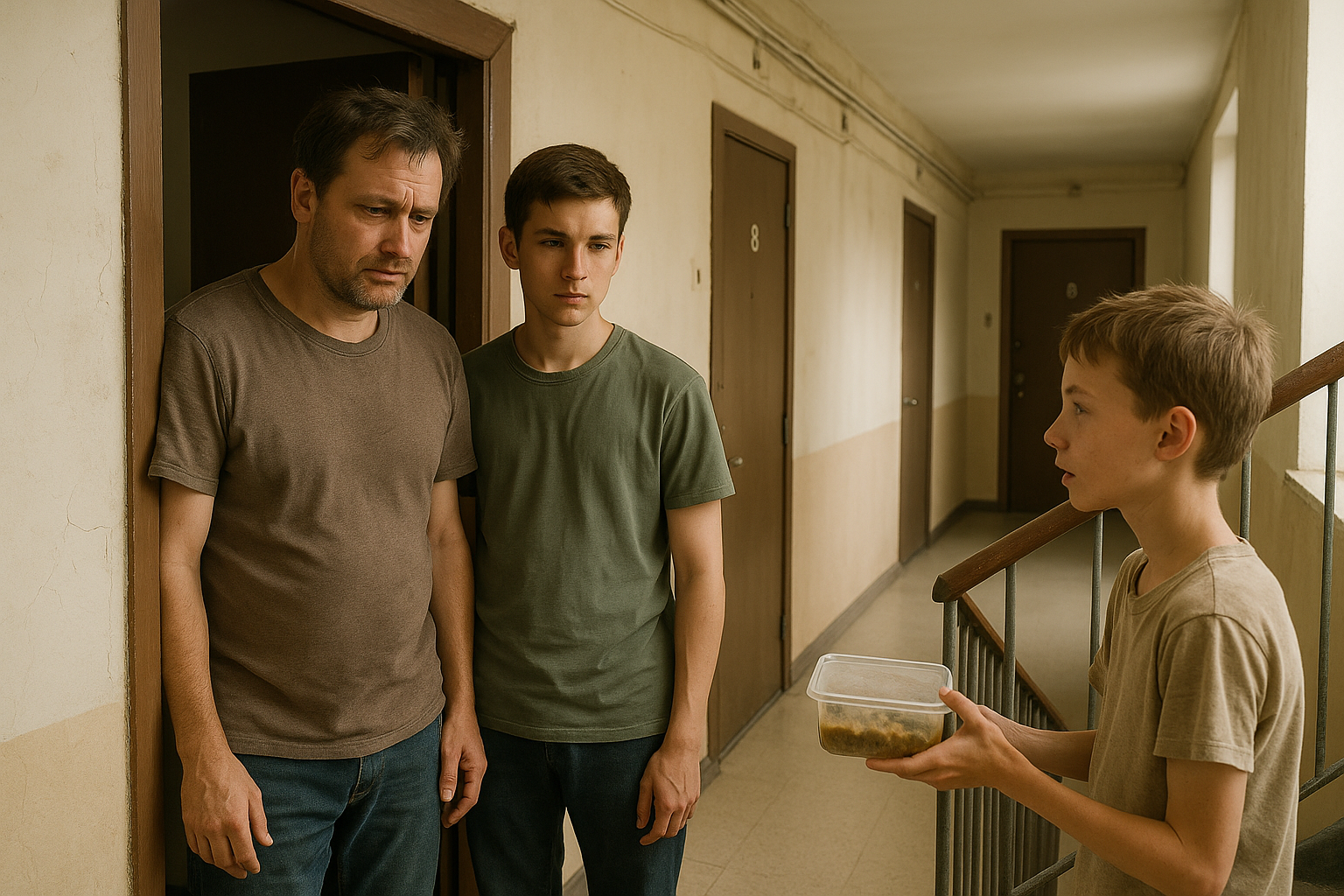
As if summoned, the boy appeared on the stairs, clutching another small bag. He froze when he saw my father.
“Is it you?” my father snapped. “You think we need your charity? Who told you to do this?” His voice echoed off the peeling walls.
The boy flinched but didn’t run this time. His lips trembled. “I’m… I’m sorry, sir. I just thought…”
“Thought what? That we can’t feed ourselves? Take your food back. We don’t need it.”
I watched, feeling my stomach knot. The boy’s eyes moved from my father’s angry face to mine. There was something in them I couldn’t place – not fear, not pity. Something like stubborn sadness.
“I know what it’s like to be hungry,” he whispered.
My father opened his mouth, ready to fire back, then closed it, struggling to breathe evenly. “Go home,” he said, forcing the words through his teeth. “And tell your parents not to send you here again.”
The boy swallowed hard. “I don’t have parents.” He said it quietly, like a fact he had repeated too many times.
The hallway went silent.
A door on the second floor creaked. Mrs. Patel, our elderly neighbor, peeked out, her gray hair in a loose bun.
“Daniel,” she said softly, “that’s Noah. He lives in 2B.”
“With who?” my father asked, his voice suddenly smaller.
“With his grandmother. She had a stroke last year. He takes care of her. Social workers come sometimes, but mostly it’s just him.”
Noah stared at the floor, his fingers twisting the handle of the empty bag. My father frowned.
“Where did you get the food?” he asked, but his tone had lost its sharp edge.
“From the school cafeteria,” Noah said, still not looking up. “They throw away a lot. If I help clean, sometimes they let me take leftovers. And… sometimes the lady from the bakery gives me bread at closing time. We always have a bit more than we can eat. So I thought…” He finally looked at my father. “You were always coming home so late. And your boy… he looked tired.”
Heat crawled up my neck. I hadn’t realized anyone noticed.
My father leaned against the wall as if someone had pushed him. The veins in his hands stood out.

“Why us?” he asked hoarsely.
Noah shrugged one thin shoulder. “I heard you on the phone. Downstairs. You were talking about bills. And you said, ‘I’ll skip dinner, I ate at work.’ But you were lying. I know that lie. I tell it to my grandma.”
For a moment nobody moved. Mrs. Patel wiped at her eyes with the corner of her shawl.
My father covered his face with his hand. When he dropped it, his eyes were red in a different way.
“Son,” he said to me, voice breaking, “did you know?”
“About him? No. About us… kind of.” The words tasted like rust.
Noah shifted the bag from one hand to the other. “I didn’t mean to make you angry,” he said. “I just… I know what it feels like when adults pretend everything is okay, and your stomach makes noises in class.” He smiled a small, crooked smile. “I thought maybe it would be easier if it was just there. On the mat. Like magic.”
The strongest man I knew, the one who never cried at my mother’s funeral because he “had to be strong,” suddenly looked like he might fall apart right in the hallway.
“I’m sorry I shouted,” he said quietly. “I was… proud. And stupid.”
Noah quickly shook his head. “You’re not stupid. You’re just like my grandma. She hates when I ask for help. She says we used to help others. But sometimes…” He lifted his eyes again. They were wet but steady. “Sometimes it’s our turn.”
Something in my father’s face softened and then broke. He took a slow breath.
“Keep the food,” he said, pushing the box back toward our mat. “If… if you still want to share sometimes, maybe you can knock instead of running away. We can at least say thank you. And maybe… we have an extra blanket. It’s cold in your place, isn’t it?”
Noah’s lips parted in surprise. “How did you know?”
My father gave a weary, almost shy smile. “I see you sitting on the stairs when the heating goes off.”
That evening, for the first time in months, our apartment felt less empty.
Noah came over with a small bowl of soup, apologizing that it wasn’t much. My father added the last of our noodles and a can of beans. We ate together at the wobbly table – my father, me, and the boy who had been secretly feeding us.
Noah talked about his grandmother, Maria, who forgot names but remembered every song from her youth. He showed us a picture of her from better days – a proud woman with sharp eyes and a firm mouth.
“She used to cook for the whole street,” he said. “Now she can barely hold a spoon. But she still tells me, ‘Never let anyone leave your door hungry.'” He looked around our cramped kitchen. “I guess I took that too seriously.”
My father shook his head. “You took it exactly right.”
In the weeks that followed, the hallway of our tired building changed.
There were still unpaid bills and long shifts and broken elevators. But there was also a quiet agreement, born out of one boy’s stubborn kindness.
Sometimes Noah knocked with a jar of soup or half a pie from the bakery. Sometimes we sent him home with a bag of rice or a carton of milk my father bought after picking up an extra shift. On Sundays, when my father was off, he would go down to 2B to fix a leaky tap or change a lightbulb, while I sat with Maria and listened to her stories about a life that had been much kinder before it turned cruel.
One evening, when Noah and I were doing homework at our table, my father came in carrying a grocery bag that looked heavier than usual.
“Guess what,” he said, trying and failing to hide the smile in his voice. “I got a raise. And some back pay. It won’t solve everything, but… it’s something.”
Noah grinned wider than I had ever seen. “So no more mystery food on the doorstep?” he joked.
My father looked at him, really looked at him.
“No,” he said softly. “No more secrets. If we need help, we’ll ask. And if you need help, you ask too. Deal?”
Noah extended his hand, then hesitated and pulled it back, wiping it nervously on his jeans. My father pretended not to notice and simply nodded.
Later that night, as I watched Noah head back down the stairs with a bag of groceries we “accidentally” overbought, my father spoke quietly.
“I thought I was the one holding us together,” he said. “But it was that kid next door, leaving food like some small, stubborn guardian angel.”
I looked at the empty mat where the plastic containers used to appear.
“Maybe,” I said, “the bravest people are the ones who know they’re hungry and still share their dinner.”
My father put a hand on my shoulder, not as strong as it once was, but warmer than it had been in a long time.
In a building full of closed doors and quiet struggles, one thin boy had dared to see our hunger and refuse to look away. And because of him, we finally stopped pretending we were okay and started becoming something better:
A family that didn’t share blood, but shared soup, worries, and the stubborn belief that no one on our floor would go to bed hungry again.