The boy who kept bringing a plastic lunchbox to the café and asking for a “kids’ portion to take home” finally made the owner follow him one rainy evening.

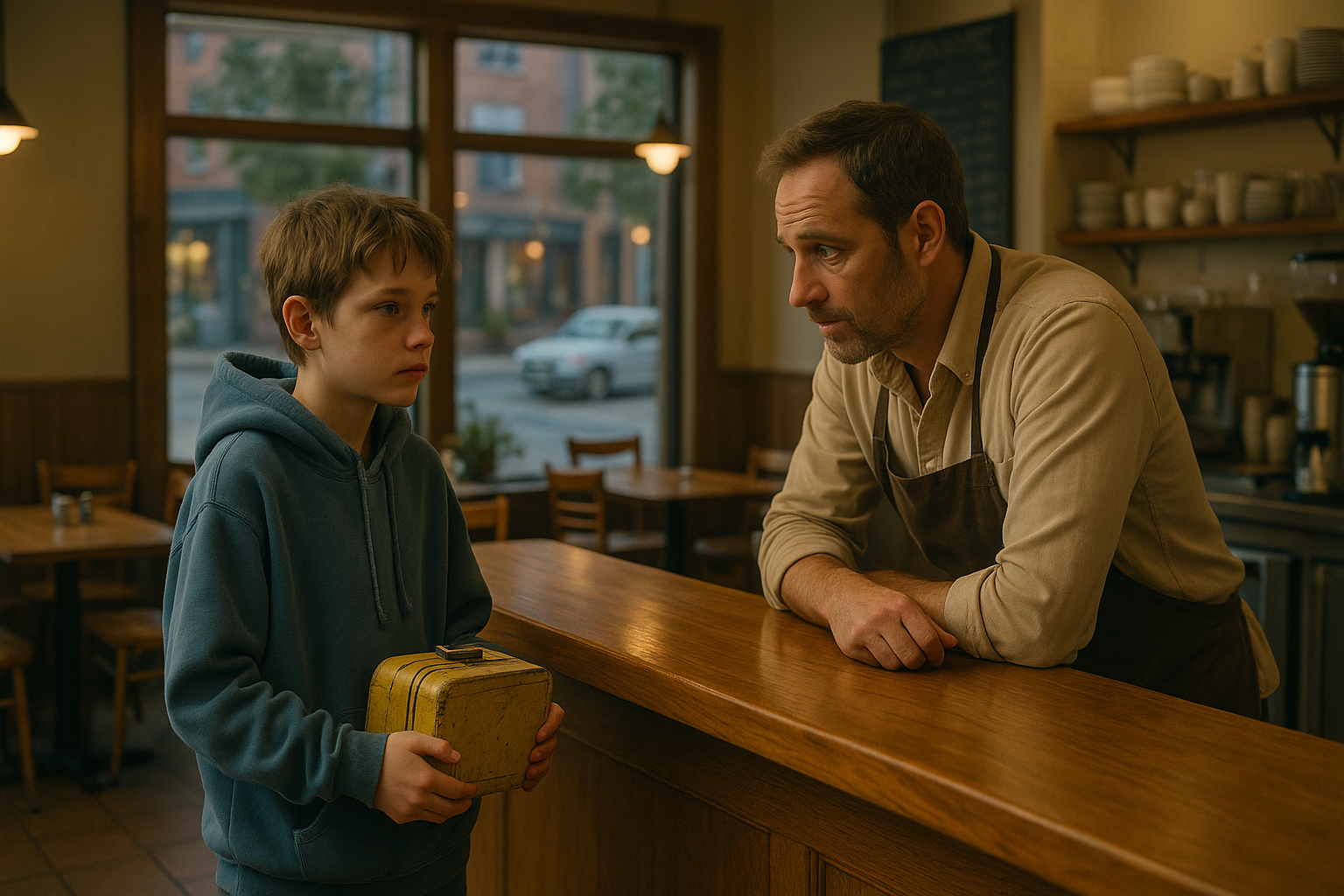
Liam first noticed the boy in early autumn. Thin, in a faded blue hoodie two sizes too big, dark hair sticking to his forehead, he would appear at the door exactly at 6 p.m. On his shoulder, a worn school backpack; in his hands, always the same scratched yellow lunchbox.
“Kids’ portion of soup, please… if there’s discount today,” the boy would say, eyes fixed somewhere near the floor. He spoke quietly but clearly, with a politeness that didn’t match his age.
Liam owned the little café on the corner. He had seen all kinds of people in fifteen years: office workers in a hurry, lonely pensioners stretching one tea for an hour, students with laptops. But this boy stood out.
“What’s your name, buddy?” Liam had asked the first time.
“Daniel,” the boy answered. “Dan.”
Liam tried not to stare at his hands. The fingers were red from cold, the nails bitten. When the soup was ready, Dan carefully poured it into the yellow lunchbox, snapped the lid three times, paid in crumpled coins, said “Thank you, sir,” and disappeared into the evening.
It went on like that for weeks. Same time, same lunchbox, almost always the cheapest soup on the menu. If there wasn’t enough money, he’d ask for half a portion and still say thank you like he’d just been served at a fancy restaurant.
“Why doesn’t he just eat here?” asked Mia, the waitress, one day as she wiped down a table.
Liam watched the boy’s small back vanish into the drizzle. “No idea,” he said, but the question lodged itself in his chest like a stone.
The first cold rain of November came early. That evening, when Dan stepped in, water dripped from his sleeves. His nose was red, his shoes soaked.
“Kids’ portion of soup, please… to go,” he said, shivering.
Liam frowned. “Sit down and eat here. It’s warm inside.”
Dan clutched the yellow box tighter. “I… I need it at home.”
“Parents waiting?” Liam asked casually.
The boy’s eyes flickered. “Yeah. Sort of.”
Liam’s mind flashed on old memories he preferred not to touch—his own childhood in a cramped apartment, the sound of his mother counting coins at the table. He shook it off.
On impulse, he filled the lunchbox almost to the brim and added a slice of bread and a small piece of chicken.
“That’s too much,” Dan whispered. “I can’t pay—”
“House treat,” Liam cut him off. “We had leftovers.” It was a lie; they barely broke even that week.
Dan stared at the food with something between panic and relief. “Thank you,” he said again, but his voice cracked this time.
When the door closed behind him, the café felt uncomfortably silent.
“I don’t like it,” Mia muttered. “That kid never smiles. That’s not normal.”
Liam dried his hands on a towel, heart beating faster. “I’m going to walk him home today.”
“You can’t just follow a child,” Mia protested.
“I’ll keep my distance. Just want to make sure he’s okay.”
He waited a minute, then stepped out into the rain, pretending to adjust the outdoor menu. Dan was already halfway down the street, hugging the lunchbox to his chest. Liam followed, two crossings behind, feeling ridiculous and strangely anxious.
The boy didn’t head toward the apartment blocks, as Liam expected, but turned into a narrow alley behind the supermarket, then onto a quieter street with older houses. He walked with the determination of someone who knew every crack in the pavement.
Finally, he stopped in front of a small, peeling house with a sagging porch. A single window glowed dimly inside. Dan glanced around—Liam pressed himself against a tree—and then hurried in.
Liam almost left. He had seen what he needed: a house, a light. Someone was home. But as he turned, he heard a sound through the rain—a rough, hacking cough, deep and painful, from inside the house.
His chest tightened. That cough sounded like his mother’s in the last year, when she refused to go to the hospital because “there’s no money, Liam, we’ll manage.” They hadn’t.
Without fully thinking it through, he walked to the porch and knocked.
The boy opened the door a crack. When he saw Liam, his face drained of color.
“Dan,” Liam said quickly, raising his hands. “I’m sorry. I didn’t mean to scare you. I just… wanted to make sure you got home safe. I heard someone coughing.”
“Mom, it’s just the café man,” Dan called over his shoulder, voice trembling.
A woman’s voice answered weakly from inside, “Let him in if you want, honey.”
The door opened wider.
The living room was small and cold. A thin woman lay on a sagging sofa under two blankets, her cheeks flushed with fever. Her hair, once thick, now clung flat to her head. The air smelled of damp walls and medicine.

“Good evening,” Liam said softly.
“Good evening,” she replied, trying to sit up, but the cough shook her whole body. Dan rushed to her, setting the yellow lunchbox carefully on a crate that served as a table.
“This is Mr…? From the café,” the woman asked.
“Liam,” he supplied. “I own the place on the corner.”
Dan opened the lunchbox. Steam rose, and the small room suddenly smelled of chicken and herbs. The woman inhaled greedily.
“For you, Mom,” Dan said. “I told you I’d bring something warm.”
Liam blinked. “You don’t eat it yourself?”
Both of them looked at him as if the idea had never occurred to them.
“I eat at school sometimes,” Dan said quickly. “She needs it more. The pills make her stomach hurt when it’s empty.”
The words hit Liam like a punch. All those evenings, that small, serious boy hadn’t been bringing dinner home for his family. He’d been bringing it for one sick, hungry person—and not touching it himself.
The mother’s eyes filled with tears. “I told him not to spend money in a café,” she whispered. “We can make do. But he keeps going.”
“It’s not expensive,” Dan protested, cheeks flushing. “And they give discounts. Sometimes leftover bread.”
Liam swallowed hard. Leftover bread. That was what his kindness looked like from the other side.
“How long have you been sick?” he asked gently.
“Since spring,” she admitted. “I… lost my job. Then the medicine. It’s complicated.”
“And your father?” The question slipped out before he could stop it.
“He left when I was six,” Dan replied calmly. “It’s just us.”
The mother closed her eyes, ashamed. Liam saw the way Dan’s thin shoulders tried to look broader, the way he stood a little in front of her, like a small shield.
Liam made a decision so fast it scared him.
“Listen,” he said, voice trembling a little, “from tomorrow, you two will eat at my café. A hot meal. Every day.”
Dan’s head snapped up. “We can’t pay,” he burst out. “I’m already behind on—”
“You’ll help me instead,” Liam interrupted. “After school, an hour or two. Wiping tables, stacking chairs, whatever the law allows for your age. Fair deal?”
Dan stared at him, disbelief fighting with hope. “Really?”
“Really,” Liam nodded. “And your mom can come eat when she feels strong enough. If not, you’ll take food home. Not kids’ portions. Real meals.”
The woman shook her head, tears rolling down her temples. “We can’t accept—”
“You can,” Liam said quietly. “And you will. Someone once did the same for me and my mother. I was too proud then. She wasn’t. It saved her a few more months.” His voice faltered on the last words.
Silence filled the room, heavy but different now—no longer hopeless, just fragile.
Dan wiped his eyes with the sleeve of his too-big hoodie. “I’ll be the best helper you ever had,” he said hoarsely.
“I don’t doubt it,” Liam answered.
The next day, at 6 p.m., the doorbell of the café rang again. Dan stepped in, but this time he didn’t bring the yellow lunchbox. He wore the same faded hoodie, but something in his posture had changed. He walked up to the counter and, for the first time, smiled—a crooked, shy smile that made him look like the child he still was.
“Where do I start, boss?” he asked.
Mia watched from behind the coffee machine, eyebrows raised. Liam just handed Dan a clean apron.
“Start by eating,” he said. “Then we’ll talk about work.”
Dan hesitated only a second before nodding. He sat down at a table, and when the bowl of steaming soup was placed in front of him, he wrapped his hands around it as if it were something sacred.
He took the first spoonful slowly, closing his eyes for a moment. Liam saw his throat move, saw the tears he quickly blinked away.
In the corner, on a chair kept free every evening from then on, a folded blanket and a yellow lunchbox waited—just in case the road home was rainy again, or someone on a sagging sofa needed a warm portion more than the boy did.
This time, though, he didn’t have to choose who would eat.