My parents threw me out three months after my 18th birthday.
Not because I drank.
Not because I got arrested.
But because I told them I didn’t want to become a doctor.
Both of my parents are surgeons. In our house, medicine wasn’t just a profession—it was a predetermined destiny that had been waiting for me long before I could even speak.
My father always said, “In our family, we save lives. That’s what we do.”
But the truth is, I never wanted a scalpel in my hand.
I wanted a guitar.
Music had always been the only place where I truly felt like myself. When I played, the pressure disappeared. The expectations faded. I could breathe.
WHEN I FINALLY TOLD MY PARENTS THAT I WAS CHOOSING MUSIC INSTEAD OF MEDICAL SCHOOL, THE DINNER TABLE FELL COMPLETELY SILENT.
My mother looked at me as if I had confessed something terrible.
My father didn’t shout. That would have been easier.
He simply folded his napkin, looked me straight in the eyes, and calmly said, “If you don’t follow the path we built for you, then you’ll be on your own.”
I thought it was just a bluff.
But it wasn’t.
By sunset, my house key no longer worked.
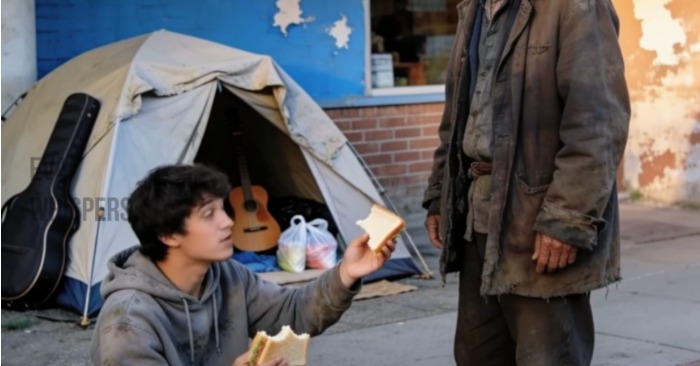
Three months later, I was living in a cheap camping tent under a bridge near an abandoned warehouse.
It wasn’t much, but it stayed dry in the rain, and no one bothered me there.
DURING THE DAY, I WORKED PART-TIME AT A SMALL COFFEE SHOP DOWNTOWN. MOSTLY WASHING DISHES, WIPING TABLES, AND TAKING OUT THE TRASH. IT WASN’T GLAMOROUS, BUT IT WAS JUST ENOUGH TO AFFORD CHEAP FOOD AND REPLACE THE STRINGS ON MY GUITAR.
Most days, I lived off whatever tips customers left behind.
That day had been especially slow. My manager handed me a leftover sandwich from the display case before we closed.
“Take it, Mike,” he said. “We’re going to throw it away anyway.”
So I sat behind the café near the dumpsters, leaning against the brick wall, eating slowly, trying to make the sandwich last as long as possible.
From the alley, I could see the sidewalk.
That’s when I noticed him.
An old man in worn-out clothes walked back and forth, quietly asking if anyone had something to eat.
HIS COAT WAS TORN AT THE SLEEVES, AND HIS SHOES WERE BARELY HOLDING TOGETHER.
Most people didn’t even stop.
A woman shook her head without looking up from her phone. A businessman waved him away like he was brushing off a fly.
After the fifth person ignored him, the man turned toward the alley.
When he reached the entrance, I called out to him.
“Hey.”
He looked up.
“Are you hungry?”
FOR A MOMENT, HE JUST STARED AT ME, AS IF HE HADN’T HEARD KINDNESS IN YEARS.
I held up my sandwich and broke it in half.
“It’s not much,” I said. “But you can have it.”
He slowly walked over and sat down next to me on the pavement.
“Thank you,” he said quietly.
We ate in silence for a while.
He took small, careful bites, as if he didn’t want the food to disappear too quickly.
After a few minutes, he looked at me.
“WHAT’S YOUR NAME, SON?”
“Mike.”
“And where do you live, Mike?”
I shrugged.
“Under the bridge. I’ve got a tent.”
He watched me for a long moment.
“You’re too young to be living like this.”
I let out a small laugh.
“THAT’S HOW THE WORLD IS.”
After he finished the sandwich, he slowly stood up.
Before leaving, he looked at me one more time and said quietly, “You shouldn’t be living like this.”
I almost laughed.
“Neither should you.”
He smiled for a moment, but he didn’t look tired or lost.
Then he walked away.
I didn’t think much about it afterward.
BUT THE NEXT MORNING, EVERYTHING CHANGED. THE SOUND OF AN ENGINE WOKE ME UP.
At first, I thought it was just a truck passing over the bridge.
But the sound didn’t fade.
It stayed.
I opened my tent and crawled out.
And froze.
A long black limousine was parked just a few steps away.
Not the kind of car that ever comes here.
A DRIVER IN A DARK SUIT STOOD BESIDE IT.
When he saw me, he walked over.
“Are you Michael Carter?” he asked.
I blinked.
“Yes… that’s me.”
He nodded politely and opened the back door of the limousine.
“Mr. Whitmore would like to speak with you.”
I was confused.
“Whitmore?”
“Charles Whitmore.”
The name meant nothing to me.
But I stepped closer and peeked inside the car.
My heart nearly stopped.
Sitting in the back seat was the old man from the alley.
Only now he didn’t look the same.
His clothes were a perfectly tailored suit. His shoes were polished. His hair was neat.
HE LOOKED… POWERFUL.
When he saw me, he smiled broadly.
“Good morning, Mike.”
I stared at him.
“You… weren’t homeless.”
He chuckled softly.
“No.”
“Then why were you asking for food yesterday?”
HE FOLDED HIS HANDS CALMLY.
“Because once a year, I like to remind myself what the world feels like from the ground.”
“That sounds like a test.”
“In a way, it is.”
He glanced briefly out the window.
“Yesterday, I asked more than twenty people for help.”
“How many helped?” I asked.
“You did.”
I shifted awkwardly.
“It was just half a sandwich.”
“But it was everything you had.”
He studied me for a long moment.
“That matters.”
I hesitated.
“So… why am I here?”
He smiled.
“MY NAME IS CHARLES WHITMORE. I OWN THE WHITMORE DEVELOPMENT GROUP.”
I still didn’t fully understand what that meant.
But the driver subtly straightened when he said it, and I knew it was something big.
Whitmore continued, “I grew up poor, Mike. I slept in my car when I was seventeen. I built my first company from nothing.”
He leaned forward slightly.
“So when I see young people who are struggling but still choose kindness… I pay attention.”
I swallowed.
“What does that mean?”
“IT MEANS I WANT TO HELP YOU.”
My heart started beating faster.
“How?”
“What do you want to do with your life?”
“Music,” I said immediately.
“What instrument?”
“Guitar.”
He smiled.
“Good.”
The limousine stopped in front of a large brick building downtown.
Outside, a sign read:
Whitmore Arts Foundation
Inside were practice rooms, recording equipment, and a small stage.
It felt like stepping into another world.
Whitmore looked at me.
“Do you have your guitar?”
“In my tent.”
“Then let’s go get it.”
An hour later, I was sitting on the small stage with my old guitar.
Whitmore sat in the front row.
“When you’re ready,” he said.
My hands trembled slightly as I began to play.
The song I chose was one I had written under the bridge. It was about feeling lost, angry, and trying to find hope when everything was falling apart.
The room filled with music.
When the final chord faded, the silence felt heavy.
WHITMORE SLOWLY STOOD UP.
Then he clapped.
“Well,” he said with a smile.
“That answers my question.”
My throat tightened.
“Was it good?”
He shook his head.
“It was real.”
THEN HE HANDED ME A FOLDER.
I opened it, and inside were official documents.
“What is this?” I asked.
“A full scholarship to the Whitmore Music Conservatory.”
My hands began to shake.
“Tuition, housing, lessons, instruments—everything covered.”
I stared at the papers.
“Why me?”
WHITMORE LOOKED AT ME CALMLY.
“Because when you had nothing… you still chose kindness.”
He placed a hand on my shoulder.
“Talent can grow. Skills can improve.”
Then he smiled.
“But character like yours… the world needs more of that.”
Three months ago, I was sleeping on the street.
Yesterday, I shared half a sandwich with a stranger.
And now…
My life was beginning again.