That winter evening I came home later than usual. The snow was falling thickly, but without wind, as if someone were deliberately trying to mute all sounds. Our street was almost empty, only a few windows were still lit, and one of them was ours.
When I opened the door, I felt a strange calm that immediately seemed unreal. Inside the house everything looked the same as always, but the air was heavier. Mom was sitting on the sofa, wrapped in an old wool blanket that we had kept since my childhood.
She asked whether I had eaten. That question calmed me for a moment, because it was so familiar. Mom always started with that, even if she herself had not eaten anything all day. I answered that I would eat later, and only then did I notice that her voice was quieter than usual.
She said that she felt a little dizzy. That she had probably overworked herself. That such days happen to everyone. I nodded, because I did not want to argue. We were both used to not rushing into fear.
I took off my jacket, put it on the chair, and went to the kitchen. The water in the kettle boiled too quickly, as if someone had sped up time. When I returned to the living room, mom was already lying down, but her eyes were open.
She asked me to bring another blanket. I went to the bedroom and opened the closet where we kept all the unnecessary but never thrown-away things. My hands trembled slightly, although I still could not say why.
When I came back, I noticed that her breathing had become uneven. Not suddenly, not dramatically, but enough that I could not ignore it. I asked if she was in pain. She shook her head and tried to smile.
The clock on the wall ticked louder than usual. Every second felt too long. Mom closed her eyes and said that she was short of breath. That sentence sounded calm, but something inside me snapped.
I took the phone and called the ambulance. Not out of panic. Out of the understanding that this time it could no longer wait. The voice on the other end of the line was calm, almost too calm.
While we waited, mom held my hand. Her palm was cold, but the grip was firm. She said that everything would be fine. That I did not need to worry. I nodded, although inside I was no longer sure.
When the sirens were heard, the snow intensified even more. The light from the ambulance briefly lit up the whole room, as if someone had switched on a spotlight. The doors opened, and the house suddenly became too small.
The medics moved quietly and precisely. They did not ask unnecessary questions. They behaved as if this scene were routine for them, and that frightened me more than haste.
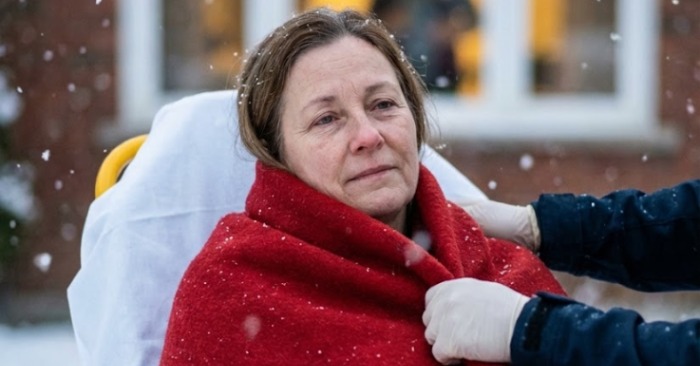
Mom was transferred onto the stretcher very carefully. Someone covered her with a thick red blanket. Snowflakes began to fall onto the fabric, slowly melting and leaving dark spots.
I stood by the door and instinctively prepared to go along. It seemed self-evident. I had always been by her side. Since childhood.
Then mom opened her eyes and looked at me. That look was neither weak nor frightened. It was very clear. She said that I had to stay at home.
She said that there was no need to go along. That it was just a check-up. That she would be back soon. Her voice was firm, almost strict. I had never heard her speak like that.
I obeyed. Not because I wanted to. Because all my life I had been taught to listen to her. The ambulance doors closed, and the snow instantly drowned out all sounds.
I remained standing in the yard for a few more seconds until the medics drove away. Then I returned to the house where the light was still on. In the kitchen that she had left as if she would return any moment.
That night I did not sleep. I sat in the living room and thought about her words. About why she had so insistently asked me not to stay by her side.
The answers did not come immediately.
In the morning the house felt too big. Every room was filled with a silence that pressed harder than the night. My jacket was still hanging on the chair, untouched tea stood on the table, and on the sofa lay the folded blanket that mom had wrapped herself in before leaving.
The hospital called around nine in the morning. The voice was neutral, without emotion. They told me that mom was alive, that she had been stabilized, and that I could come later. At that moment I felt relief, but also a strange emptiness. Something inside me had already changed.
When I saw her in the hospital, she looked smaller. Not physically, but somehow differently — as if part of her had remained in that house. She smiled, but tiredly. I wanted to ask her why she had not let me go along, but at that time I did not dare.
The first weeks passed slowly. Mom returned home, but she needed rest. I stayed with her, helped, took care of the house, cooked. We did not talk about that evening. As if it had been too fragile for words.
Months passed. Life gradually returned to its rhythm, but that evening did not go anywhere. It became something unresolved, hanging between us. Sometimes I wanted to ask, but kept postponing it.
Only after a year, while cleaning the closet, I found her notebook. It was not hidden. It simply lay among old documents, as if waiting for someone to open it.
There were dates, names, short sentences. And one page marked with that same winter month. She wrote that that evening she was afraid not for herself. She was afraid that I would see her weak, dependent, being taken out of the house on a stretcher.
She wrote that all her life she had tried to be a support for me. That she did not want my last image of her to be hospital lights and strangers’ voices. She wanted me to stay at home — where she had always been strong.
Then I understood that her request had not been accidental. It had been a decision. A conscious, thought-out, maternal decision. She chose to protect me even when she herself was most vulnerable.
When we spoke about it the next time, she did not say much. She only said that that evening it was more important to her how I would feel than how she herself would look. And that she would do the same again.
Now, when I remember the snow, the ambulance lights, and the empty house, I no longer feel guilt. I feel gratitude. For having been loved so quietly that at first I did not even notice it.
Sometimes the greatest love shows itself not in staying by someone’s side, but in asking them to stay.
Have you ever realized that someone was protecting you even when you thought you were left alone?