When I look at photos of other people’s holidays on the internet, I feel like everyone lived in some different reality. Perfect tables, perfect families, perfect moments captured in perfect light. Our holidays were never like that. And for a long time, I thought something was missing for us.
Only after my mom’s death did I understand that it was exactly the opposite.
Every year, on Christmas Eve, my mom cooked a dinner that filled the entire apartment with the smell of home. Not a luxurious home, not a perfect one — a real one. Sometimes it was honey-glazed ham, if the budget allowed for it. Sometimes just a regular chicken. Always buttered potatoes, green beans, and cornbread, which my mom considered “the essence of the holidays.
But the most important thing was one extra plate.
The one that never went to our table.
I was eight years old when I asked for the first time who that extra portion was for. Mom wrapped it in foil with such care, as if she were packing something fragile, and said calmly that it wasn’t for us. That someone else needed it more.
I didn’t push further. Children quickly learn which questions don’t need answers.
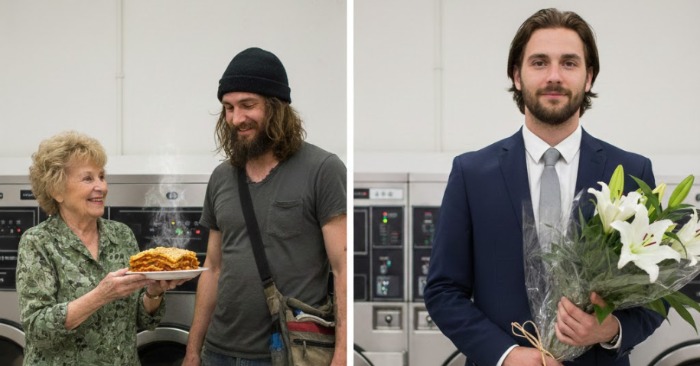
We lived in a small town where everyone knew everything — except those whom no one wanted to notice. At the end of our street there was an old self-service laundromat. Open 24 hours a day, loud with spinning drums and smelling of laundry detergent. That’s where my mom and I went every year.
That’s where Eli slept.
He was young. Too young to look like someone life had already broken. Always in the same worn sweatshirt, with a plastic bag and a battered backpack. He slept curled up in a corner, close to the vending machine, as if trying to be invisible.
Mom never called to him from a distance. She walked up, crouched beside him, and calmly slid the bag of food toward him.
“I brought you dinner,” she said quietly.
Eli always answered the same way. He thanked her. Said it wasn’t necessary. That she didn’t have to.
And Mom, always with the same calm, said: “I know. But I want to.”
As a teenager, I started to feel afraid. I asked her whether it was safe. Whether it wasn’t risky to help someone you don’t know. She answered without hesitation that hunger and being forgotten are dangerous — not a person who can say “thank you.”
Over time, Eli began to talk more. Not right away. Not everything. But enough for me to understand that his life had been a chain of losses. He told us about his sister, the only family he had. About the accident. About how after all that he stopped trusting anyone.
Mom didn’t interrogate him. Didn’t push. She was simply there.
Sometimes, besides dinner, she brought gloves. Sometimes warm socks. Other times a store gift card, saying that she had “gotten it in the mail.”
Then I grew up. I moved out. Started my own life. And my mom got sick.
Cancer came quietly. Took her quickly. Without one last Christmas. Without a goodbye.
In December I stood alone in her kitchen, looking at the old pot. I almost didn’t cook anything. But then I heard her voice in my head: “It’s for someone who needs it.”
And I went to the laundromat.
The laundromat looked exactly the same as always. Flickering light. The same smell. The same machines. But the person standing inside… wasn’t.
Eli wasn’t wearing a sweatshirt. He didn’t have a bag. He stood upright in a perfectly tailored dark suit. In his hand he held white lilies.
For a moment I thought I had the wrong place.
When he saw me, his face softened and his eyes filled with tears. He said only one word: “You came.”
We sat on plastic chairs. He told me he knew about my mom’s death. That the flowers were for her. And that he had to tell me something.
He told me a story from years ago. About the day I got lost at a fair. About how he was the one who found me first. Held my hand until he handed me over to a police officer. About how my mom didn’t look at him like a threat, but like a human being.
That’s when everything began.
The dinners. The conversations. The help.
My mom helped him find therapy, work, stability. And he promised her that if he ever got back on his feet, he would come in a suit to show her.
He pulled out an envelope. Inside was a photo from the fair. Me and my mom. And in the background, him.
We went to the cemetery together. He left the lilies on her grave. And I understood that my mom didn’t just save his life.
She saved mine too.