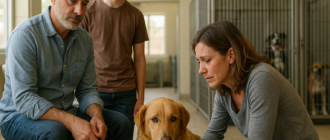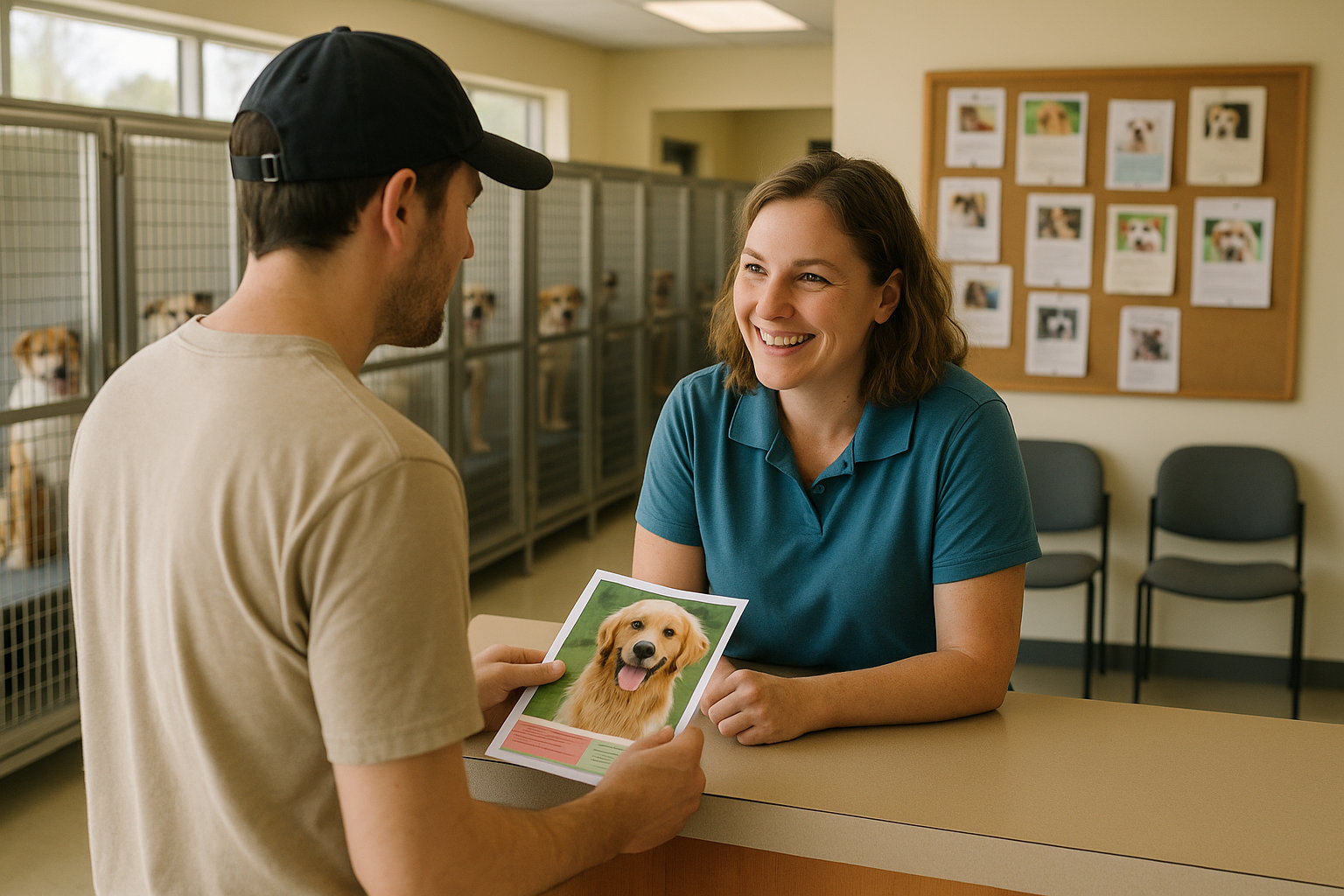
The boy who kept returning a dog that wasn’t his until the shelter worker realized why he always came alone.

On a rainy Tuesday, Anna was closing the small city shelter when the door opened and a thin boy in an oversized gray hoodie slipped inside, water dripping from his sleeves. He couldn’t be more than twelve. He clutched a crumpled flyer with the photo of a golden retriever.
“Is this Max?” he asked, out of breath. “My dad’s dog. He ran away.”
Anna glanced at the photo. The dog on the flyer looked like any golden retriever: soft eyes, light coat, gray on the muzzle. But the boy’s hands were shaking.
“We do have a golden,” she said gently. “Come, I’ll show you.”
The dog in kennel 7 lifted his head when they approached. Same color, same tired eyes. The boy froze, then his face crumpled.
“That’s not him,” he whispered. “Max has a white spot on his chest. Like a cloud.”
The dog pushed his nose to the bars, wagging hopefully. The boy’s fingers hovered in the air, then he stepped back, as if touching the wrong dog would be a betrayal.
“I’m sorry,” Anna said. “Maybe he’ll come in tomorrow. What’s your name?”
“Liam.” He swallowed. “Can I… leave the flyer?”
He pinned the damp paper to the crowded board, carefully smoothing the corners, then left without looking back. Anna watched him run into the rain with no umbrella.
Liam came again on Thursday. This time the hoodie was different, but just as big. He carried the same flyer, printed again, edges neater.
“We got two new goldens,” Anna said, surprised to hear her voice sound hopeful. “Maybe…”
They walked through the kennels. Dogs barked, tails thumped, paws scratched metal. Liam studied every golden muzzle with an intensity that made Anna’s chest ache.
All of them were almost right. None of them were Max.
By his fifth visit, the staff knew him. Someone would always say, “Liam, we got a new intake,” before he even reached the front desk. He always came alone. Always said the same thing when Anna asked about his parents.
“Dad’s at work. Mom’s… not here. It’s okay.”
He never explained. She never pushed.
One afternoon, Anna noticed the same gray hoodie hanging strangely on his shoulders. The sleeves were rolled three times, the cuffs stained with what looked like old paint.
“Big hoodie,” she joked softly, trying to lift his mood.
“Dad’s,” he said quickly. “He let me borrow it.” The words sounded rehearsed.
Weeks passed. No Max.
Then came the day that changed everything.
It was a bright Saturday, unusually warm for early spring. Families wandered the shelter, children squealing at the puppies. Liam slipped in quietly, as always, but today there was no new golden to show him.
“Still nothing,” Anna said, hating the defeat in her voice.
Liam stared at the wall of flyers. His own was now wrinkled and sun-faded, edges curling. He reached up to fix it, and the sleeve of the hoodie slid down.
Purple bruises ringed his wrist.
Anna’s breath caught. “Liam,” she said carefully, “what happened to your arm?”
He yanked the sleeve back down. “I’m just clumsy,” he muttered. “It doesn’t matter. I just need to find Max. He doesn’t like loud voices. He gets scared.”
The shelter, suddenly, felt too quiet. The barking, the chatter, all muffled by the pounding in Anna’s ears.
“Does your dad know you’re here?” she asked.
He stared at the floor. “He knows I’m… out.”
The answer was nothing. The answer was everything.
Anna knelt so she could see his eyes. “Liam, when was the last time you saw your dad?”
He hesitated for a long moment. “Before Max ran away,” he finally whispered. “But he’ll come back. When Max comes home, Dad will have to come back for him. He loves that dog. He won’t just leave him.”
The words were so certain and so broken at the same time that Anna felt something inside her crack.
“Who do you live with?” she asked, her voice trembling.
“My aunt,” he said. “She says Dad is… gone. But she lies a lot when she cries.”
The world rearranged itself in front of Anna’s eyes. The endless searching. The too-big hoodie. The bruises. The boy who kept coming alone.
Max wasn’t just a lost dog. Max was proof of a father who loved him, of a time before everything fell apart. Finding Max meant undoing the worst thing that had ever happened to him.
“Liam,” Anna said softly, “can you wait here for a minute?”
His face tensed. “I didn’t do anything wrong.”
“You didn’t,” she said quickly. “You absolutely didn’t. I just… I want to help. Really help. Not just look in kennels.”
She left him in the office with a bowl of shelter cookies and called the number on the original intake form for Max’s flyer. A woman picked up on the second ring, voice wary.
“This is Claire.”

“Ms. Claire, this is Anna from the city animal shelter. I’m calling about a boy named Liam and a dog named Max.”
There was a small sound, like someone choking on air.
“He’s there again?” the woman whispered. “I told him to stop. It’s been eight months. My brother is dead. He’s not coming back. And that dog…” Her voice broke. “Max ran away the night the police came. Liam thinks if he finds the dog, he’ll get his father back. He sneaks out whenever he can.”
Anna closed her eyes. The boy. The flyer printed over and over. The hope that refused to die.
“Can you come here?” Anna asked. “I think we need to talk. All of us.”
Thirty minutes later, a tired woman with red-rimmed eyes rushed into the shelter. Liam stiffened when he saw her.
“I told you I was just going out,” he snapped, fear behind his anger.
“I know,” Claire said, chest heaving. “I know. I just… I needed to be here.”
Anna led them both into the quiet adoption room and closed the door.
“Liam,” she began carefully, “I called your aunt because I think Max is… very important to you. More than just a dog.”
Liam glared. “You promised you’d help. Not tell on me.”
“I am helping,” she said, forcing herself to meet his hurt. “But sometimes helping means not letting you carry something this heavy alone.”
Claire sat on a plastic chair, hands twisting in her lap. “Liam, honey,” she said, voice shaking, “Max is not coming here. It’s been so long. He was old, remember? He probably…”
“Don’t say it,” Liam hissed. His eyes were bright with unshed tears. “Dad loved Max. He wouldn’t just leave him. He wouldn’t.”
The room fell silent. Somewhere down the hall, a dog barked once, then quieted.
Anna suddenly knew what she had to do.
“Come with me,” she said. “Both of you.”
They walked past the kennels, past the flyers, out to the small fenced yard behind the shelter. The sun was low, turning everything gold.
“Every time you came,” Anna said to Liam, “you saw dogs that almost looked like Max. But you always walked away because they weren’t exactly him. The white spot, the exact muzzle, the way he tilted his head. You were looking for your dad in his fur.”
Liam’s lower lip trembled.
“I can’t bring Max back,” she said. The words felt like cruelty, but lies would be worse. “And I can’t bring your dad back. No one can. But I can promise you this: there are dogs here who need someone the way you need Max. Not to replace him. Nothing can. But to sit next to you when you miss him so much you can’t breathe.”
She opened the gate to the yard, and one of the volunteers gently let out a skinny brown mutt with too-big ears and eyes like melted chocolate.
“This is Daisy,” Anna said. “She was left on the side of the road. Been with us almost as long as you’ve been coming. Nobody chose her yet.”
Daisy trotted over, then stopped a safe distance away, head tilted, unsure. Liam sank to the grass, shoulders hunched. He didn’t reach for her. He just sat.
Slowly, cautiously, Daisy inched closer. She sniffed his shoes, then his sleeve. Finally, she rested her head on his knee as if she had been doing it all her life.
Liam made a strangled sound.
“She’s not Max,” he whispered.
“I know,” Anna said.
He buried his face in Daisy’s neck, fingers clutching her fur. The first sob tore out of him like it had been trying to escape for months. Claire knelt a few steps away, hands pressed to her mouth, tears streaming down her cheeks. She didn’t touch him. She just let him cry, for his father, for the dog, for the whole broken shape of his life.
When his tears finally slowed, Daisy was still there, breathing patiently against him.
“Will Dad be mad,” he croaked, “if I love another dog?”
Anna sat down on the grass beside him, leaving a small respectful distance. “If your dad could see you right now,” she said, steady despite the lump in her throat, “I think he’d be proud you chose a dog that needed you as much as you need her.”
He wiped his nose on his sleeve, eyes red. “We don’t have money,” he muttered. “Aunt Claire says we can’t even fix the washing machine.”
Anna smiled through her own tears. “Daisy’s adoption fee is already covered. Someone donated to help the dog who waited the longest. That’s her.” She paused. “And I know a shelter that gives food for the first few months. Collars, too. Even a bed.”
Claire looked at Anna, understanding dawning. “You’d really…?”
“We would,” Anna said. “All of us.”
In the weeks that followed, Liam still came to the shelter, but now he came with Daisy and with Claire. They brought photos: Daisy sleeping on Liam’s homework, Daisy stealing socks, Daisy waiting by the door when school ran late.
The flyer with Max’s face stayed on the board longer than any other. One day, Anna found Liam standing in front of it, Daisy leaning against his leg.
“Should we take it down?” she asked softly.
He stared at it for a long time, then reached up and carefully removed the yellowed paper.
“I’ll keep it,” he said. “For Dad. But I think… I think Max is with him now. And Daisy is with me.”
He folded the flyer and slipped it into his pocket. Then he looked up at Anna with a small, fragile smile.
“Thank you for helping me find a dog that wasn’t mine,” he said. “So I could finally understand why he had to be.”