Forced by her late husband’s final wish, she had to live with her five children inside the hollow of a gigantic tree; yet the secret discovered within left everyone in shock.
The dawn wrapped the endless agave plantations in a suffocating gray cloak in a forgotten little village in Jalisco. On that March morning, María awoke with a tightening knot in her throat, her blood turning cold from a dark premonition. Her hardworking and honest husband, Alejandro, had set out long before sunrise in his rickety pickup truck to sell three cows at the market in a neighboring town. It was their only hope to repay the debts that had piled up during the season. María set the traditional Mexican coffee to brew, then woke her five children to begin the exhausting day.
Her twelve-year-old eldest daughter, Valeria, helped dress the younger ones like a second mother. Nine-year-old Mateo hurried out into the dusty yard to tend to the few remaining animals, while seven-year-old Sofía and five-year-old Santi played quietly near the stove. The youngest member of the family, eight-month-old Leo, slept peacefully. At ten o’clock in the morning, the sharp creak of the wooden door startled them. Don Chente, the oldest neighbor on the street, stood on the threshold, his face pale as death. He didn’t even need to speak; in that instant, María knew her world had shattered. Alejandro’s pickup had plunged into the abyss on a treacherous mountain hairpin turn. No one had survived the crash.
María felt as if the ground had opened beneath her feet, yet her maternal instinct would not allow her to collapse. Five innocent pairs of eyes stared at her, five beating hearts whose fate now rested solely in her hands. The days that followed passed in a chaotic storm of tears and prayers. But the real nightmare did not arise from grief—it came from family greed. Exactly three days after the modest funeral, Ramiro, Alejandro’s older brother, the wealthiest and most ruthless local land baron, appeared at her door.
With a malicious smile on his face, waving a thick stack of legal papers, Ramiro informed the widow that her late husband owed him millions of pesos. “Alejandro was a complete failure. He used this house as collateral for his debts to me,” the man lied, spitting contemptuously on the ground. He was speaking of the home where they had lived for fourteen years. Knowing full well that María did not have a single coin for legal defense, the landowner acted mercilessly: he gave her exactly one week to pack up her miserable belongings and leave for the street.
That very night, broken by despair, María sought comfort in the old family Bible. As she opened it, an envelope fell to the floor. Her hands began to tremble when she recognized Alejandro’s handwriting: “My love, if you are reading this, the worst has already happened. Ramiro will try to take everything from you, but I ask you, trust me one last time. Take the five children and go to the old swamp cypress on your grandmother’s abandoned property. The answer to everything is inside.”
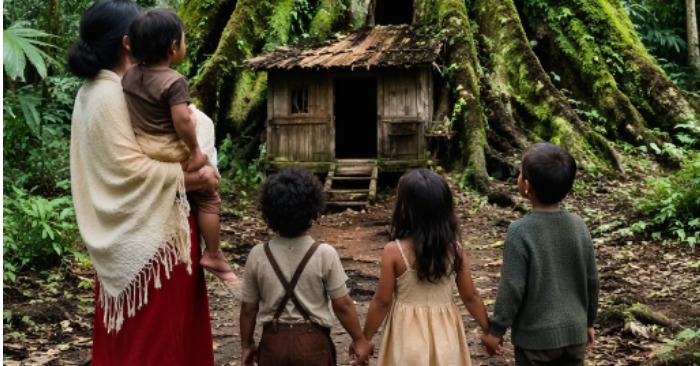
The family land had stood abandoned for fifteen years, eight kilometers of exhausting dirt road separating them from it. The tree mentioned was a gigantic swamp cypress over three hundred years old, famous for the massive natural hollow gaping in its trunk. At dawn, María tied baby Leo to her back with a scarf and gave the command for the children to leave. The journey under the scorching western sun felt like walking through hell. Santi cried from exhaustion, so Mateo had to carry him on his back. When they finally saw the farm, the tree towered twenty meters high before them in majestic silence. At its base, a split revealed a dark cavern of about fifteen square meters.
María lit an old storm lantern and stepped inside first. The beam of light revealed ancient, hand-carved wooden shelves. In the darkest corner rested a heavy cedar chest. With a heart pounding wildly, she lifted the lid. Inside, she found not jewelry, but a thick bundle of official documents and Alejandro’s warning message—one that turned her completely to stone.
Before she could even process the shocking discovery, the violent screech of brakes tore through the air outside. Three black SUVs surrounded the tree. Ramiro had followed them. The man stepped out holding a machete and a burning torch, ready to set the tree ablaze with the family inside just to seize these lands as well. No one could believe the chilling tragedy that was about to unfold…
The smoke from Ramiro’s torch began to choke the air around the colossal cypress. “Get off my land, you starving parasites!” the landowner roared, his eyes burning with greed. He was convinced that a priceless hidden resource lay on the old farm, and he had no intention of letting his widowed sister-in-law stand in his way. The five children clung to their mother’s skirt, screaming in terror. But María, gripping the documents she had just taken from the cedar chest, felt her fear suddenly vanish, replaced by an unstoppable, merciless fury.
She stepped out of the hollow tree, illuminated by the enemy’s fire, and raised the papers high. “This land will never be yours, Ramiro!” she shouted with such force that even the giant tree’s leaves trembled. “And neither will those fields where your agave worth millions grows!”
Ramiro froze in place, slowly lowering the torch. Alejandro’s message, which María had just read, exposed the massive fraud: over the past two years, Alejandro had secretly combed through communal and federal land registries. He had discovered that nearly the entire valley—including its most valuable lands—legally belonged to María’s grandmother. Ten years earlier, Ramiro had forged signatures and bribed officials to steal the most fertile hectares. Working quietly, Alejandro had ensured that in the capital the original deeds were officially registered in María’s name just one month before his death. The mountain accident had not been bad luck at all; Alejandro had been gathering the courage to report his own brother, fully aware of the consequences.
“These are nothing but the lies of a foolish dead man!” Ramiro screamed, raising his machete to carry out the massacre. But in that sacred moment, the roar of engines and angry shouts shattered the night’s silence. Don Chente and at least twenty villagers followed the henchmen on their old tractors and trucks. Armed with sticks, machetes, and rifles, they had grown tired of the tyrant’s years of extortion. Seeing himself cornered by a crowd ready to lynch him, and knowing that the federally sealed documents in María’s hands would send him to prison, Ramiro dropped his weapon, jumped into his vehicle like a coward, and fled at full speed.
At dawn that same day, finally able to breathe and protected by the community, María explored the depths of the cypress hollow. Behind a false wooden panel—ingeniously built by Alejandro—she discovered a secret chamber. Her late husband had hidden not only the deeds that meant their freedom. On the packed earth floor lay three large chests. The first contained brand-new, finely sharpened agricultural tools. The second held dozens of glass jars filled with seeds—blue corn, red tomatoes, habanero peppers, and high-quality mountain coffee. The third chest contained manuals on organic farming, architectural plans, and a sealed metal box. When María opened it, she broke into heart-wrenching yet relieved sobs: inside were exactly 45,000 pesos in various banknotes—her husband’s hard-earned savings, meant to secure their survival.
Despite their victory over the tyrant, winter struck the mountains of Jalisco with brutal severity. Living inside a tree trunk remained a harsh test of human endurance. The interior was freezing, and the wind whistled sharply through the cracks. Little Leo fell seriously ill twice, battling high fevers. María spent weeks without sleep, placing cold compresses on him while begging God not to take him away. The 45,000 pesos were spent with strict discipline, used only for medicine, thick blankets, and lime necessary for cultivating the land.
But the Silva family did not give up. Valeria, despite being only twelve, showed strength beyond her years, cooking hot atole every morning in large pots. Nine-year-old Mateo stepped into the role of the man of the house, tirelessly gathering firewood until his hands bled. Seven-year-old Sofía and five-year-old Santi helped with weeding. Soon they began cultivating the rich black soil around the ancient tree. Every single seed Alejandro had carefully preserved was planted. After three months of exhausting labor under the blazing sun, their small garden burst into a miracle of green life.
The entire village showed deep solidarity. One afternoon, Don Chente arrived with three plump hens, lovingly named Lupita, Chabela, and Blanca by the children, along with a noisy rooster named Pancho. Mateo built a sturdy chicken coop from dry branches and old wire, and within weeks, the family was collecting 18 fresh eggs weekly. Valeria and Sofía took on the task of walking to the village’s Sunday market. The twelve-year-old girl shouted at the top of her lungs: “Fresh vegetables from the Estate of Hope, chemical-free!” The quality of their produce was so exceptional that they sold everything on the very first day, returning to the cave with 400 pesos and unerasable smiles.
But María knew well that they would not survive another winter in the cypress. That was when the ancient Mexican tradition of “faena” came to life. Seeing the widow’s superhuman struggle, fifteen strong neighbors voluntarily joined forces. Over a single exhausting weekend, mixing red clay, water, and straw under the scorching sun, they molded hundreds of adobe bricks. The village women cooked huge pots of pozole to feed the workers. By Sunday evening, a beautiful forty-square-meter house with a red-tiled roof and polished concrete floor stood just steps away from the protective tree. When María saw her five children sleeping on dry mattresses under a safe roof for the first time, she kissed the adobe floor and gave thanks to Alejandro’s spirit.
Two years of relentless work passed. On the land now officially named the “Estate of Hope,” two hectares of thriving organic farming flourished. Federal authorities closed the investigation regarding the land deeds. Ramiro was arrested, convicted in a public trial, and sentenced to fifteen years in a maximum-security prison for multiple counts of fraud, extortion, and land theft. All illegally acquired land was confiscated and returned to the Silva family. True to her noble heart, María did not keep this vast monopoly for herself; in a gesture that moved the entire nation, she donated ten hectares to the poorest farming families in the region to create a community agricultural cooperative.
On a bright Tuesday afternoon, a white car bearing a state government logo parked in front of the adobe house. Dr. Roberto, a lawyer and representative from the Ministry of Agriculture, stepped out with a briefcase in hand. “Mrs. María,” the official said, respectfully tipping his hat, “the state leadership has assessed the nutritional purity of your crops. We would like to offer you a multi-year contract of historic significance. We want the Estate of Hope to become the main supplier for the municipality’s school breakfast program. We are talking about feeding 2,000 underprivileged children daily, and federal law requires that 30% of these foods come from exceptional local producers like you.”
The legal contract guaranteed a fixed, clean monthly income of 35,000 pesos, far beyond anything they had ever dreamed of. María signed the papers with hands still dirty from the fertile soil, while Valeria, Mateo, Sofía, Santi, and little Leo—now running around everywhere—wrapped her in one great embrace. The circle of divine justice had closed; their father’s painful sacrifice had ripened into the sweetest fruit life could offer.
That same starry night, as silence covered the land, María walked alone to the majestic cypress. She lit the same old storm lantern from that first night and sat on the packed earth inside the giant trunk. With deep reverence, she ran her hand along the rough wooden walls. The tears that streamed from her eyes no longer carried the salty taste of despair; they were filled with perfect, infinite peace.
Alejandro had not left her shallow luxury, foreign bank accounts, or easy paths. He had left behind a sacred map that led her to her own inner strength and resilience. The great tree was not merely a shelter from the elements—it was the womb in which a broken family was reborn. The story of the Mexican widow forced to live inside a tree became an immortal legend across Latin America. She became living proof that when life forces you to crawl through mud and darkness, it sometimes does so only to teach you how to grow the deepest and strongest roots. An epic and glorious testament that a father’s love breaks through the boundaries of death, and that a wounded mother protecting her children’s future is, without question, the most powerful, beautiful, and unstoppable force in all of nature.