Sometimes the sound of a door closing can be louder than a scream.
A single dry, final metallic click was enough to shatter Margaret Wilson’s heart into pieces.
At sixty-eight, she stood on the porch of the house that had been her home just minutes earlier. In her trembling hands, she clutched two old canvas suitcases with worn seams. They had no wheels, their weight burned her palms — but not nearly as much as the pain tightening her chest.
Her daughter, Emily Parker — the same little girl Margaret had once raised through endless cleaning shifts — was now asking her to leave.
There was no argument.
There were no dramatic tears.
Only a coldness that bit like winter.
“Mom, we’ve already discussed this” — Emily said without emotion, avoiding her mother’s gaze. “We simply can’t support you anymore. It’s too much.”
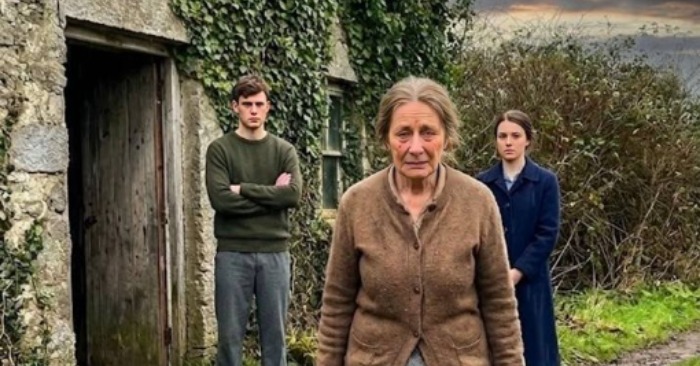
Behind her stood David, Margaret’s son-in-law, holding their baby in his arms. He watched silently with folded arms — as if this were just an ordinary move-out, not the exile of the woman who had sacrificed everything for them.
MARGARET DID NOT BEG.
The years when she had gone hungry just so her daughter could eat had given her something stronger than pride.
Dignity.
She pressed her lips together, lifted the suitcases with her trembling arms, and turned away.
Every step on the sidewalk felt heavier than the last — as if she were dragging not just her luggage, but an entire lifetime of quiet sacrifice.
She walked until she reached the corner.
Only when she was sure no one from the house could see her did she place the suitcases beside the curb.
In the shade of a tree, Margaret buried her face in her hands — and finally began to cry.
Not loudly.
But quietly, stifled, desperately.
She was not crying because she had nowhere to go.
Not because she had no money.
She was crying because for a mother, the deepest wound is when her own child forgets her.
Yet as the tears ran down her lined face, Margaret gripped her worn fabric bag even tighter.
Inside, hidden among old papers, lay a small bank card.
And with that card came a secret of 1.7 million dollars.
A SECRET THAT EMILY KNEW NOTHING ABOUT.
And one that would soon teach her the hardest lesson of her life.
Everyone in her family believed Margaret had been fired from her cleaning job because she had grown too old.
That was not true.
She herself had decided to retire.
Arthritis was stabbing her joints as if there were shards of glass inside them.
Her boss begged her to stay, even offered her lighter work, but Margaret chose to leave with her head held high.
What no one in the family knew was that Margaret had a long-forgotten piece of land on the outskirts of the city.
SHE HAD INHERITED IT MORE THAN TWENTY YEARS EARLIER.
Everyone considered it useless.
“Sell it for pennies” — they told her.
But Margaret never sold it.
Year after year, she paid the taxes, even in the hardest times.
Once, she even pawned her wedding ring just to save the land from being taken from her.
Then fate intervened.
Two months before Emily threw her out, an engineer tracked Margaret down.
THE “WORTHLESS” LAND LAY EXACTLY ON THE PLANNED ROUTE OF A MAJOR NEW RAILWAY LINE.
The offer they made was almost unimaginable.
Millions.
Margaret accepted — but on one strict condition:
she requested complete anonymity.
The money quietly appeared in her account.
On that first night after being thrown out — already a millionaire — Margaret did not go to a luxury hotel.
Instead, she walked into a small shelter for elderly women.
THE IRON BEDS WERE HARD.
The blankets were rough.
But the people there were real.
She shared bread with her roommate and listened to stories of abandonment, loss, survival.
And in that forgotten corner of the city, Margaret found something unexpected:
a new purpose.
She did not want revenge.
She did not want to throw her wealth in her daughter’s face.
SHE WANTED TO EASE THE SAME PAIN IN OTHERS THAT SHE HERSELF HAD ENDURED.
Within a few weeks, Margaret quietly purchased an abandoned large farmhouse on the outskirts of the city.
The building was crumbling, overgrown with weeds, and marked everywhere by neglect.
Yet under the direction of an anonymous nonprofit organization, the “Hope Rising Foundation,” the place was completely transformed.
The broken windows were replaced.
A new roof was installed.
Hot water showers were built.
The backyard was filled with life by a thriving vegetable garden.
SOON THE PLACE OPENED ITS DOORS AS A COMMUNITY KITCHEN AND SHELTER, UNDER THE NAME:
“Margaret’s Table.”
No ID was required.
No explanations were needed.
There was no judgment.
Above the entrance hung a hand-carved wooden sign:
“There is a place for everyone here.”
Margaret spent her days quietly: cooking soup, distributing food, helping families in difficult situations.
FEW KNEW THAT SHE WAS BEHIND IT ALL.
Most only saw a kind elderly woman in an apron.
Meanwhile, Emily’s life slowly fell apart.
The relief she had hoped for after her mother’s departure never came.
The rent increased.
David lost his job.
Bills piled up.
The baby became ill.
THE FRIENDS WHO HAD ONCE BEEN KIND NO LONGER ANSWERED THE PHONE.
Then one evening, the sound of a door slamming changed Emily’s life again.
This time, David left.
He did not even leave a letter.
Only a short voice message.
“I can’t do this anymore.”
Not long after, Emily was evicted as well.
She found herself on the cold streets, holding her baby in her arms, a diaper bag on her shoulder.
Hungry.
Exhausted.
Terribly afraid.
On a gray afternoon, she saw a white building in the distance.
Outside, a wooden sign hung.
“Margaret’s Table — There is a place for everyone here.”
The smell of fresh bread pulled her out of the cold. Emily stepped inside.
Warmth itself greeted her.
CHILDREN WERE LAUGHING.
Elderly men were playing dominoes near a heater.
Volunteers moved calmly from table to table.
And at the end of the room, serving hot soup —
stood her mother.
Margaret.
Emily froze.
Her knees buckled.
MARGARET LOOKED UP.
Their eyes met.
There was no scream.
No melodramatic reunion.
Margaret simply filled a bowl with steaming soup, walked over, and placed it in front of her daughter.
Emily looked at the soup.
Then at her mother’s scarred hands.
And she collapsed.
GUILT, FEAR, AND SHAME BURST OUT OF HER IN UNCONTROLLABLE SOBS.
Margaret did not scold her.
She did not say “I told you so.”
She simply gently placed her hand on her daughter’s shoulder.
“It’s cold out there” — she said quietly.
“You can stay.”
That night, Emily slept in a clean bed upstairs, her baby wrapped in a handmade blanket.
She did not sleep much.
MEMORIES KEPT FLOODING BACK — HER MOTHER IRONING HER SCHOOL UNIFORM, COOKING DINNER, LAUGHING IN THE KITCHEN.
And that image would not leave her either:
her mother walking away with those heavy suitcases.
The next morning, Emily woke early and went to the kitchen.
She began washing dishes.
She swept.
She wiped down tables.
Quietly.
DAYS PASSED.
One afternoon, Margaret approached her from behind.
“These trays are shining” — she said warmly.
Emily turned with tearful eyes.
“Mom, I—”
Margaret gently raised her hand to stop her.
“Have you eaten?” — she asked.
Then she took tomatoes, carrots, and garlic out of a bag.
“DO YOU STILL LIKE TO COOK?”
Emily nodded shyly.
“Good” — said Margaret, handing her an apron.
“Today we’re making lentil soup.”
And somewhere between chopping onions and stirring the pot —
the ice finally began to melt between them.
Months passed.
Emily became one of the driving forces of the shelter.
SHE ORGANIZED READING SESSIONS.
Collected books for children.
Expanded the garden.
She no longer measured life in comfort or luxury —
but in how much she could give to others.
One day while cleaning, she found an old wooden box in the storage room.
Inside lay an envelope with the inscription:
“For my daughter, if she ever returns.”
WITH TREMBLING HANDS SHE OPENED IT.
It contained a letter:
Emily, if you are reading this, then you have returned.
Not to ask for forgiveness — because I never needed that.
I only wanted to know who would stay by my side even when I could give nothing but my company.
Everything you see here grew from the work of many hands.
I only planted the first seeds.
Now it’s your turn.
Emily cried — but now because of love.
Not long after, Margaret handed over the foundation’s documents to her.
“From now on, everything is in your name” — she said.
“Why?” — Emily asked, overwhelmed with emotion.
“Because it was never mine” — Margaret replied quietly.
“IT BELONGS TO EVERYONE WHO HAS EVER FELT FORGOTTEN.
And you… now know exactly what that feels like.”
Two years later, Margaret passed away peacefully in her bed.
Her funeral was not luxurious.
But the hall was filled to capacity.
Children, elderly people, single mothers, former coworkers — hundreds came to pay their respects to the woman who restored people’s dignity.
Emily stood before them, holding her mother’s letter in one hand, and Margaret’s old kitchen apron in the other.
“My mother once walked out of my house through a door that I closed on her” — she said.
“SHE LEFT IN SILENCE, WITH HEAVY SUITCASES IN HER HANDS.
But instead of choosing pride, she chose compassion — and opened hundreds of doors for others.”
Outside, above the shelter, the wooden sign shone in the sunset.
“Doors opened with love are always stronger than doors closed with selfishness.”
Emily looked up at the sky, held the apron close, and went back into the kitchen.
There was still a lot of soup to serve.
And her mother’s legacy had only just truly begun.